WATER: Our Blue Commons: High Seas Treaty

“High Seas Trader” image from video game box. Creative Commons Fair Use. Included with appreciation.

What are the “high seas?” The expression came into being around 1350 ce, deriving from Old English heahflod or “deep water.” The high seas were out of reach, and often a place of maritime adventure, piracy, and danger. Later, the term defined the ocean area not within territory of any nation.
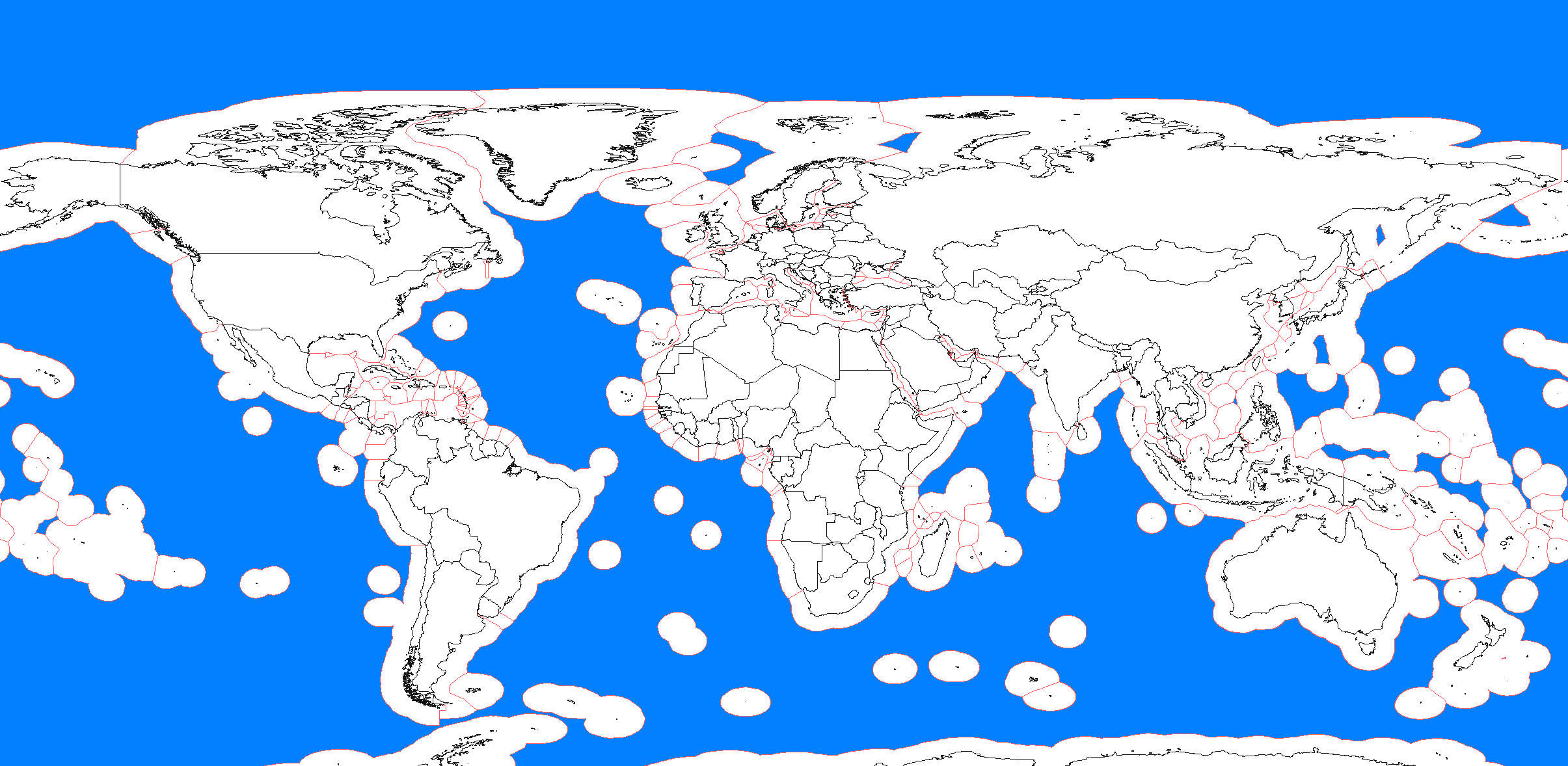
Ocean beyond 200 nautical miles is considered the “high seas” of international waters and belongs to everyone. It is our blue commons. Image: Kvasir, Creative Commons 3.0. With appreciation.

Ocean waters beyond 200 nautical miles, not subject to national jurisdiction and legally categorized as international waters, belong to every country, even those that are landlocked. This is our blue commons.

Wave graphic by NASA. Public Domain. With appreciation.

This month, September 2025, a new agreement, formally known as the “United Nations Convention on the Law of the Sea on the Conservation and Sustainable Use of Marine Biological Diversity of Areas Beyond National Jurisdiction,” is the first legally binding agreement for sustaining marine fauna and flora, sharing of scientific data , access to marine genetic resources, and creating marine protected areas (MPA).
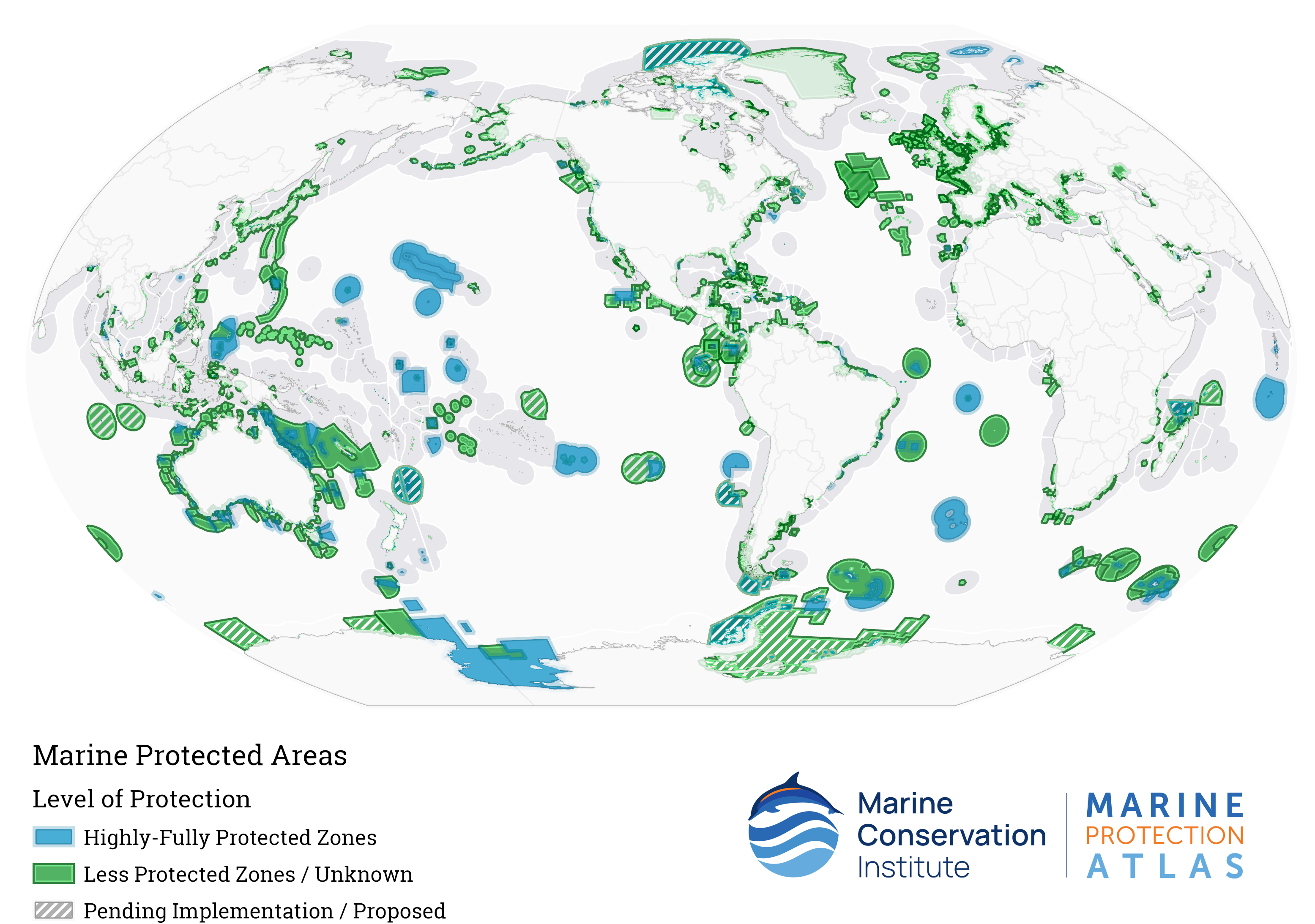
“Marine Protected Areas” as of 2022. Will the High Seas Treaty create more MPA spots of hope? Image by Yo Russmo from MP Atlas. Creative Commons 4.0. With appreciation.

Marine protected areas (MPAs) provide sources with ecosystems intact, in circularity, so that nature is balanced and able to renew. Dr Sylvia Earle, founder of Mission Blue and sometimes called “Her Deepness,” proposed what she called “hope spots” that would serve to keep and potentially renew the ocean habitat. Rena Lee, President of the Intergovernmental Conference on Marine Biodiversity, who captained 36 hours of negotiation that led to the “30 x 30” pledge to protect 30% of Earth’s land and sea by 2030, made the High Seas Treaty text ready for ratification in 2023: it took two years to ratify. Lewis William Gordon Pugh, often referred to as “Sir Edmund Hillary in a swim suit” swam every ocean on the globe to promote Marine Protected Areas.

Lewis Pugh, 2007. Creative Commons 3.0. With appreciation.

The International Seabed Authority (ISA) has approved “Areas of Particular Environmental Interest” or (APEI). This is good news. But the ISA is also preparing to decide whether (or when) to mine the deep seabed. Therein lie buried treasure deposits of critical minerals. ISA keeps a database “Deep Data” that identifies marine mineral resources.

International Seabed Authority (ISA) logo. Image by Rballeiro and ISA. Public Domain. With appreciation.

Cobalt, nickel, and other minerals important for electronics and smart devices are in high demand. Mining on land has thus far provided these resources, but mines are getting tapped out. The same minerals and metals are present in the deep seabed – in untapped abundance. For example, gold in the deep seabed is estimated to be worth $150 trillion.
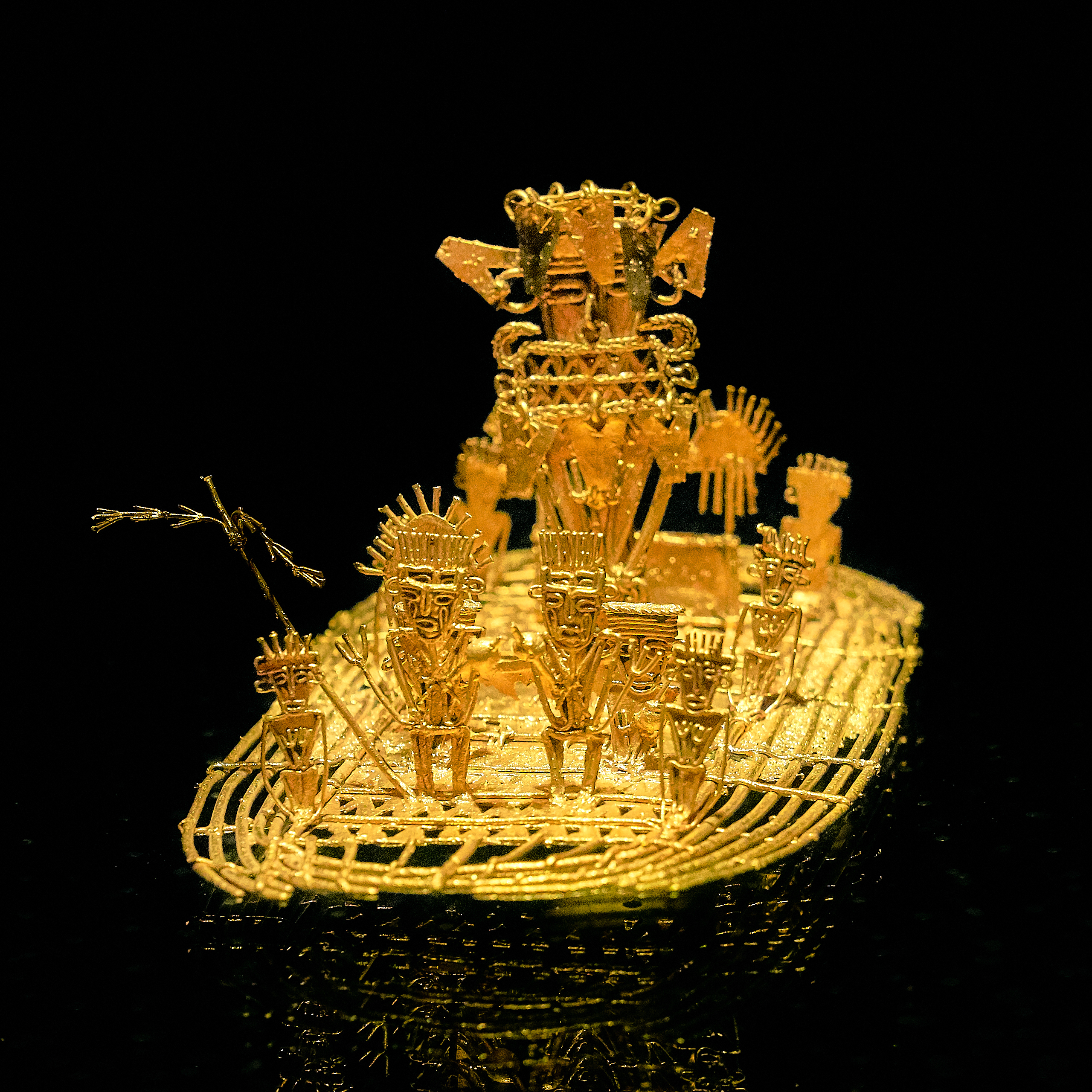
Gold of El Dorado, Gold Museum of Bogotá. Photograph by Pedro Szekely. Creative Commons 2.0. With appreciation.

ISA is presently developing its Mining Code. Countries that are signatory to the Law of the Sea have the right to apply for mining access. So far, all the ISA contracts for cobalt and other materials are only for the first phase of Exploration. The next phase is Exploitation. Nauru triggered the Two Year rule, so mining decisions may be forthcoming.
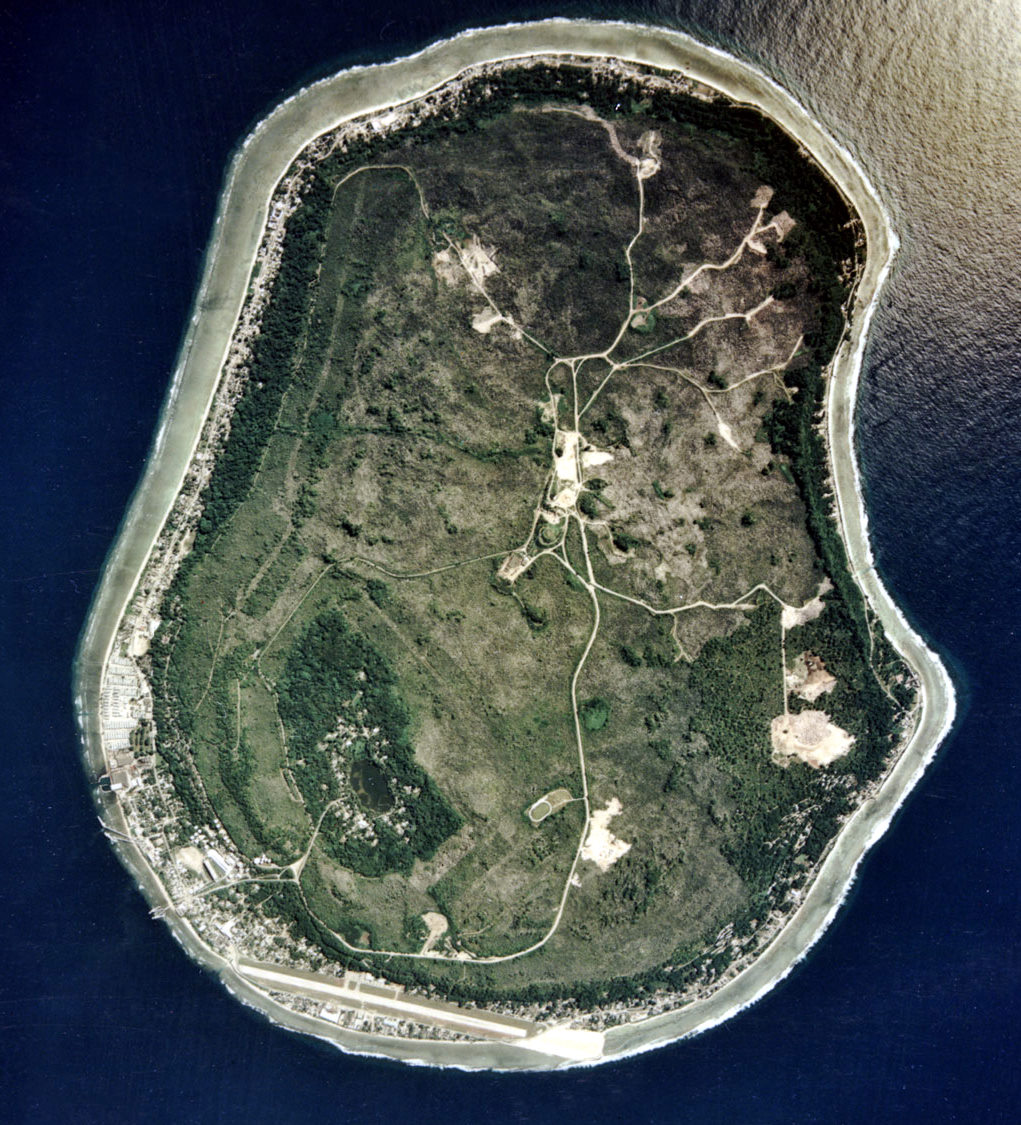
Nauru. Image: Atmospheric Radiation Measurement Program (ARM), US Department of Energy, 2002. Public Domain. With appreciation.

Our blue commons is the greatest portion of our planet, and also the origin of what we are now. We all came from the sea. And, it is the sea that will sustain us. As Rachel Carson warned: “No blue, no green.”

“No blue, no green.” Water may be the key to climate and environmental sustainability. Image: DipoleRadiation by Geoemyda, 2006. Creative Commons 3.0. With appreciation.

Once the High Seas Treaty is in effect, on 17 January 2026, there will soon be a Conference of the Parties (COP) to set the strategic agency and goals.  What are your views? How can the High Seas Treaty protect, sustain, and renew our blue commons?

Brooke, K. Lusk. “Water/ENERGY: Deep Seabed Mining.” 10 July 2024. Building the World Blog. https://blogs.umb.edu/buildingtheworld/2024/07/10/water-energy-deep-seabed-mining/

Brooke, K. Lusk. “Speedo Diplomacy.” pages 56-67. Renewing the World: Casebook for Leadership in Water. 2024. ISBN: 9798985035957. See also: https://renewing theworld.com

Earle, Sylvia. “My Wish: Protect Our Oceans.” https://missionblue.org and TED Talk  2009, VIDEO https://www.ted.com/talks/sylvia_earle_my_wish_protect_our_oceans

Etymonline. “Origin and history of high seas.” https://www.etmonline.com/word/high%20seas

High Seas Alliance. “Historic Milestone for Global Ocean Protection.” 19 September 2025. https://highseasalliance.org/2025/09/19/historic-milestone-for-global-ocean-protection-60th-ratification-triggers-entry-into-force-of-high-seas-treaty/

Humphreys, John and Robert W.E. Clark. “A critical history of marine protected areas.” Marine Protect Areas: Science, Policy, and Management, 2020. https://www.sciencedirect.com/science/article/abs/pii/B9780081026984000010

International Seabed Authority: Mining Code. https://www.isa.org.jm/the-mining-code/

Kriegl, Michael, et al., “Marine Protected Areas: At the Crossroads of Nature Conservation and Fisheries Management.” 07 June 2021. Frontiers in Marine Science. https://www.frontiersin.org/journals/marine-science/articles/10.3389/fmars.2021.676264/full

Lee. Rena. “The ship has reached the shore.” 4 March 2023. United Nations. IDEO: https:/youtu.be/BQauwZ9b9xs

Pugh, Lewis. Achieving the Impossible. New York: Simon & Schuster, 2010. ISBN: 9781847372482

United Nations. “United Nations Convention on the Law of the Sea on the Conservation and Sustainable Use of Marine Biological Diversity of Areas Beyond National Jurisdiction.” https://treaties.un.org/doc/Publication/MTDSG/Volume%2011/Chapter%20XXI/XXI-10.en.pdf

United Nations. “United Nations Convention on the Law of the Sea.” https://www.un.org/depts/los/convention_agreements/texts/unclos/unclos_3.pdf

United Nations. “Kunming-Montreal Global Biodiversity Framework.” Conference of the Parties to the Convention on Biological Diversity, CBD/COP/DEC/15/4,19 December 2022. Official Text: https://www.cbd.int/doc/decisions/cop-15/cop-15-dec-04-en.pdf

Washburn, Travis, et al., “Environmental Heterogeneity Throughout the Clarion-Clipperton Zone and the Potential Representativity of the APEI Network.” 30 March 2021. Frontiers in Marine Science, Volume 8, 2021. https://www.frontiersin.org/articles/10.3389/fmars.2021.661685

Building the World Blog by Kathleen Lusk Brooke and Zoe G. Quinn is licensed under a Creative Commons Attribution-NonCommercial-NoDerivs 3.0 U

 

ENERGY: Climate Conservation Corps

“Many Hands,” by Sharon and Nikki McCutcheon, 2015. Dedicated by the photographers to the public domain. Included with appreciation.

During UN climate week, the U.S. announced creation of an “American Climate Corps” that will combine public service with training for environmentally beneficial professions and technologies. Ali Zaidi, White House point person, may lead the effort to recruit 20,000 young people for the inaugural year. Some Corps areas will also include age-diverse cohorts. Collaborators joining the training and development will feature experts from the National Oceanic and Atmospheric Association (NOAA) and AmeriCorps, as well as departments of Agriculture, Energy, Interior, and Labor. If we need an energy revolution, this could be it.

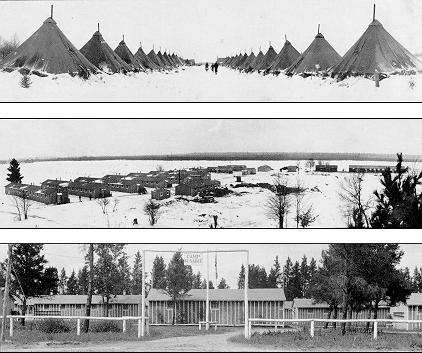
“CCC camps in Michigan, USA” circa 1930s. Public Domain. Included with appreciation.

There are historic precedents. President Franklin Delano Roosevelt pulled American youth out of Depression-era joblessness by creating the Civilian Conservation Corps (CCC). While initially aimed at those suffering poverty. CCC expanded, through the creative leadership of Frank P. Davidson, to include Camp William James in Tunbridge, Vermont, welcoming college recruits.

Without dikes, the Netherlands would be flooded to this extent. Image by Jan Arksteijn, 2004. Dedicated by the graphic artist to the public domain, CC 0.1. Included with appreciation.

But the earliest organization of service work might be the Dike Armies of the medieval Netherlands. In 1319, this edict described the corps: “Ende alman sal ten menen werke comen op den dijc, daers hem ie Baeiliu, of die Dijcgrave vermaent” – “Everybody shall come to work at the dike on instruction of the bailiff or dike reeve.” It should be noted that today, with social media like Instagram, X, TikTok, calling up volunteer teams to respond to a climate disaster would have instant effectiveness. 

Look at Earth from space. There are no lines on a map showing states or nations. Our planet is land surrounded by water. Climate is regional and global – so must be our response. “The Blue Marble” by NASA Apollo 17, enhanced by Degir6328. Public Domain. Included with appreciation.

The newly planned American Climate Corps might be the beginning of a new era of job and skills development to respond to climate change. But a broader vision could expand the scope. Climate change will not stop at national borders: San Diego in the USA and Tijuana in Mexico share the same coast and the same need for response to sea level rise. Vermont, site of CCC Camp William James, shared smoke from Canada’s recent wildfires. Look at Earth from space; you see not countries and nations, but land and water. Climate change must be addressed by regional, and global, response. The American Climate Corps could become a regional organization inviting Canada, Mexico, and the USA, together with the original Tribes of the Americas, to share language training, technology development, and regional capability to respond to climate change.

The new CCC can build wind turbines, delivering green electricity. It’s a fast-growing industry with great jobs. Image: “Dual Rotor Wind Turbine” by Deas1. Creative commons. Included with appreciation.

Those trained by the new Climate Corps can serve a dual role of training for climate-ready jobs, and also be ready to respond to climate disasters that affect the region. In the last decade, 85% of natural disasters like drought and fires, storms and floods, were attributed to, and intensified by, global warming. Climate change calls us to work together in ways that can strengthen education, technology, and shared vision through climate justice. As Climate Corps members build green energy technology and plant drought-resistant agricultural grains, perhaps they may also sow the seeds of peace.

Can we plant drought-resistant agriculture as a way to sow the seeds of peace? Image: Logo “Plant for the Planet,” 2015. Public Domain Fair Use. Included with appreciation.

Davidson, Frank P. and K. Lusk Brooke. “Protective Dikes and Land Reclamation: The Netherlands,” Volume 1, page 57. Building the World (Greenwood, 2006). ISBN: 0313333734.

Friedman, Lisa. “Wanted: 20,000 Young Americans to Fight Climate Change.” 20 September 2023. The New York Times. https://www.nytimes.com/2023/09/20/climate/biden-climate-corps-youth.html

Building the World Blog by Kathleen Lusk Brooke and Zoe G. Quinn is licensed under a Creative Commons Attribution-NonCommercial-NoDerivs 3.0 U

TRANSPORT: Highways and Wildflowers

“Balsamroot and lupine wildflowers near Tom McCall Preserve along the highway.” by photographer Gary Halvorson, Oregon State Archives, 2014. CC 3.0. Included with appreciation.

On Memorial Day weekend, 34 million Americans will travel by car. It’s the first long weekend of spring: a time of flowers, especially wildflowers. Parks play a role, and so do household and campus lawns participating in No Mow May. But highways can also provide miles of sustenance for spring pollinators like bees.

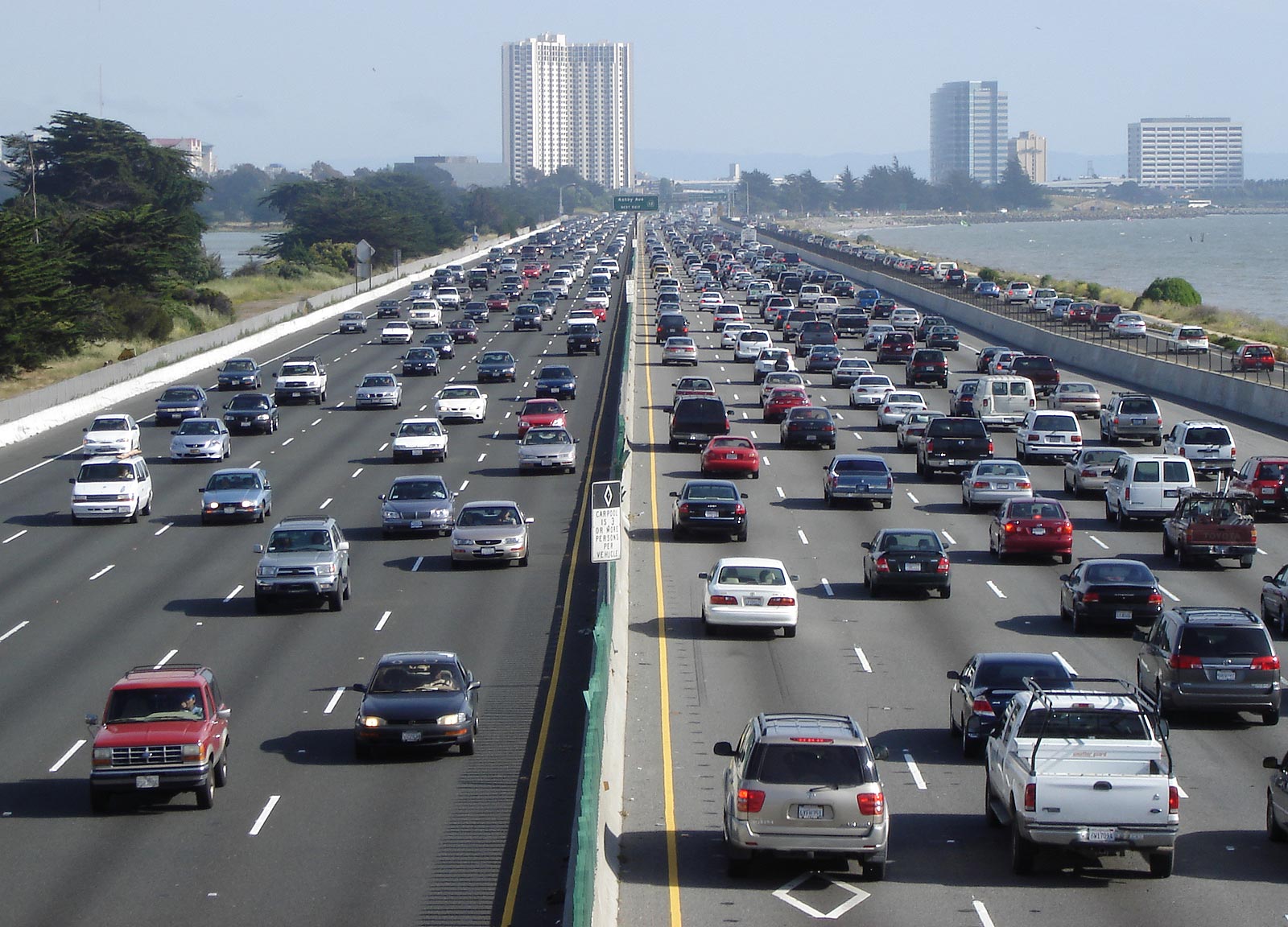
Highways will be an area of innovation in climate change. “Interstate 80, Eastshore,” by photographer Minesweeper 30. CC3.0. Included with appreciation.

Concrete is efficient, but highways could be improved. In 1965, the United States passed the Highway Beautification Act, providing funding for planting and protection of wildflowers along median and shoulder strips of American highways. President Lyndon B. Johnson signed the bill into law, stating “We have placed a wall of civilization between us and the beauty of the countryside. Beauty belongs to all the people.” (Johnson, 1965) Encouraged by his wife, Lady Bird Johnson who advocated the program to beautify American roads. The Lady Bird Johnson Wildflower Center also honors her vision.

“Highways UK-EI.” by SPUI, dedicated to the public domain. Image: wikimedia. Included with appreciation.

In the United Kingdom (UK), the Construction Industry Research and Information Association (CIRIA) launched the “Big Biodiversity Challenge” with Highways England. Realizing that the UK has lost 97% of its wildflower meadows since 1930, road construction crews finish highways by preparing a side strip or verge for wildflower planting. Highways England plants the flowers. Recently, a section of the A38 from Ashburton to Ivybridge in Devon won the Biodiversity Pollinator Award. France places stormwater ponds every two kilometers along major roads: a recent survey found the ponds have welcomed many amphibian species. Across the UK, B-Lines have mapped a kind of bug highway across England, Northern Ireland, Scotland, and Wales.

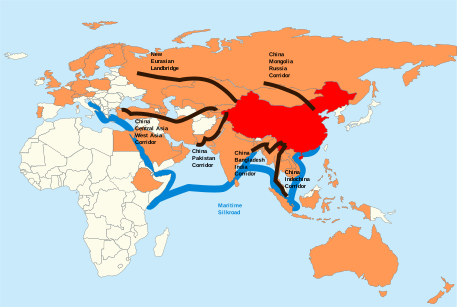
Belt and Road Initiative. “One-belt-one-road,” by Lommes. Creative Commons 4.0 International. Included with appreciation.

As the world builds more roads, including space for wildflowers and wildlife is an opportunity to be noted. Will China’s Belt and Road Initiative  (BRI) connecting China, Central and West Africa, parts of Europe, Indian sub-continent, Indo-China, Mongolia, and Pakistan may be the largest road building project in history. Now, as 37,000 miles (60,000 kilometers) of roads are designed and built, would offer an un-precedented chance for environmental inclusion. Should environmental provisions be stipulated by banks, including multilateral development banks and the National Development and Reform Commission (NDRC), funding and overseeing the BRI? What of the roads of India? Africa? The Pan-American Highway?

“Wild-flower” by photographer Anilmahajan19, 2017, in Nagpur, India. GNU license. Included with appreciation.

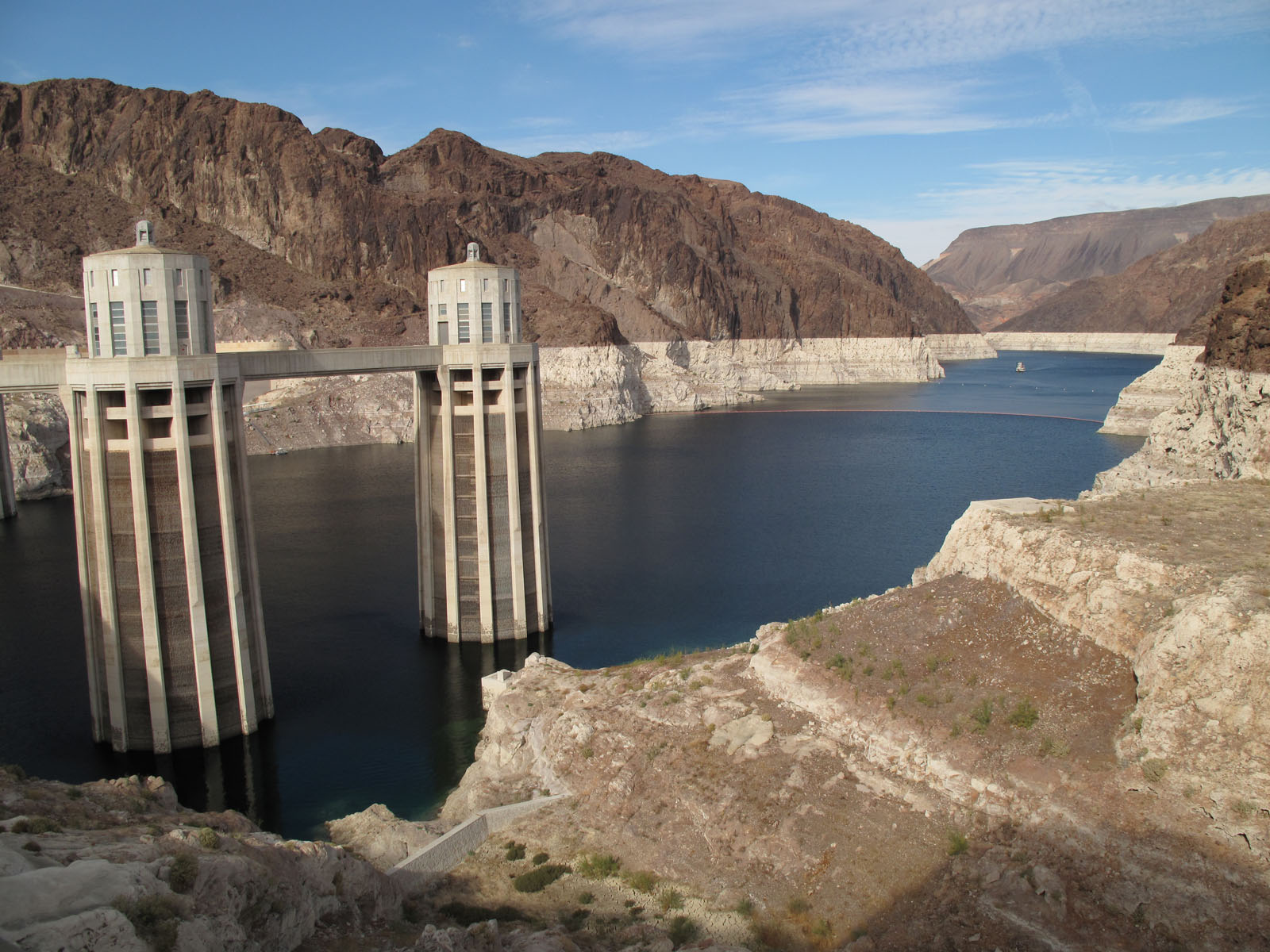
It has been the practice of some highway systems to seed the median strip between divided highways with grass. But grass can be thirsty, and yet yields relatively sparse benefits. In fact, some states in the Colorado River Compact are outlawing non-functional turf due to the shrinking of Lake Mead and Lake Powell, water reservoirs for the river that supplies both drinking water and electricity to 40 million people. Drought in the area is causing water shortages and also wildfires.

“Lake Mead and Hoover Dam with water intake towers, seen from Arizona side of Hoover Dam,” by photographer Cmpxchg8b, 2010. Generously dedicated to the public domain by the photographer.Image: wikimedia. Included with appreciation.

Should highways be planted, instead, with wildflowers? If you hit the road this weekend, take a look at the wildflowers along highways and also country roads. It’s a natural resource, not often noticed, but increasingly important to the future of climate and environment.

What if all highways and roads hosted wildflowers? Could the world look like this? “Bitterwater Road Wildflowers,” by photographer Alan Schmierer, generously dedicated to the public domain CC1.0. Wikimedia. Included with appreciation.

Conniff, Richard. “Green Highways: New Strategies To Manage Roadsides as Habitat.” 10 June 2013. Yale Environmental 360, Yale University School of the Environment.

Construction Industry Research and Information Association (CIRIA).  https://www.ciria.org

Forman, Richard T.T., et al., Road Ecology: Science and Solutions. Island Press, 2003. ISBN: 1559629326 and 1559639334.

Highways England. https://www.gov.uk/government/organisations/highways-england/

Lady Bird Johnson Wildflower Center. https://www.wildflower.org

Organisation for Economic Cooperation and Development (OECD). “China’s Belt and Road Initiative in the Global Trade, Investment, and Finance Landscape.” OECD Business and Finance Outlook 2018. https://www.oecd.org/finance/Chinas-Belt-and-Road-Initiative-in-the-global-trade-investment-and-finance-landscape.pdf

United States Highway Beautification Act of 1965. Public Law 89-285, 22 October 1965. https://www.govinfo.gov/content/pkg/STATUTE-79/pdf/STATUTE-79-Pg1028.pdf

Building the World Blog by Kathleen Lusk Brooke and Zoe G. Quinn is licensed under a Creative Commons Attribution-NonCommercial-NoDerivs 3.0 Un

T-MEC: What’s in a Name?

Naming and framing the new agreement shared by Canada, United States, and Mexico. Image: wikimedia.

Finding common ground among nations joining in regional agreements is difficult enough: policies on issues from food to energy to trade must be deliberated. And then, there’s the name. While the “New Nafta,” launched 29 January 2020, was named top-down as USMCA (US-Mexico-Canada-Agreement) in the United States, Mexico took an inclusive approach. Andrés Manuel López Obrador, known popularly as AMLO, announced a naming contest on Twitter. According to Dr. Amrita Bahri, co-chair of the WTO Chair Program for Mexico and Professor of Law, ITAM University, and Guillermo Moad Valenzuela, of International Trade Law, ITAM University, the naming contest stated four criteria:

NAMING AND FRAMING:

Name similar to the English and French versions;

Name begins with the letter “T” as in Tratado;

Name is easily pronounceable in Spanish;

Name reflects the spirit of cooperation.

On Twitter, Mexico received hundreds of suggestions, selecting two finalists for adoption: TEUMECA (Tratado Estados Unidos México Canadá) or T-MEC (Tratado México Estados Unidos Canadá). The winner, T-MEC, contains a review provision in six years. Perhaps the parties learned that lesson from the Colorado River Compact, when a failure to define all parties’ water rights resulted in subsequent lawsuits. Mexico and the Navajo sued and were awarded water rights with sovereignty not granted to American states. In T-MEC, Mexico specifically reserved “Direct, inalienable, and imprescriptible ownership of hydrocarbons” (chapter 8).

Regions may be the new nations. Viewed from space, the world shows no lines as seen on maps; instead, we observe that linked land shares common resources. Recognizing dual values of inclusion and diversity, how should we frame, and name, future agreements on shared resources?

Bahri, Amrita and Guillermo Moad Valenzuela. “A new name for NAFTA: USMCA, TEUMECA or T-MEC?” 15 October 2018. El Universal. https://www.eluniversal.com.mx/english/new-name-nafta-usmca-teumeca-or-t-mec/

ACEUM text: https://www.international.gc.ca/trade-commerce/trade-agreements-accords-commerciaux/agr-acc/cusma-aceum/text-texte/toc-tdm.aspx?lang=fra

CUSMA text: https://www.international.gc.ca/trade-commerce/trade-agreements-accords-commerciaux/agr-acc/cusma-aceum/index.aspx?lang=eng

T-MEC text: https://www.gob.mx/t-mec/acciones-y-programas/textos-finales-del-tratado-entre-mexico-estados-unidos-y-canada-t-mec-202730

USMCA text: http://www.sice.oas.org/Trade/USMCA/USMCA_ToC_PDF_e.asp

Building the World Blog by Kathleen Lusk Brooke and Zoe G. Quinn is licensed under a Creative Commons Attribution-NonCommercial-NoDerivs 3.0 Unpor

Decade of Decision

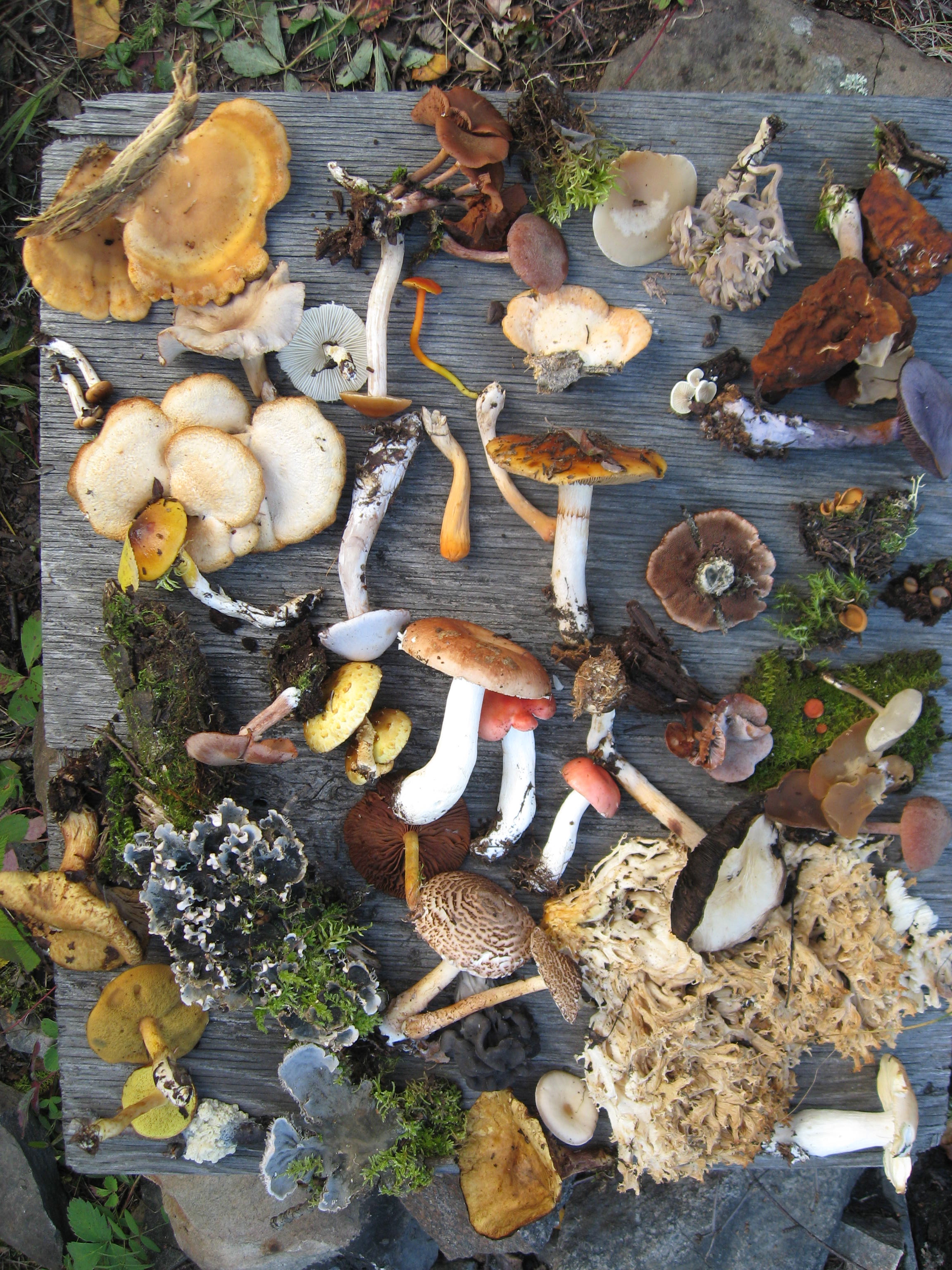
Biodiversity: the decade of decision. “Mushrooms and diverse fungi of Saskatchewan.” Image: wikimedia.

Decisions made in the next decade may shape the future. In 2020, the United States will hold an important election; Japan will host the Olympics. All eyes on the future. Species, both animal and plant, are disappearing 1,000 times faster than before humans appeared. Earth is threatened by climate change; water is becoming more scarce; and, as Hansjorg Wyss states: “extractive industries chew further into the wild.” Wyss believes there may be an answer: conserve remaining wild lands as public reserves. The world’s first national park (Yellowstone in 1872) opened a new idea of preservation: now, 15% of earth’s land and 7% of the oceans is protected. Wilderness tamed and framed like the National Trails System; greenways like that on Boston’s Central Artery as nature ribboning through cities; rivers granted personhood rights are among the regulatory and legal measures of protection. Edward O Wilson, founder of Half-Earth Day, warns we must preserve half the earth to save the whole. Timing may be urgent: 77% of land on earth has been modified by humans. Wyss pledged $1 billion over the next decade with the goal of protecting 30% of the planet by 2030.When the United Nations Biodiversity Conference convenes in land of the Suez Canal on November 13, 190 countries will seek agreement to preserve the natural systems that support the earth. Here’s a link to include your voice.

Albeck-Ripka, Livia. “Scientists Warn That World’s Wilderness Areas Are Disappearing: ‘Wild areas provide a lot of life support systems for the planet,’ said the author of a study that found 77 percent of earth’s land had been modified by humans.”31 October 2018, The New York Times, https://www.nytimes.com/2018/10/31/world/australia-wilderness-environment-gone.html.

Half-Earth Project. https://www.half-earthproject.org

Jackson, Michael, Lionel Richie, Quincy Jones, and USA for Africa Chorus: “We Are the World.” https://www.youtube.com/watch?v=M9BNoNFKCBI

Watson, James E.M., Oscar Venter, Jasmine Lee, Kendall R. Jones, John G. Robinson, Hugh P. Possingham, James R. Allen. “Protect the last of the wild.” 31 October 2018, Naturehttps://www.nature.com/articles/d41586-018-07183-6

Wilson, Edward O. Half-Earth: Our Planet’s Fight for Life. 2016. ISBN: 9781631490828.

Wyss, Hansjorg. “We Have to Save the Planet. So I’m Donating $1 Billion.” 31 October 2018. The New York Times. https://www.nytimes.com/2018/10/31/opinion/earth-biodiversity-conservation-billion-dollars.html.

Building the World Blog by Kathleen Lusk Brooke and Zoe G Quinn is licensed under a Creative Commons Attribution-NonCommercial-NoDerivs 3.0 Unported Licen

Migrants and the Renewal of Culture

“Detail of Cyrene bronze head, circa 300 bce.” Image: British Museum and wikimedia.

Migrants have been a source of change, and renewal, throughout history. Cyrene, founded in 630 bce, several miles south of the Mediterranean Sea in Libya, became the first of five flourishing cities called the Pentapolis of Cyrenaica. Cyrene’s migrants brought fertile minds to a new land: it was here that Earth’s circumference was first determined by Eratosthenes. Fresh thinking, fostered in an atmosphere promoting science, technology, and art, produced an early map of the stars, the mechanics of doubling a cube, and research that developed prime numbers. The poet Apollonia was also a resident of Cyrene. What policies and cultural practices fostered such innovation? In today’s world, with migrants on the move and in the news, can we draw inspiration from Cyrene to build a better future?

Building the World Blog by Kathleen Lusk Brooke and Zoe G Quinn is licensed under a Creative Commons Attribution-NonCommercial-NoDerivs 3.0 Unported License

Words and Swords

Word balloon types. Image: wikimedia commons.

Code talk and authorizations. What is the not-so-hidden code in a government directive that certain words or phrasing not be used in budget proposals, lest those words become swords killing the possibility of funding. Forbidden phrases: “science-based” and “evidence-based.” Word prohibitions include “diversity” and “vulnerable.” Authorizations throughout history have varied: some were a notes scrawled from parent to child, as in the Trans-Siberian Railway. Others were private handshakes made public, as in the New River. A few espoused values for the future of humanity: the Atomic Energy Act set the guiding purpose of peace. But de-authorizing certain code words by directive may be one of the few instances where values are so explicitly defined, and demanded. Summing up the reaction of many, Rush Holt, CEO of the American Association for the Advancement of Science, tweeted: “Here’s a word that’s still allowed: ridiculous.”

What do you think about “science-based” and “evidence-based?” What about the other directives? Can language ever be changed, or is it beyond directive? Abram de Swaan, of the Amsterdam School for Social Research, University of Amsterdam, observed that military conquests cause the spread of new wordings and even languages, but as soon as the newcomers are ousted, language returns to its natural evolution.

De Swaan, Abram. Words of the World: The Global Language System. Wiley 2013. ISBN: 9780745676982. Originally published, Polity Books, 2001.

Sun, Lena H. and Juliet Eilperin. “CDC gets list of forbidden words: Fetus, transgender, diversity.” 15 December 2017. The Washington Posthttps://www.washingtonpost.com/national/health-science/cdc-gets-list-of-forbidden-words-fetus-transgender-diversity/2017/12/15/f503837a-e1cf-11e7-89e8-edec16379010_story.html?utm_term=.08926eab4d6a

https://www.cdc.gov

Building the World Blog by Kathleen Lusk Brooke and Zoe G Quinn is licensed under a Creative Commons Attribution-NonCommercial-NoDerivs 3.0 Unported License

Welcome

How can the world welcome 65 million people in new settings? Image: wikimedia commons.

The United Nations reports that 65.3 million people are refugees, asylum seekers or displaced: 1 in 113 of all the people on the planet. In the year 2015, every minute saw 24 people forced to flee; half under 18 years old. Conditions for millions are perilous. The first-ever United Nations Summit for Refugees and Migrants this week produced a Declaration, building upon the 1951 Refugee Convention that defines ‘refugee’ and the rights of the displaced. Education and employment are urgently needed. Can macro-scale infrastructure projects offer an opportunity? After World War II, Australia invited displaced skilled people to join the Snowy Mountains Hydroelectric Project; over 100,000 moved to a new land. Housing for families included schools where children learned together, adding diversity to the curriculum. How can the world welcome 65 million new arrivals today? Will Alex set an example of welcome?

Building the World Blog by Kathleen Lusk Brooke and Zoe G Quinn is licensed under a Creative Commons Attribution-NonCommercial-NoDerivs 3.0 Unported License.

Singapore at 50


Singapore at 50: does diversity contribute to innovation and prosperity? Image: wikimedia commons.

This month marks the 50th anniversary of Singapore‘s independence. Rapid growth may be traced to its founding, as a colony, but more importantly, as a special economic zone. With per capita GDP of $56,000, and 90% home ownership, an achievement aided by the development of Housing Development Board (HDB) homes, the 277 sq. miles are marked by prosperity. HDB helped to eliminate poverty and also promoted diversity: the goal was for Chinese and Malay families alike to think of themselves first as Singaporean. With four official languages, and multiple recognized religions, can Singapore claim the power of diversity in prosperity?

Building the World Blog by Kathleen Lusk Brooke and Zoe G Quinn is licensed under a Creative Commons Attribution-NonCommercial-NoDerivs 3.0 Unported License.

New Cities, New Visions: Abuja, Nigeria

Nigeria — Lagos and Abuja. Image: Library of Congress.

Abuja became the new capital of Nigeria, replacing Lagos, in 1991. Reasons were similar to factors that led Brazil to leave popular coastal Rio to the tourists and samba dancers (not to mention soccer players and Olympians) and build a new center of government, Brasilia. Nigeria’s new capital was named after a nearby emirate founded in 1828 by Abu Ja, Zarian ruler of some renown (the old town also got a new name: Suleja). Nigeria is 50% Muslim and 40% Christian, and the new capital also had to honor the Gbagyi people who had been in the area for over 40,000 years. What is the significance of building a new capital? How can diversity become a part of the patriotic vision?

Building the World Blog by Kathleen Lusk Brooke and Zoe G Quinn is licensed under a Creative Commons Attribution-NonCommercial-NoDerivs 3.0 Unported License.