CITIES: Fast Forward Food

“Noodle Bowl for Lunch” by Tran Mau Tri Tam, 2016. Wikimedia/Unsplash: CC0 1.0. Dedicated to the public domain by the photographer. Included with appreciation.

Cities are known for fast food: the drive-through, the grab and go, the snack stop, pop-up restaurants, food trucks, street cafes and food stalls. Fast food can also be found on shelves of urban convenience and grocery stores. One of the world’s favorite quick treats is the instant noodle. In 2020, 116 billion servings of instant noodles were enjoyed. (Cairns 2022)

“Singapore Skyline at Night with Blue Sky.” Merlion444, 2009. Wikimedia Creative Commons 1.0 public domain. Dedicated to the public domain by the photographer, Included here with appreciation.

Singapore, a city created with trade and diversity as founding principles, is home to the launch of new kind of instant noodle  –  good for taste and for the environment, too. Based in Singapore, WhatIF Foods has introduced a noodle made from the Bambara Groundnut.
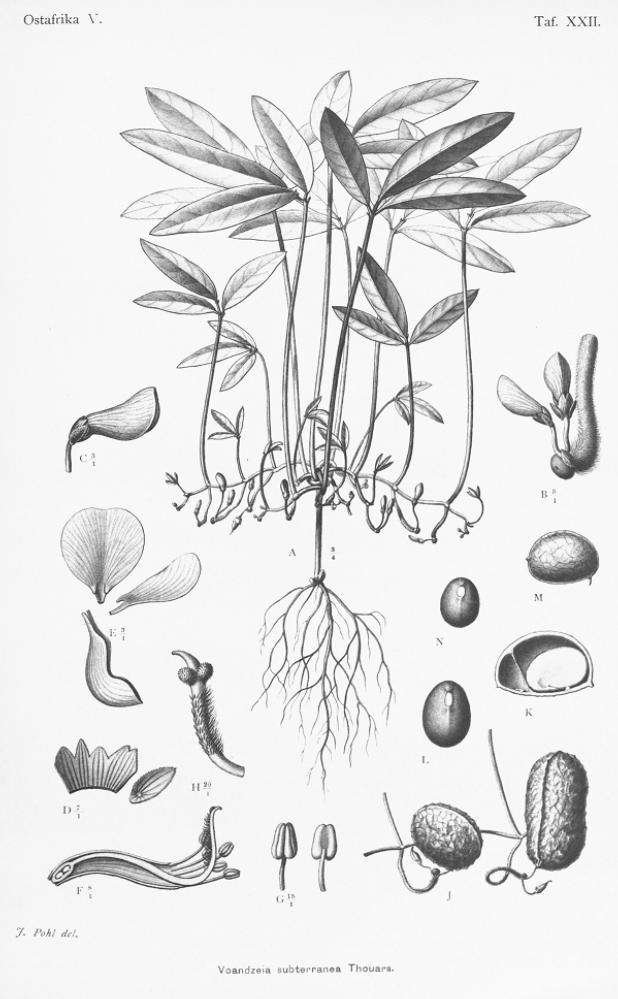
“Vigna subterranea” as illustrated by A. Engler in Die Pflanzenwelt Ostafrikas und der nachbargebiete. Volume 2, 1895. This work is the public domain and is included with appreciation.

Bambara (Vigna subterranea) is in the legume family and grows underground (like peanuts): it originated in West Africa and is now grown across the world. It’s what is known, nutritionally, as a complete food: offering protein, carbohydrates, amino acids, minerals, vitamins, and fiber. WhatIF Foods produces “BamNut” flour made into noodles. The noodles are a bit pricier than the cheapest brands, but many people may value their superior nutrition.

Map of West Africa by Mondo Magic, 2009. Dedicated by the artist to the public domain (CC 1.0) and included here with appreciation.

Bambara Groundnut, or Vigna subterranea, currently comprises a very small part of food supply market (production in Africa is 0.3 million tons) versus the more traditional noodle dough made from wheat (776.6 million metric tons per year globally). But that may change – because Bambara is drought-tolerant. Many areas of the world already suffering drought (from states served by the Colorado River in the United States, to African and Australian areas experiencing drought and expecting more due to climate change and warming). Crops that can survive in dry soil will be in demand. Recent figures from the United Nations reveal that dry soil chokes 40% of agricultural land, and 56 acres (23 hectares) of arable land are lost to drought EVERY MINUTE.

“Corn shows the effects of drought in Texas,” by USDA’s Bob Nichols, 20 August 2013. This photo is the public domain and included here with appreciation to USDA and Bob Nichols.

There are 300,000 edible plant species, but just three (rice, maize, wheat) comprise 86% of all exports. According to Professor Victoria Jideani of Cape Peninsula University of Technology in South Africa, governments should subsidize agricultural diversity, such as the bambara groundnut, that can resist drought, support food security, and broaden the plant-based dietary options for a future-forward table. By 2050, 68% of the world’s people will live in cities. Land is limited, not only by population growth demands but also by agricultural needs. Optimal use of arable land will be one of the factors in balancing population, food security, and environment.

Bangkok, Thailand is a global megacity offering some of the tastiest food in the world, including legendary noodles. Image: “Food Stalls Bangkok,” by Ian Grattan, 2012. Wikimedia CC2.0. Included here with appreciation to Ian Grattan and Bangkok.

WhatIF Foods are currently sold in Singapore and produced in factories located in Australia and Malaysia, are sold in Asia, and in the regulatory approval process in the European Union. Privately financed, the company is now attracting investors. In the United States, you can purchase WhatIF products (noodles are just one of the products) online. Looking for instant noodle recipes? Here’s eight from eight countries.

Adetokunboh, Adeola, Anthony Obilana, Victoria Jideani. “Enzyme and Antioxidant Activities of Malted Bambara Groundnut as Affected by Steeping and Sprouting Time.” March 2022. Foods 11 (6): 783. DOI:10.3390/foods11060783

Cairns, Rebecca. “This Singaporean startup has reinvented the instant noodle.” 9 May 2022. CNN Business. https://www.cnn.com/2022/05/08/business/whatif-bamnut-sustainable-instant-noodles-climate-hnk-intl-spc/index.html

Cheetham, Peter and Christoph Langwallner, co-founders of WhatIF Foods. https://whatif-foods.com/

Jideani, Victoria. Cape Peninsula University of Technology, South Africa. https://www.researchgate.net/profile/Victoria-Jideani

United Nations Environment Programme. “#FridayFact: Every minute, we lose 23 hectares of arable land worldwide to drought and desertification.” 12 February 2018. https://www.unep.org/news-and-stories/story/fridayfact-every-minute-we-lose-23-hectares-arable-land-worldwide-drought

Building the World Blog by Kathleen Lusk Brooke and Zoe G. Quinn is licensed under a Creative Commons Attribution-NonCommercial-NoDerivs 3.0 Un

CITIES: No Mow May

NO MOW MAY. This month, let your lawn grow with wildflowers to feed seasonal pollinators like bees. Photo: “Wildflowers” by Richard Croft, 2007. Wikimedia CC 2.0. Included with appreciation.

Public parks like Boston’s Greenway or New York City’s Central Park might be the lungs of the city, but urban and suburban yards may be the pop-up restaurants for seasonal pollinators like bees that will help the world through climate change. American lawns occupy 40 million acres, and may be the largest irrigated “crop” in the United States – three times more than irrigated corn. (Milesi, University of Montana and NOAA National Geophysical Data Center)

“Automaton Lawn Mower by Ransomes, Sims & Jeffries of Ipswich, England,” advertisement circa 1867. Public Domain.

No Mow May is an organization in the United Kingdom advocating the absence of lawn mowing, letting lawns grow wild, for this month, offering a spring habitat and feeding ground of wildflowers and clover critical for emerging bees and early pollinators. In addition to homes, colleges are included: Lawrence University recently joined the organization Bee City, USA, and its affiliate: Bee Campus USA.

Fewer lawns, more bees. “Abeille” by Jean-Raphaël Guillaumin, 2010. Wikimedia, CC 2.0. Included with appreciation.

Yards, and campuses, participating in No Mow May noted three times more bee species abundance and five times more bee attendance than in lawn areas.

Another benefit of No Mow May? Water retention. People water lawns. In an era of drought and water scarcity, lawns may be phased out. That what happened in Las Vegas, Nevada.

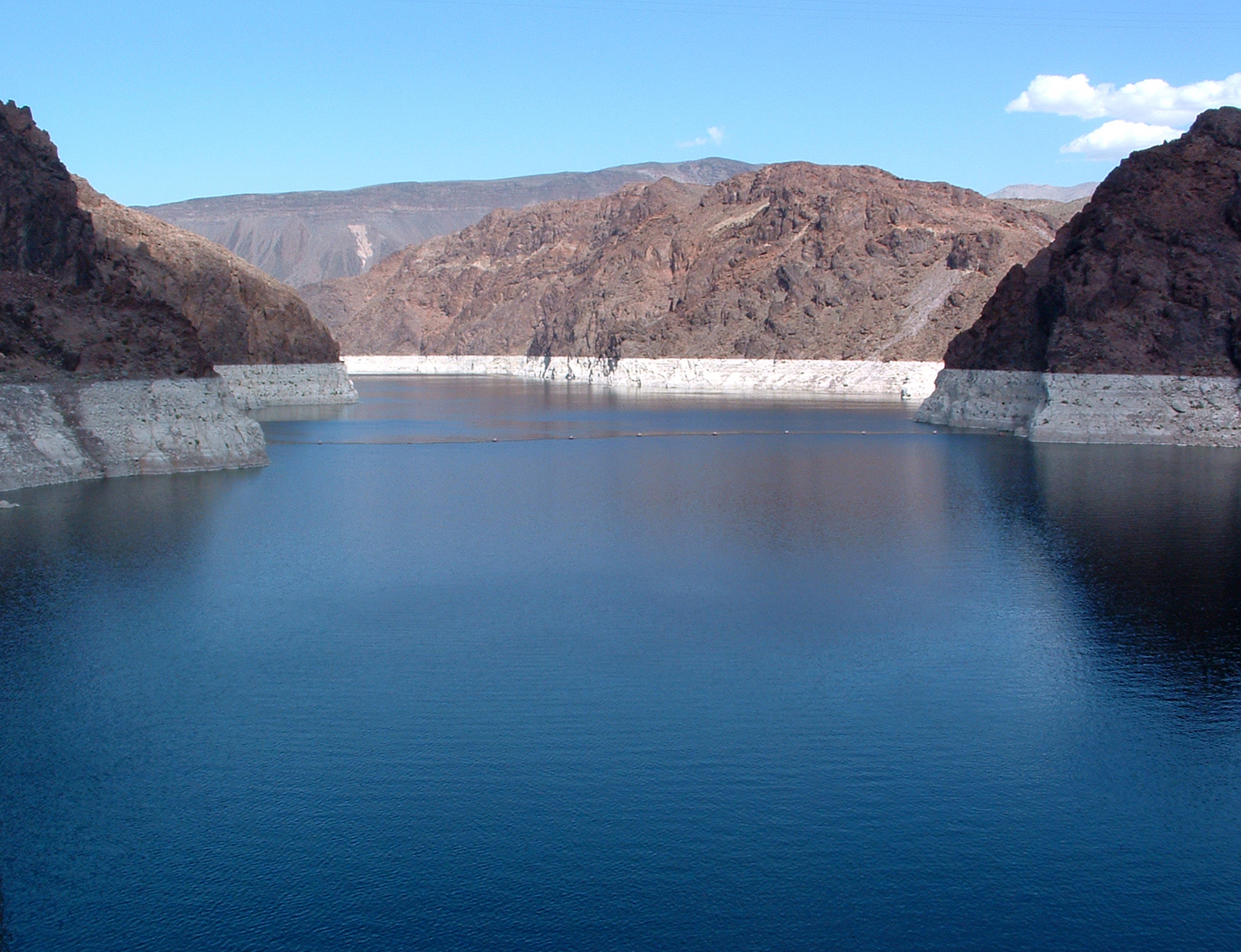
Lake Mead, water reservoir of the Colorado River, supplies Las Vegas with water. A new law by the Southern Nevada Water Authority prohibits lawns, and watering of nonfunctional turf, in response to drought conditions on the Colorado River. Image: “Lake Mead” by Kjkolb, public domain. Included with appreciation.

A new law, related to water shortages in the Colorado River, enacted by the Southern Nevada Water Authority, decreed first-ever permanent prohibition of non-functional turf (soccer fields are functional, household lawns are not). Residents are digging up grass and replacing it with rocks and cactus, creating xeriscapes, a kind of landscaping reducing or eliminating need for irrigation.

Do you have grass in your yard or on your campus? Participate in No Mow May: for a printable yard sign, click here

Bee City USA. https://beecityusa.org

Bee Campus USA. https://beecityusa.org/current-bee-campus-use-affiliates

Del Toro, Israel and Relena R. Ribbons. “No Mow May lawns have higher pollinator richness and abundances: An engaged community provides floral resources for pollinators” 22 September 2020. National Library of Medicine: National Center for Biotechnology Information. doi: 10.7717/peerj.10021

Milesi, Cristina. “More Lawns than Irrigated Corn.” 8 November 2005. Earth Observatory, NASA.gov. https://earthobservatory.nasa.gov/features/Law/lawn2.php

No Mow May. Plantlife.  https://www.plantlife.org.uk

Osann, Ed. “Toward Sustainable Landscapes: Restoring the Right NOT to Mow.” 6 May 2016. Natural Resources Defense Council. https://www.nrdc.org/resources/toward-sustainable-landscapes-restoring-right-not-mow

Southern Nevada Water Authority. “An Act relating to water; prohibiting, with certain exceptions, the use of water from the Colorado River to irrigate nonfunctional turf on certain properties.” Assembly Bill No. 356, 22 March 2021. https://www.leg.state.nv.us/Session/81st2021/Bills/AB/AB356_R1.pdf

Building the World Blog by Kathleen Lusk Brooke and Zoe G. Quinn is licensed under a Creative Commons Attribution-NonCommercial-NoDerivs 3.0 Un



World Water Day – Making the Invisible Visible

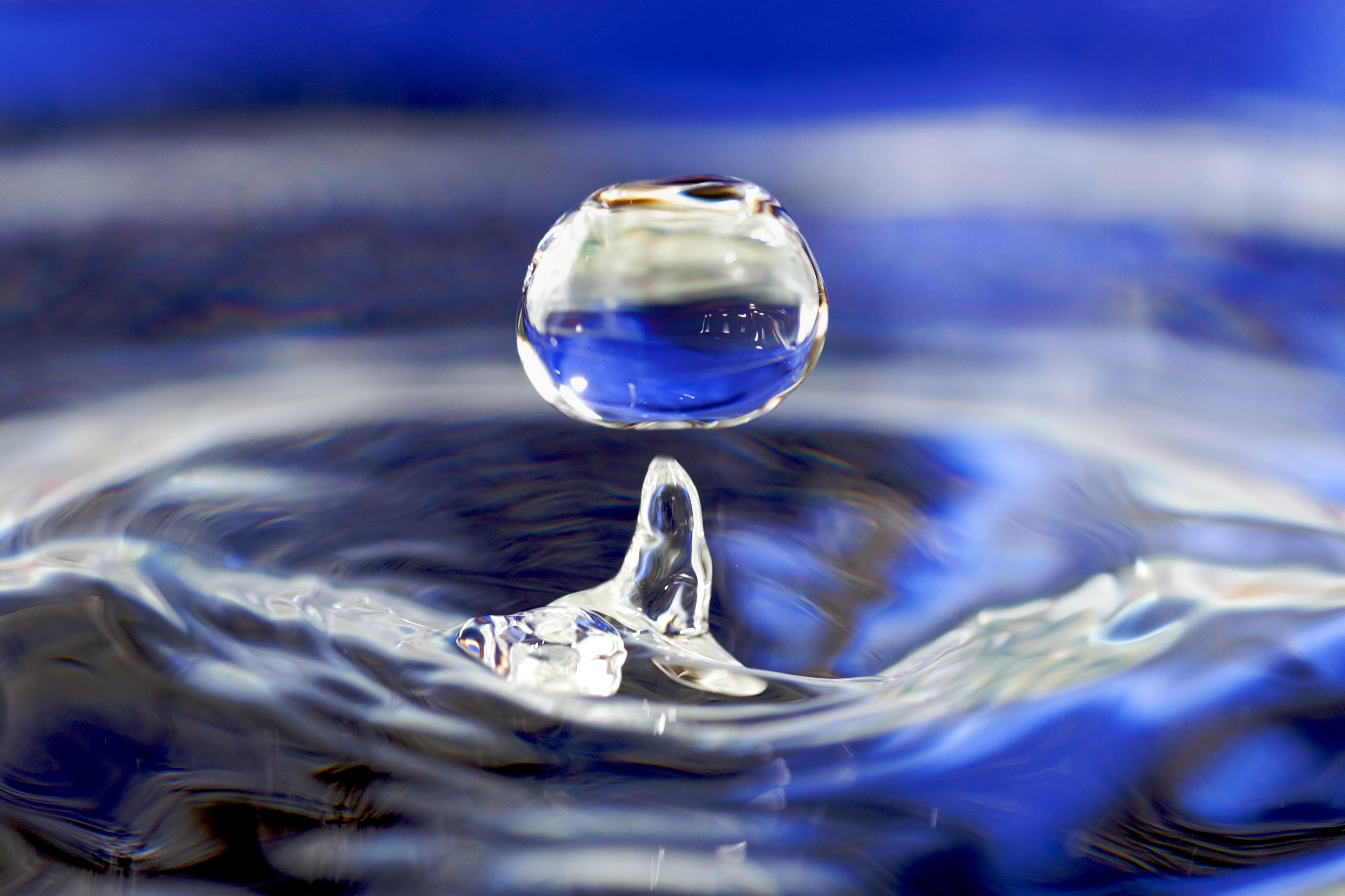
World Water Day 2022. “Splash!” by José Manuel Suárez, 2008. Image: Wikimedia CC 2.0 creative commons. Included with appreciation.

Today is World Water Day, begun by the United Nations as an international day of observance. This year’s theme is “Groundwater – Making the Invisible Visible.” Did you know that groundwater is the largest source of freshwater on earth? How can we sustain and renew this essential element?

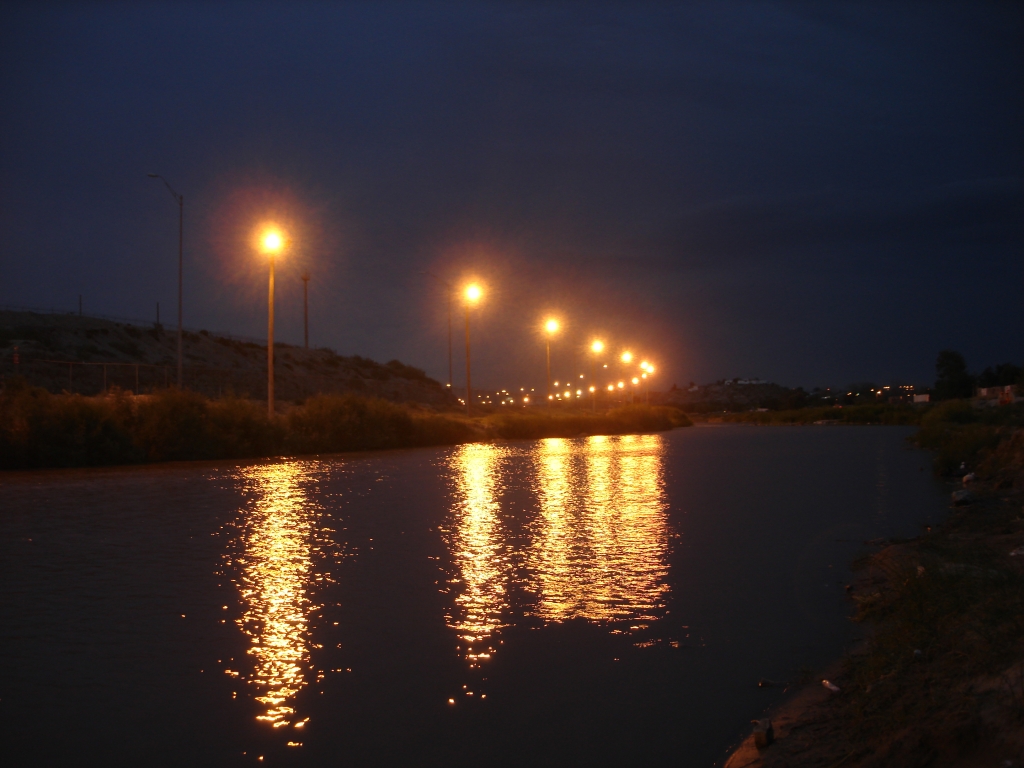
Vista nocturna del Río Bravo, frontera El Paso – Ciudad Juárez.” By Iose, 2007. Dedicated by the photographer to the public domain and included here with thanks. Image: Wikimedia.

Groundwater is transnational. Rivers, above-ground water resources, are often boundary lines separating countries. An example is the Rio Grande (called Río Bravo in México), a river that separates what is now known as the United States and México. Another US/México river whose resources are apportioned, and sometimes disputed, is the Colorado River. But the groundwater beneath both nations is also noteworthy: there are as many as twenty  transboundary aquifers shared by México and the United States.

“Groundwater Withdrawals 2010.” by Herbert and Doell, 2019.  Image: CC 4.0 wikimedia. With appreciation.

Transboundary aquifers demand cooperation. Because groundwater is critically important as a freshwater source, and because so many nations share underground aquifers, groundwater may become one of the most important areas of cooperation  –  and perhaps serve as the water of peace.

Interested to know more about world water, and how we can sustain and renew the Water Planet? You might like to explore this new book: Renewing the World: Water.

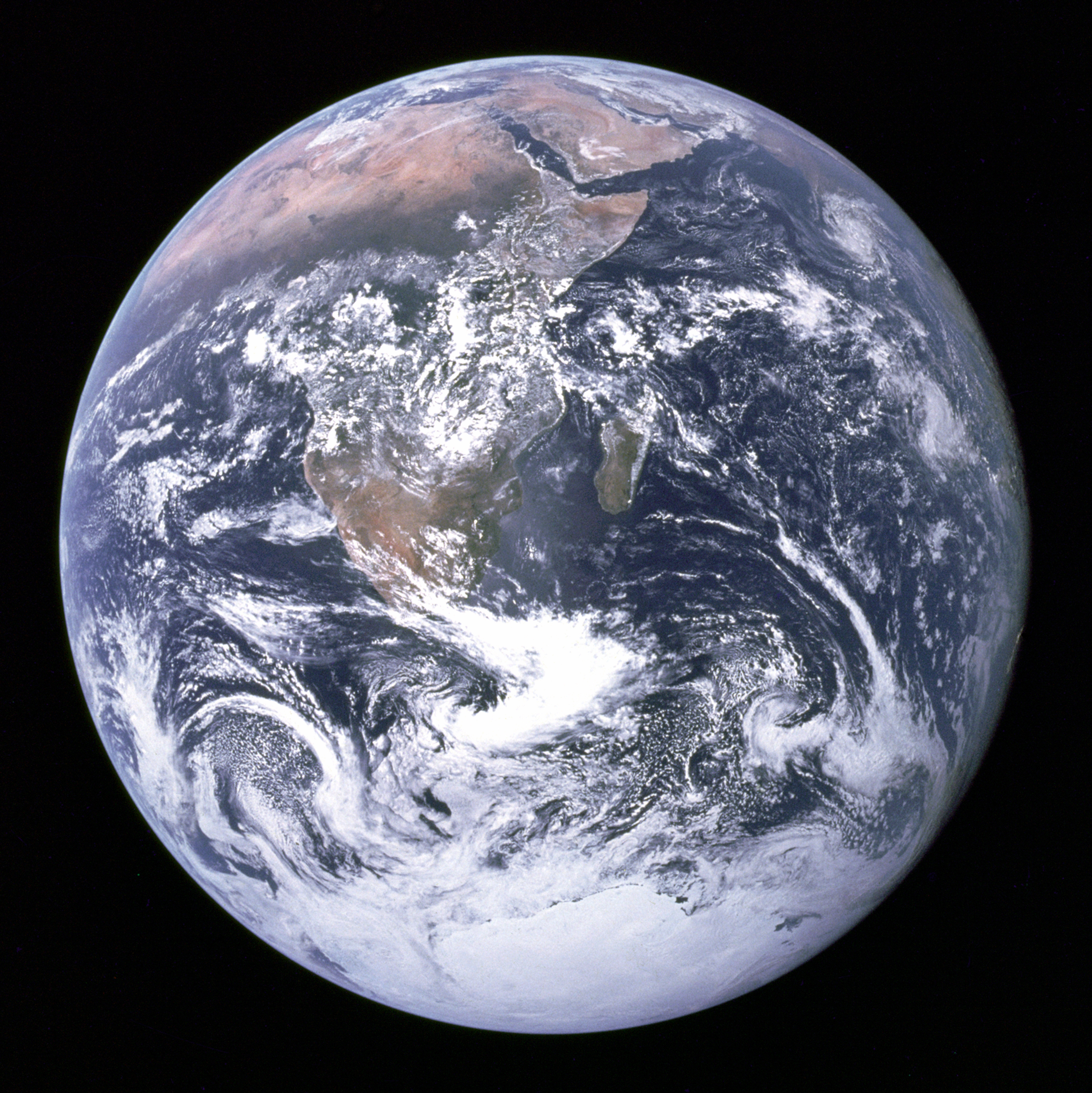
Renewing the World: Water explores the future of the water planet. Image: “The Earth seen from Apollo 17.” Photo by nasa.gov. public domain. Included here with appreciation.

Brooke, K. Lusk. Renewing the World: Waterhttps://renewingtheworld.com

Eckstein, Gabriel. “Buried Treasure or buried Hope? The Status of Mexico-US Transboundary Aquifers under International Law.” International Community Law Review 13 (2011): 273-290. https://scholarship.law.tamu.edu/facscholar/129/

International Groundwater Resources Assessment Centre (IGRAC). “Transboundary Aquifers of the World” https://www.un.igrac.org/sites/default/files/resources/files/TBAmap_2015.pdf

Herbert, Claudia and Petra Doell. “Global assessment of current and future groundwater stress with a focus on transboundary aquifers.” Water Resources Research,  55(3), 4760-4784. DOI:10.1029/2018WR023321.

UN-Water. www.unwater.org

United States Bureau of Reclamation. “Environmental Flows in the Rio Grande-Río Bravo Basin.” 1 February 2022. Drought Adaptation Webinar Series. VIDEO: https://www.youtube.com/watch?v=5I-prBCOjTs

World Water Day. https://www.worldwaterday.org/

Building the World Blog by Kathleen Lusk Brooke and Zoe G. Quinn is licensed under a Creative Commons Attribution-NonCommercial-NoDerivs 3.0 Un

WATER: Microplastic Filter Innovations

Microplastics in four rivers – Image. “Microplastics in freshwater ecosystems: what we know and what we need to know.” by Martin Wagner, et al., Environmental Sciences Europe. 26, 2014. doi: 10:1186/s12302-014-0012.7

Did you know that 35% of the plastic in our water is microfibers? Those microfibers come from our clothing, released into the water supply during laundering. Microfibers are too small (0.5mm) to be captured by traditional filters. Currently, 2/3rds of clothing contains some percentage of synthetic materials. A typical washload of polyester clothing may shed 9,000,000 microfibres with every wash. Now there is something we can do to stop this problem: attaching a filter to washing machines to catch the microfibers. While the origin of microfibers in clothing is the garment industry, a major source of plastic microfibers is the effluence of laundry water. PlanetCare is expanding their product to a larger version for commercial laundries. 

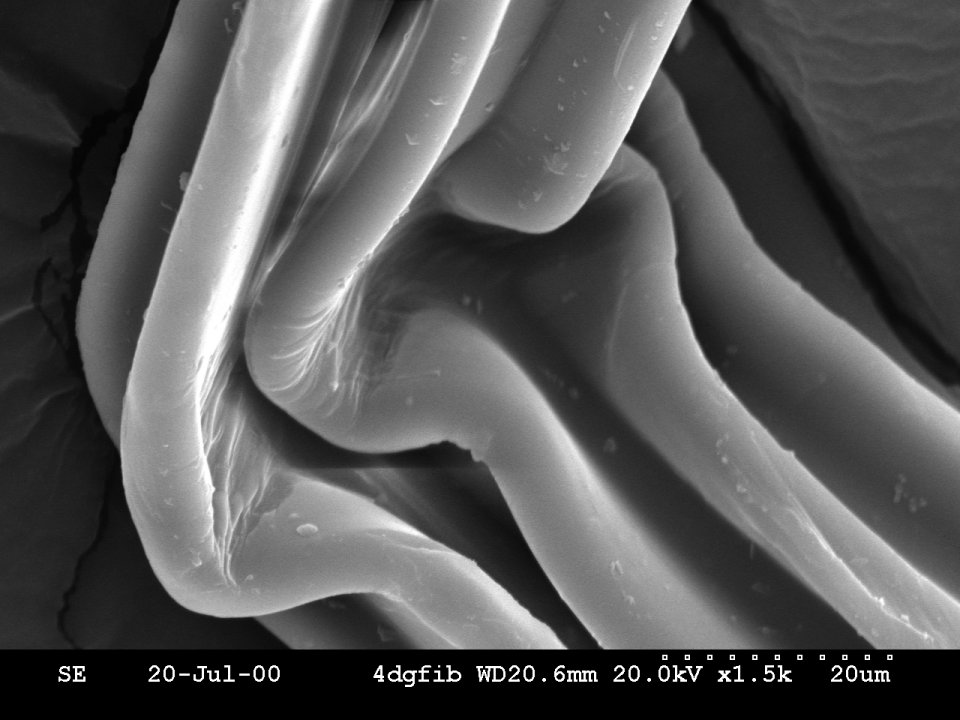
“SEM picture of a bend in a high-surface area polyester fiber with a seven-lobed cross section” by Pschemp, 2000. Image Wikimedia.

Other companies are developing microfiber filters for washing machines. Environmental Enhancements offers the Lint LUV-R. Xeros Technologies produces the XFiltra. Filtrol makes a similar product. Cora Ball and Guppyfriend use a different technology: devices that collect microfibers inside the washing machine during the laundry cycle. While attached filters catch more fibers (87%), these tend to be the longest ones; Cora Ball inserts and Guppyfriend washing bags capture 26%, mainly the smallest fibers. Using both approaches would increase success.

Fast Company “G-Star Raw x Planetcare collab to flight microfibre pollution.” 8 October 2019. https://www.fastcompany.co.za/business/g-star-raw-x-planetcare-collab-to-fight-microfibre-pollution

Kart, Jeff. “Science says laundry balls and filters are effective in keeping microfibers out of waterways.” 2019. Forbes.https://www.forbes.com/sites/jeffkart/2019/02/01/science-says-laundry-balls-and-filters-are-effective-in-removing-microfibers/?sh=208899e6e07a

Rabinovich, Ben. “World Oceans Day: Check out these amazing inventions currently cleaning our oceans.” 4 June 2019. Daily Mail. https://www.dailymail.co.uk/sciencetech/article-7104173/World-Oceans-Day-Check-amazing-inventions-currently-cleaning-oceans.html

Tuttan, Mark and Katie Pisa. “Washing your clothes is causing plastic pollution, but a simple filter could help.” 14 November 2019. CNN. https://www.cnn.com/2019/11/14/world/microfiber-filter-plastic-pollution-int/index.html

Zupan, Mojca.  2019 YouTube: https://www.youtube.com/watch?v=AD7iTYhAC_U

Building the World Blog by Kathleen Lusk Brooke and Zoe G. Quinn is licensed under a Creative Commons Attribution-NonCommercial-NoDerivs 3.0 Unp

WATER: World Water Day 2021

“Water Drop” by José Manuel Suárez, photographer, 2008. Image: wikimedia.

World Water Day, begun in 1993, calls us to honor and preserve the world’s freshwater supply. Water, in the form of drinking water and safe sanitation, is the #6 Sustainable Development Goal of the United Nations.  Environmental historians observe that human history can be traced by innovations in water systems. Aqueducts built by the Romans brought fresh spring water to a growing city when the Tiber river became threatened. In England, the New River was one of the world’s first built watercourses, bringing potable water to the burgeoning city of London. The Colorado River Compact defined the rights and use of water for the American states of the Upper Basin (Wyoming, Colorado, Utah, New Mexico) and Lower Basin (California, Arizona, Nevada); sovereign peoples of the Navajo, Havasupai, Walapai, and several others; and México.  Rights of the Whanganui River of New Zealand established legal personhood in 2017, confirming a growing awareness of the rights of nature. Today’s World Water Day 2021 is dedicated to our personal use of water. While 71% of the world has access to safe drinking water, only 45% have use of safe sanitation. To access the country data where you live, the United Nations invites you to explore the world water database here. To tell your own story about how you experience water, record your views here.

Building the World Blog by Kathleen Lusk Brooke and Zoe G. Quinn is licensed under a Creative Commons Attribution-NonCommercial-NoDerivs 3.0 Unp

ENERGY: Genie in a Bottle

“Genie in a Bottle,” from Stripped Tour, Christina Aguilera Image: wikimedia.

February 18, 2021. It’s National Battery Day. What is this genie in a bottle that we call a battery?

Lithium-ion batteries are making news. It’s a technology popularized in 1991, when rechargeable lithium-ion batteries were first used in hand-held camcorders. A decade later, Apple began using these batteries in smartphones. When electric cars entered the market (Edison worked on one, before Henry Ford invented the gasoline-driven automobile), batteries became the way to power the future. SEMATECH introduced a new industry, and now two new semiconductor materials – gallium nitride (GaN) and silicon carbide (SIC) are now being used in EV batteries. With General Motors (GM) pledging a full transition from gas and diesel to electric vehicles by 2035 (Ford, Tesla, Volkswagen and others in similar quests), the race is on.

“Tesla Model S at a Supercharger station.” Image: wikimedia.

Who’s Who (a partial list) in Electric-Vehicle Batteries:

CATL or Contemporary Amperex Technology Col, Limited, founded in 2011 in China, announced an increased investment of $4.5 billion on 4 February 2021. CATL will open a new plant in Zhaoqing, Guangdong Province, upgrade a plant in Yibin, Sichuan Province, and expand a joint venture plant with automaker China FAW Group. A new plant in Germany is also under construction. (300750:CH)

LG Chem in South Korea, world’s biggest EV battery manufacturer, just announced its battery division would now be a stand-alone business. LG counts GM, Geely Automotive Holdings Shanghai Maple Guorun Automobile Co., Hyundai Motor Group, and Tesla among its customers. Tentative name for the new business: LG Energy Solutions. (LGCLF)

Nissan Motor Co. and American Electric Power are competitors with a different strategy: reusing old EV batteries with a technology to extend lithium-ion battery life by over 30%. The experiment uses Nissan Leaf expired-batteries with a method developed by Melbourne-based Relectrify. BMW AG and Toyota are also reusing cells in EV charging. (NSANY)

Novonix is working with Dalhousie University on battery material research, noting new deals with Tesla on synthetic graphite. (NVNXF)

Panasonic. Tesla is in talks with Indonesia to build a battery cell factory with Panasonic. (PCRFY)

QuantumScape is introducing solid-state batteries lithium-metal batteries, offering a faster charge, longer life, and increased safety. The San Jose, California company filed with the SEC for a new development on 1 February 2021. (QS)

Tesla. Bringing battery production in-house has been a goal for Elon Musk who introduced a ‘tab-less’ battery called 4680 that will produce a 16% increase in range for the company’s electric vehicles. They new cells measure 46 millimeters by 80 millimeters. (TSLA)

Zinc Copper Voltaic Pile. Image: wikimedia.

The oldest battery known to history was found in Baghdad: a clay pot containing a metal tube and rod. But when Alessandro Volta discovered that zinc and coper, placed in a saline or acid solution, could transform zinc into a negative pole and copper into a positive pole, the action began. Chevrolet named one of its early EV models a “Volt.”

Will batteries advance hydroelectric power? Image: Hoover Dam, wikimedia.

Battery storage may transform hydroelectric power In Chile, a 50 megawatt-hour (MWh) battery energy storage project (think the equivalent of 5 million iPhones) will be paired with a hydroelectric facility, to store generated energy without need to construct a dam or reservoir. Will the Hoover Dam explore this technology, with consideration to drought affecting Lake Mead? It was hydroelectric power that first fascinated Nikola Tesla who, looking at a photo of Niagara Falls, said: “Someday I’ll harness that power.”

Battery Council International. “It’s national battery day.” www.batterycouncil.org

Hareyan, Armen. “Rumor says Tesla may have completed 1st round of Indonesia battery talks involving Panasonic.” 12 February 2021. Torque News. https://www.torquenews.com/1/rumor-says-tesla-may-have-completed-1st round-indonesia-battery-talks-involving-panasonic

Hawkins, Andrew J. “Tesla announces ‘tabless’ battery cells that will improve the range of its electric cars.” 22 September 2020. The Verge. https://www.theverge.com/2020/9/22/21449238/tesla-electric-car-battery-tabless-cells-day-elon-musk

Kawakami, Takashi. “EV-battery giant CATL to boost capacity with $4.5bn investment.” 4 February 2021. NikkeiAsia.com. https://asia.nikkei.com/Business/Automobiles/EV-battery-giant-CATL-to-boost-capacity-with-4.5bn-investment

Kubik, Marek. “Adding Giant Batteries To This Hydro Project Creates A ‘Virtual Dam’ with Less Environmental Impact.” 23 May 2019. Forbes. https://www.forbes.com/sites/marekkubik/2019/05/23/adding-giant-batteries-to-this-hydro-project-creates-a-virtual-dam-with-less-environmental-impact

Schmidt, Bridie. “EV battery material firm Novonix strengthen ties with Dalhousie University.” 15 February 2021. The Driven. https://thedriven.io/2021/02/15/ev-battery-material-firm-novonix-strengthen-ties-with-dalhousie-university

Semiconductor Review. “How Semiconductor Advancements Impact EV Batteries.” 26 October 2020. Semiconductor Review. https://www.semiconductorreview.com/news/how-semiconductor-advancements-impact-ev-batteries-nwid-124.html

Stringer, David and Kyunghee Park. “Top Electric-Car Battery Maker Wins Approval for Company Split.” 30 October 2020. Bloomberg News and Transport Topics. https://www.ttnews.com/articles-top-electric-car-battery-maker-wins-approval-company-split

Stringer, David. “Companies Explore Using Old Electric Car Batteries to Cut Costs.” 24 January 2020. Transport Topics. https://www.ttnews.com/articles/companies-explore-using-old-electric-car-batteries-cut-costs

Building the World Blog by Kathleen Lusk Brooke and Zoe G. Quinn is licensed under a Creative Commons Attribution-NonCommercial-NoDerivs 3.0 Unp

ENERGY: 2020 by the Numbers

The year 2020 will go down in history for many reasons, including climate change. Temperatures were 1.08 degrees Fahrenheit (0.6 Celsius) warmer than the 1981-2010 average and 2.25 degrees Fahrenheit (1.25 Celsius) above pre-industrial times. Rising temperatures have consequences. In January of 2020, Australia suffered wildfires burning an area bigger than Florida. In summer, Atlantic hurricane season brought 30 named storms, carrying more water (warming oceans produce more water, higher waves, increased flooding). Western United States areas like California, Nevada, Oregon, Washington witnessed fires that destroyed 10.3 million acres. In the Arctic, data from the Copernicus Climate Change Service showed the region is warming faster than feared, more than twice the pace as the rest of the globe, with 5.4 degrees Fahrenheit (3 degrees Celsius). Environmental scientists noted that 2020 set a record for carbon dioxide concentrations, rising to 413 ppm (parts per million) in May of 2020, even with Covid-19 lockdowns. (Kann and Miller, 2021)

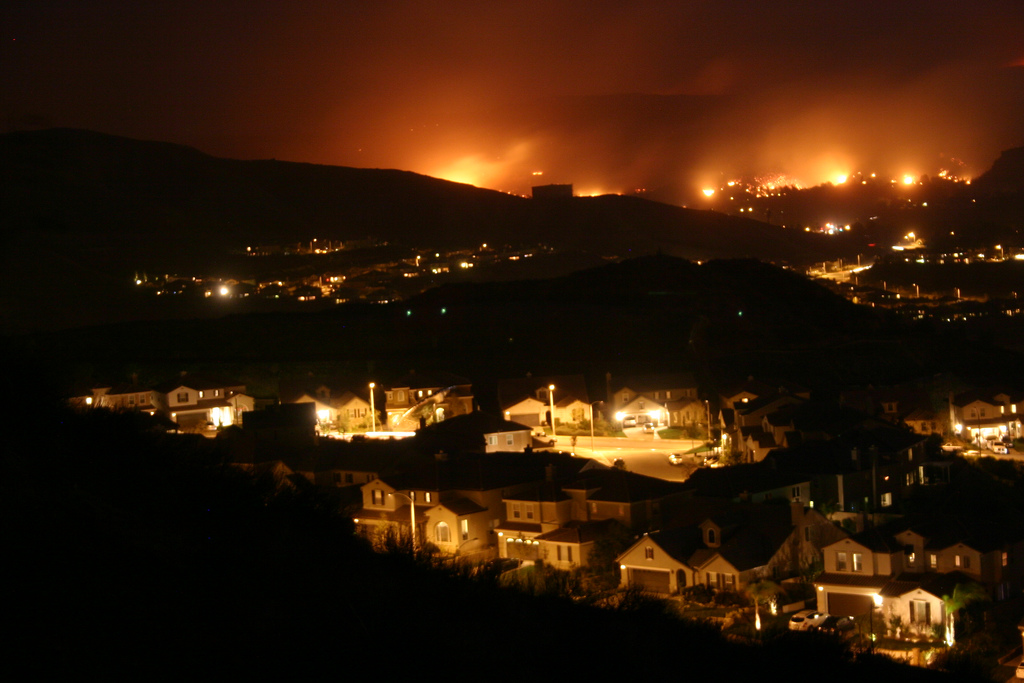
“Wildfire in Santa Clarita, California.” Image: wikimedia.
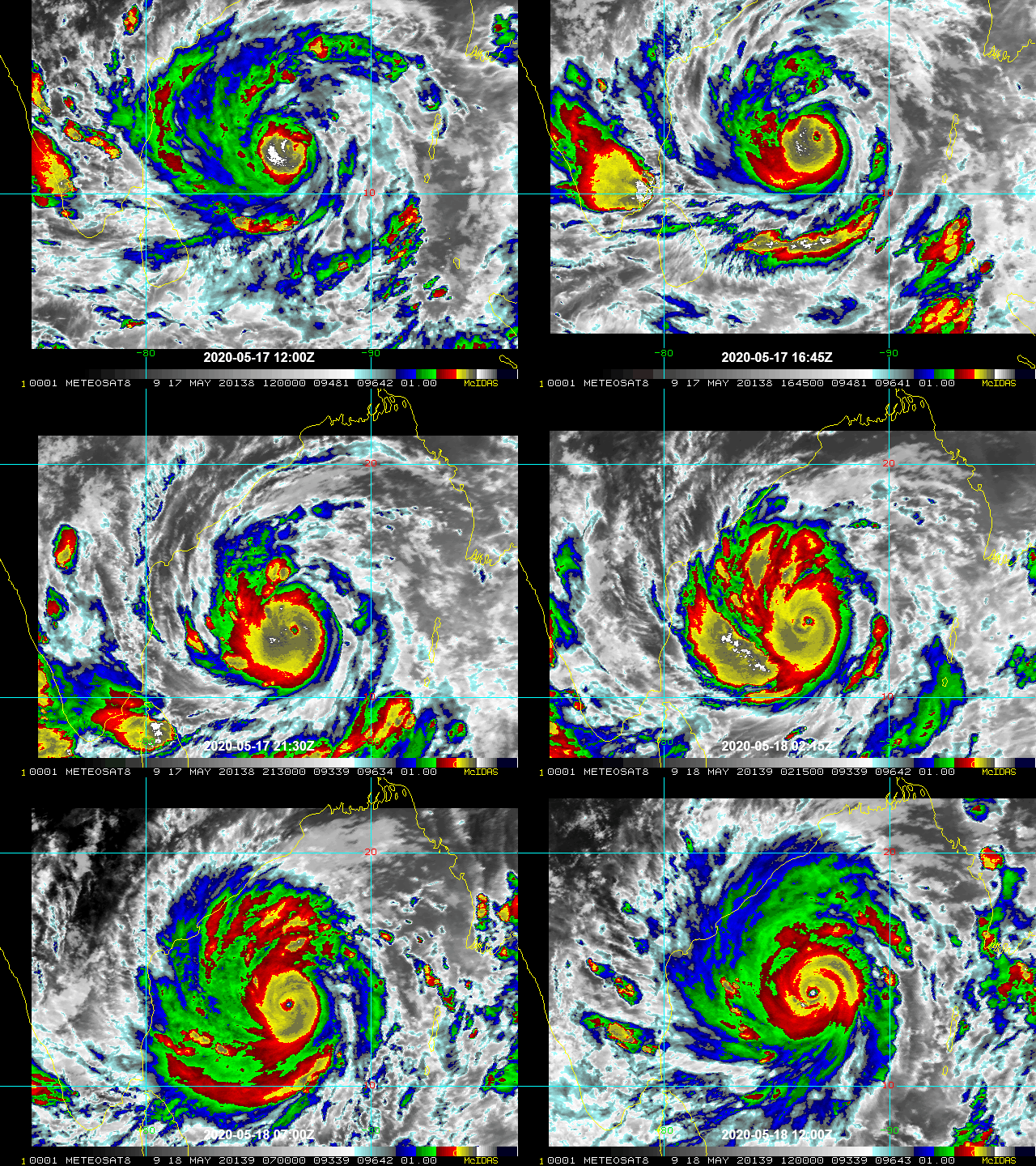
Price tag? $95 billion. And that’s just for U.S. climate-related damage, according to Munich Re, insurance company to other insurance firms that covered damage from Atlantic storms and California wildfires. Chief climate scientist of Munich Re Ernst Rauch warned that building in high-risk areas added to losses. Hurricanes  were significant in damage, causing $43 billion in losses. Convective storms (like hailstorms and tornadoes) caused $40 billion. Wildfires added up to $7 billion including destruction of crops, endangering food security. Residential and business properties sustained damage and claimed insurance losses, over 4000 properties in Oregon and many more in California. According to Donald L. Griffin of American Property Casualty Insurance Association, “We can’t, as an industry, continue to just collect more and more money, and rebuild and rebuild and rebuild in the same way.” (Flavelle, 2021) Beyond the United States, the numbers are just as dire. Cyclone Amphan struck Bangladesh and India in May, resulting in $14 billion in damage. Asia sustained $67 billion in losses from natural disasters.

Cyclone Amphan May 2020. Image: wikimedia commons.

What does this mean for 2021? Following the money and perhaps led by the insurance industry, new ways to rebuild may lead us into the New Year. We’ll take a look at some hopeful trends, next.

American Property Casualty Insurance Association. https://www.apci.org

Flavelle, Christopher. “U.S. Disaster Costs Doubled in 2020, Reflecting Costs of Climate Change.” 7 January 2021. The New York Times. https://www.nytimes.com/2021/01/07/climate/2020-disaster-costs.html?referringSource=articleShare

Kann, Drew and Brandon Miller. “2020 was tied for the hottest year ever recorded — but the disasters field by climate change set it apart.” 8 January 2021. CNN.com. https://www.cnn.com/2021/01/08/weather/2020-global-temperatures-tied-for-warmest-on-record-copernicus/index.html

Munich Re. https://www.munichre.com/en.html

Thanks to Jason W. Lusk for editorial guidance and suggestions.

Building the World Blog by Kathleen Lusk Brooke and Zoe G. Quinn is licensed under a Creative Commons Attribution-NonCommercial-NoDerivs 3.0 Unp

WATER: Beach Weekend? Biodegradable Flip Flops

“Pristine Beach on the Soline Peninsula,” 2011. Photographer Alex Proimos. Image: wikimedia.

Labor Day 2020: for many it’s a beach weekend in flip flops. Too often, beaches are strewn with broken or discarded flip flops that litter the sand and pollute the water. Enter an innovation: biodegradable flip flops from the University of California San Diego and the California Center for Algae Biotechnology.

“Algae in pond, North Carolina.” Photographer: Ildar Sagdejev, 2008. Wikimedia.

Formula: take pond algae, dehydrate to a paste, extract lipids, run through series of chemical changes to produce polymers, pour resulting material into a mold. Present product, manufactured in partnership with Algenesis Materials, is 52% biodegradable and 48% petroleum; by 2025, the flip flops will be 100% made from renewables. If you do leave your flip flops at the beach, they’ll biodegrade and compost in 18 weeks.

Biodegradable flip flops will go on sale in 2021. Image: wikimedia.

It’s the world’s most popular shoe. Over three billion people wear only flip flops, but the footwear lasts only for about two years and is then discarded, eventually entering the world’s waters. East African beaches see 90 tons of discarded flip flops each year. Three billion flip flops end up in waterways and oceans every year. UniqueEco recycles old flip flops into toys; Terracycle shreds them to use for manufacturing picnic benches.  DIY Dreaming uses old flips to make dog beds. Okabashi makes recyclable sandals, and Splaff and Sanuk use natural materials for footwear. But Algenesis may be the first to make flip flops from algae. The footwear industry generates $215 billion annually, and the plastic industry is worth $1.2 trillion. Algensis biodegradable flip flops will go on sale in January 2021.

California Center for Algae Biotechnology. https://algae.ucsd.edu/about/index.html

Elassar, Alaa. “Researchers create eco-friendly, biodegradable flip flops made of algae,” 23 August 2020. CNN.com. https://www.cnn.com/2020/08/23/us/uc-san-diego-algae-flip-flops-trnd-scn/index.html

Frerck, Robert. “Flip Flop Factos: Find Out.” Blue Ocean Network. https://blueocean.net/flip-flop-facts-find-out

Segran, Elizabeth. “How one lab is turning algae into flip-flops – and taking on Big Plastic in the process.” 8 August 2020. Fast Company. https://www.fastcompany.com/90543908/how-one-lab-is-turning-algae-into-flip-flops-and-taking-on-big-plastic-in-the-process/

Building the World Blog by Kathleen Lusk Brooke and Zoe G. Quinn is licensed under a Creative Commons Attribution-NonCommercial-NoDerivs 3.0 Unp

ENERGY: Promethean Problem

“Prometeo trayendo el fuego,” Jan Cossiers, 1637. Museo del Prado. wikimedia.

Ever since Prometheus stole fire and gave it to humans, we’ve been the only species that can start and stop a fire. Darwin believed human capability to control fire was the greatest evolutionary achievement, second only to language. Now, that capability may be changing.

Wildfire Map of California, seen by NASA satellites. Image: nasa.gov.

Increase temperatures by 1.8 degrees Fahrenheit, decrease rainfall by 30%: it’s a formula for fire risk. Add occurrence of lightning strikes, like those in California recently, and there is a predictable crisis. According to Berkeley Atmospheric Science Center, the area’s temperatures are 3.5 degrees higher than a century ago. Lightning strikes have also increased: up by 12% across the United States. According to California governor Gavin Newsom, California experienced 10,849 lightning strikes in 72 hours in August 2020, amid record temperatures. In 2020, California has battled 40 percent more fires than in 2019. It’s not just a California problem. In Alaska, temperatures are increasing faster than anywhere else in the USA, with four of the ten largest fire years on record occurring in the past fifteen years, with 2 million acres lost in each major fire year. In Colorado, over 1 million people receive drinking water from the Upper South Platte Watershed, northwest of Denver: in the past two decades, fires have threatened the water utility. In Colorado this week, wildfires burned across 135,423 acres, causing the state to warn residents about air quality and banning campfires: the Grizzly Creek Fire closed Interstate 70 for more than one week. Some warned that after the fires, landslides may increase. Water levees across the Colorado River Basin have decreased, including reservoirs of Lake Mead and Lake Powell. In South America, wildfires also pose dangers. It’s a global problem that will increase with climate change. What can we do?

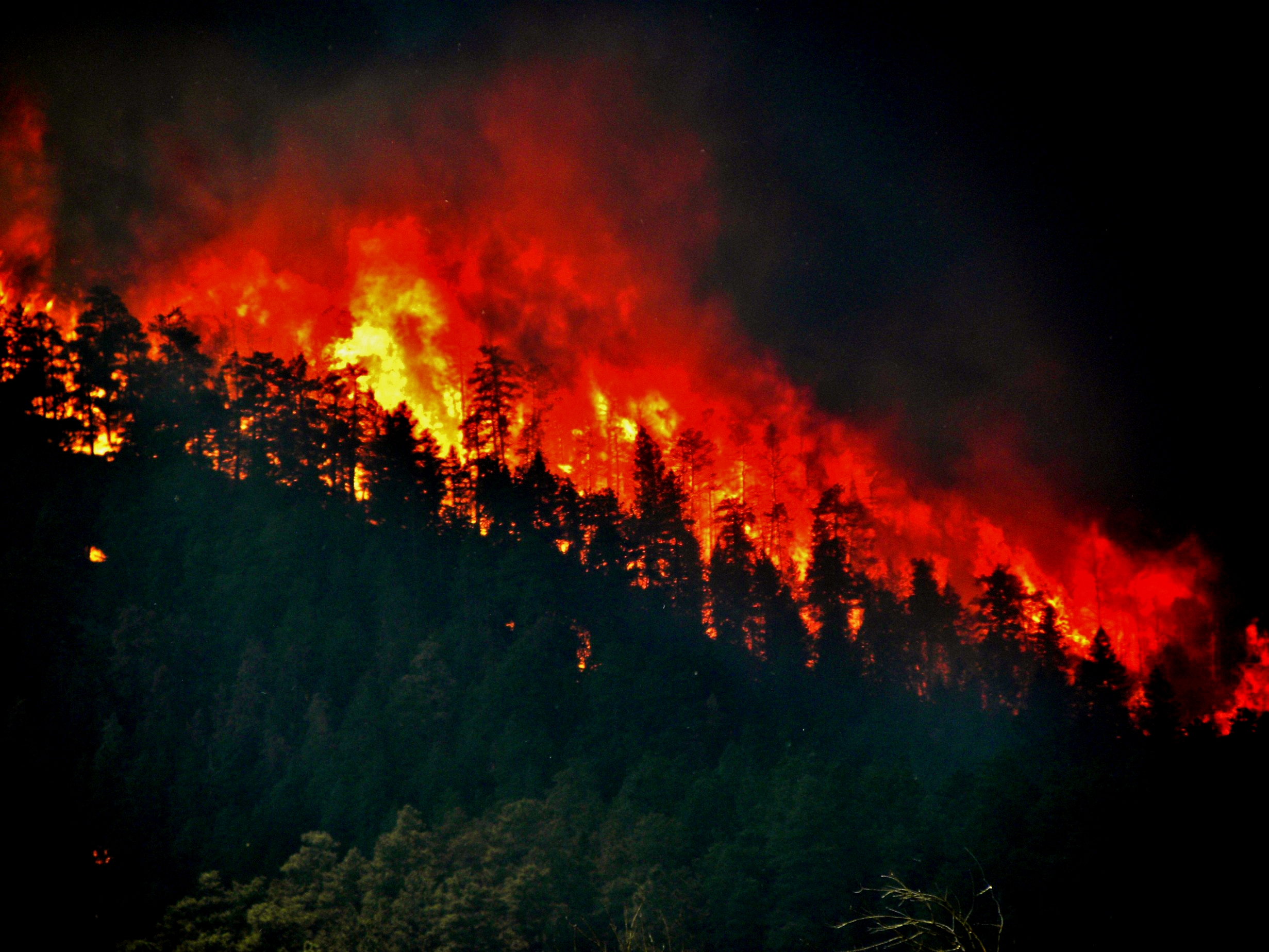
“Trees Torching: High Park Wildfire” U.S. Department of Agriculture, 2017. Image: wikimedia.

World Weather Attribution (WWA), an international collaborative organization including the Environmental Change Institute at Oxford (ECI), Laboratories des Sciences du Climat et de l’Environment (LSCE), National Center for Atmospheric Research (NCAR), Red Cross Red Crescent Climate Centre, and Royal Netherlands Meteorological Institute (KNMI), uses satellite data and other sources to monitor atmospheric pressure patterns and levels of water vapor to predict heatwaves, fires, droughts, among other weather threats. Study data on every global region from 2014 – 2020 can be found here. These studies provide both warnings, and the basis for sustainability litigation.

Wildfire Propagation Model. Image: wikimedia.

Like sea-rise that will continue to some extent after we solve the climate crisis, temperature increases, with resultant drought and fires, can also be expected. There are some options: limit building and development in fire-prone areas, manage forests, combat insect-borne disease, improve our power grid, strengthen data analysis on climate change, and develop early warning systems for wildfire smoke that can pose air pollution and health risk. Future environmental decisions will need collaboration among biologists, fire scientists, and landscape ecologists, according to Professor Van Butsic of UCBerkeley, who states “land sits at the nexus of ecological conditions and human decisions.”

“Eden Reforestation Projects Logo,” www.edenprojects.org.

Wildfire protection innovations include Elevated Rain Induced Solution (ERIS) developed by Wildfire Innovations with targeted, moveable, suppression systems. Early detection innovations like SmokeD by IT for Nature can detect fires and alert nearby businesses and residents, via a phone app. Verisk Analytics Inc. developed a fire risk management tool to evaluate fuel, slope, and access, generating a hazard score. Will reforestation help? According to studies, the cost of replanting may bring promising returns: one reforested acre will be worth $191, 110; 30 acres, $5,733.300. Eden Projects and MillionTrees help restore land and lives. Private investment may see an opportunity, with investor capital innovations like Blue Forest Resilience Bond (FRB) and  Encourage Capital. 

Butsic, Van, A.D. Syphard, J.E. Keeley, and A. Bar-Massada. (2017). “Can private land conservation reduce wildfire risk to homes? A case study in San Diego County, California, USA.” Landsc. Urban Plan, 157, 161-169. LUC LAB: Researching Land Use and Land Use Change, University of California Berkeley.

Darwin, C. The Descent of Man. London: 1871.

Doer, Stefan H. and Cristina Santin. “Global trends in wildfire and its impacts: perceptions versus realities in a changing world. 5 June 2016. Philos Trans R Soc Lon B Biol Sci. 2016 Jun 5: 371 (1696): 20150345. doi: 10.1098/rstb.2015. 0345 PMCID: PMC4874420.

Finley, Bruce. “Climate change hits home in Colorado with raging wildfires, shrinking water flows and record heat: State faces continued increases in average temperatures for decades due to past burning of fossil fuels.” 25 August 2020. The Denver Post. https://www.denverpost.com/2020/08/19/colorado-climate-change-wildfire-drought/

Gowlett, J.A.J. “The discovery of fire by humans: a long and convoluted process.” 5 June 2016. https://doi.org/10.1098/rstb.2015.0164. Article ID: 20150164. Special issue on The Interaction of Fire and Mankind. https://doi.org/10.1098/rstb.2016.0149

Lenihan, Rob. “Innovation at the forefront of wildfire prevention.” 24 July 2018. Business Insurance. https://www.businessinsurance.com/article/20180724/NEWS06/912322839/Disaster-management-innovations-at-the-forefront-of-wildfire-prevention#.

Lightning Maps. https://www.lightingmaps.org.

Mulkern, Anne C. “Climate Change Has Doubled Riskiest Fire Days in California.” 3 April 2020, Scientific American. https://www.scientificamerican.com/article/climate-change-has-doubled-riskiest-fire-days-in-california/

NASA. Forecasting Fires in South America. VIDEO: https://commons.wikimedia.org/w/index.php?title=File%3AForecasting_South_American_Fires.ogv

Newsom, Gavin. “CA has experienced 10,849 lightning strikes in the last 72 hours.” 19 August 2020. Twitter: @GavinNewsom.

Temple, James. “Yes, climate change is almost certainly fueling California’s massive fires.” 20 August 2020, Technology Review. https://www.technologyreview.com/2020/08/20/1007478/california-wildfires-climate-change-heatwaves/

Union of Concerned Scientists. “The Connection between Climate Change and Wildfires” published 9 September 2011; updated 11 March 2020. https://www.ucsusa.org/resources/climate-change-and-wildfires

U.S. Global Change Research Program. “National Climate Assessment”. https://nca2018.globalchange.gov

World Weather Attribution. https://www.worldweatherattribution.org/analysis/projects/

Building the World Blog by Kathleen Lusk Brooke and Zoe G. Quinn is licensed under a Creative Commons Attribution-NonCommercial-NoDerivs 3.0 Unp

WATER: How much do you use?

How much water do you use? Image: “Blue question mark,” wikimedia commons.

Only 1% of water on Earth is drinkable (actually, it’s 2.5% but only 1% is readily accessible). The rest of the water on the planet rests in the sea, but it is salty and therefore requires desalination to use for drinking or agriculture.

New River, a fresh water supply and a fresh idea. Image: wikimedia.

Ever since the most ancient times, humans have invented ways to find, distribute, use, and power with water. From the Roman Aqueducts and the New River of England that brought fresh water to the growing cities of Rome and London, respectively, to the water use agreements of the Colorado River of the USA and Snowy Mountains Hydroelectric of Australia, the story of civilization is the story of water.

With populations growing and climate changing, water will become more scarce and more important for uses for drinking, agriculture, industry, and energy. While macro systems that deliver water to our taps are large in scale, each of us can do something to protect and conserve water.


Take this quiz to calculate your WATER USE.

Attenborough, Sir David. “Fresh Water.” Episode 3. Our Planet. BBC One/Netflix. https://www.youtube.com/watch?v=R2DU85qLfJQ/

Jacobsen, Rowan. “Israel Proves the Desalination Era is Here,” 29 July 2016. Scientific American. https://www.scientificamerican.com/article/israel-proves-the-desalination-era-is-here/

Spang, E., E. R, K.S. Gallagher, P.H. Kirshen, D.H. Marks. 2014 “The Water Consumption of Energy Production: An International Comparison.” Environmental Research Letters, Volume 9, 105002. https://iopscience.iop.org/article/10.1088/1748-9326/9/10/105002/meta/

Water Calculator. https://www.watercalculator.org/wfc2/q/household/

Water Footprint Calculator. “Water Websites for Kids.” 13 November 2019. https://www.watercalculator.org/resource/water-websites-for-kids/.

Thanks to Sierra C. Lusk for research and inspiration.

Building the World Blog by Kathleen Lusk Brooke and Zoe G. Quinn is licensed under a Creative Commons Attribution-NonCommercial-NoDerivs 3.0 Unp