SPACE: Trash Talk

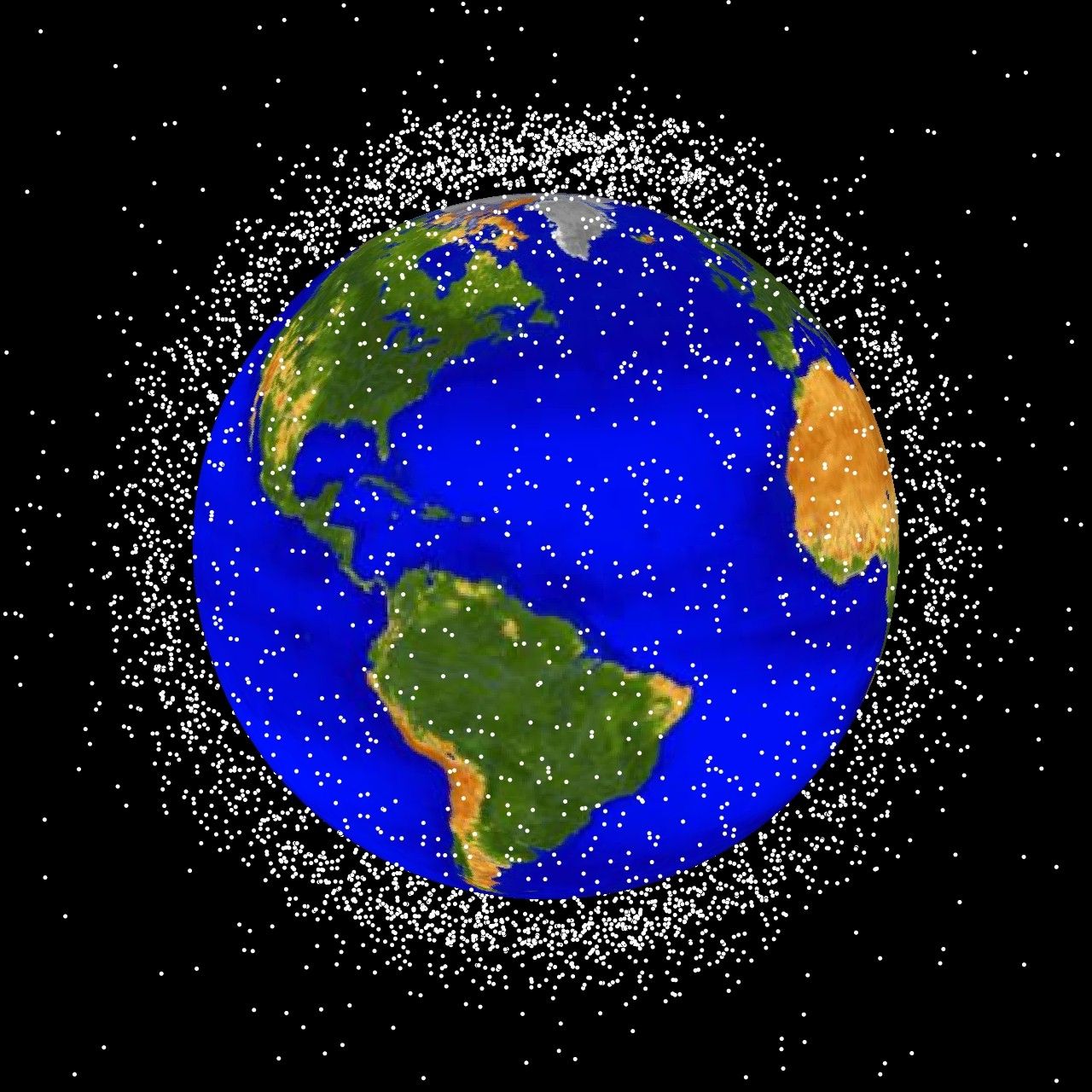
Space debris in low earth orbit by NASA, 2005. Public Domain.

Want to talk trash? Look up. More than 25,000 pieces of defunct satellites, odd parts lost in extra-vehicular activity, bolts that floated off while repairing the International Space Station (ISS), are circling the Earth. And those are just the larger chunks (more than 4 inches in diameter). Go small and you go big: with 100,000,000 tiny but powerful bits flying at 17,000 mph (28,000 km). At that speed, even a paint chip could shatter a satellite – there are more than 8,000 of those in orbit, with 100,000 more planned by 2030.

More space objects, more danger of damage. Graphic: “Debris Object Evolution” by European Space Agency (ESA: A290134), 2017. Creative Commons 3.0.

Not long after the first satellite was launched in 1957 and COMSAT soon developed, the Kessler Syndrome, suggested by NASA scientists Donald J. Kessler and Burton G. Cour-Palais, reminded us that the more space objects we send into orbit, the more likely collisions will not just occur but pile up – the way a highway collision can create a multi-vehicle traffic jam. In space, such an event could cause outages of essential terrestrial communication systems.

Kessler Syndrome Image by NASA, Orbital Debris Program Office, Public Domain.

On Earth, we have become familiar with the “reuse-repurpose-recycle” paradigm. But in space, we tend to shoot stuff up there and leave it to eventually degrade. Enter Astroscale and other space repair and debris removal businesses that offer a new paradigm: “inspect-service-remove.” Think of it as orbital road-service.
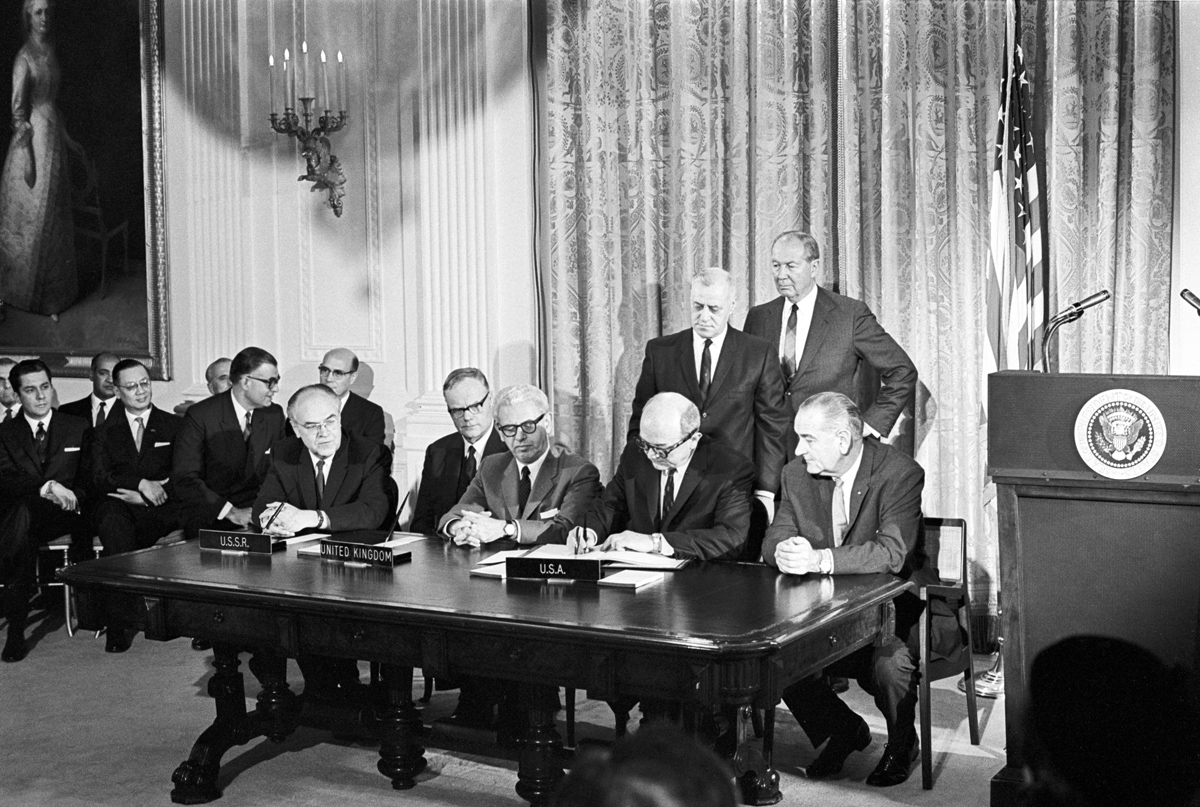
The 1967 Outer Space Treaty began the legal framework for space. Image: “Signing Outer Space Treaty 27 January 1967,” courtesy of ITU. Creative Commons 2.0.

Legal precedent will help to guide the process. The 1967 Outer Space Treaty mentioned liability for damage sustained in space. The 1972 Convention on International Liability for Damage Caused by Space Objects developed and presented a regulatory framework. In 1975, the Convention on Registration of Objects Launched into Outer Space mandated launching States to keep track of, and take responsibility for, their orbiting technology. The Inter-Agency Space Debris Coordination Committee may provide regulatory options. Space Traffic Management (STM) is a new industry that will help launchers to clean up their orbits.
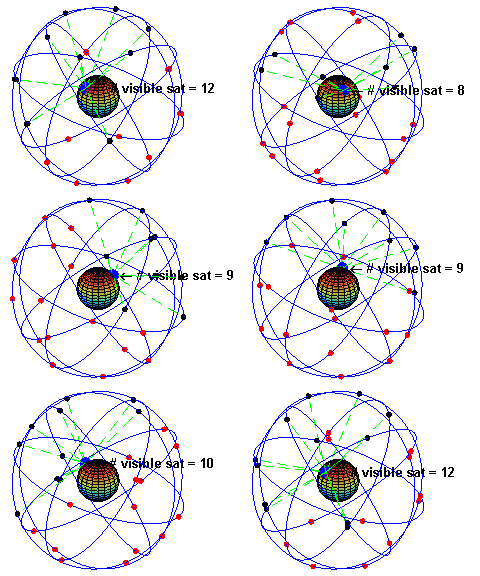
Space debris collisions could damage key satellite systems including GPS. Image: “Constellation Global Positioning System (GPS)” by El Pak, 2007. Public Domain, with appreciation.

Case Example: Astroscale. Founded in 2013 by Nobu Okada, Astroscale Holdings Inc (listed on the Tokyo Stock Exchange as 186A) can service satellites in orbit, detecting potential problems and servicing devices while still operational. Beyond repair, the ADRAS-J can carry space junk safely out of orbit and return it to earth, where materials recycling may prove valuable. To make servicing easier, Astroscale manufactures a docking plate that enables in-orbit servicing and controlled removal, when needed.

Space and orbital break-ups can occur when satellites may explode. Image: “Space Break Up ESA375611,” European Space Agency (ESA) 2017. Creative Commons 3.0.

In 2027, NewSpace India Limited (NSIL) and India’s Department of Space will launch In-situ Space Situational Awareness–Japan1 from the Satish Dhawan Space Center. The mission will inspect two large space debris objects now in orbit. In 2025, Astroscale received US Patent number 12,234,043 B2 for “Method and System for Multi-Object Space Debris Removal.”

Space Services and Debris Removal will be a profitable new field. Image: “New” b Neji, 2009. Creative Commons 3.0

NEW LEADERS in SPACE DEBRIS SERVICES include these companies. Some financial professionals note that while the satellite businesses has many entrants, space servicing and debris removal is an emerging market that will grow. Many of these new enterprises are at the private investment stage; when public, stock information is listed below:

Airbus. https://www.airbus.com   Paris (AIR.PA) US OTC (EADSY)

Altius (subsidiary, Voyager). https://voyagertechnologies.com NYSE: VOYG

Artificial Brain. https://artificialbrain.in

Astroscale Holdings. https://astroscale.com/en  Tokyo (186A)

Bull. https://bull-space.com

ClearSpace. https://clearspace.today/

D-Orbit. https://www.dorbit.space

Delta Infinite. https://www.delta-infinite.com

Digantara. https://www.diganara.co.in

iSEE. https://isee-space.ai

Kurs Orbital. https://kursorbital.com

LeoLabs. https://leolabs.space

Lockheed Martin. https://www.lockheedmartin.com NYSE: LMT

Northrup Grumman. https://www.northopgrumman.com  NYSE: NOC

Orbit Guardians Corporation. https://orbitguardians.com

Orbital Lasers. https://www.orbitallasers.com

Paladin Space. https://www.paladinspace.com

Rocket Lab. https://rocketlabcorp.com NASDAQ (RKLB)

Space Cowboy. https://spacecowboy.today

Spaceflux. https://spaceflux.io

New materials for space may help to avoid future space debris. For example, satellites made of wood. Enter LIGNOSAT by JAXA and NASA. Image NASA, 2024. Public Domain.

While space traffic management enterprises address already orbiting older designs, aerospace engineers are calling for more recyclable materials and devices. SpaceX pioneered reusable launch rockets. Now, more entrants are offering options.

JAXA’s LignoSat is made from Japanese Magnolia wood. Image: “LignoSat Detail” by Koichi Wakata, JAXA. Public Domain with appreciation.

JAXA/NASA astronaut Dr. Takao Doi, now a professor at Kyoto University, developed a satellite made of wood. LignoSat, biodegradable, can bypass the danger stage when re-entering Earth’s atmosphere. LignoSat is an example of a growing movement towards better materials for space.

The International Space Station (ISS) was built from 1998 to 2011: the process of its construction is summarized in this video. Plans are to retire, and let ISS splash down in the Pacific. But, why not use ISS for new purposes in space? Image: NASA, 2011. Public Domain.

But for larger space installations, there may be possibilities for reuse. Why not repurpose outdated space stations? The International Space Station will close in 2030. It took from 1998 to 2011 to construct and refine (see above video). The current plan is to let ISS crash into the Pacific Ocean. Any better ideas?

Astroscale. VIDEO. https://www.astroscale.com/en/missions/adras-j

Brooke, K. Lusk. “SPACE: Wood – Satellite Innovation.” 3 December 2024. Building the World Blog. https://blogs.umb.edu/buildingtheworld/2024/12/03/space-wood-satellite-innovation/

Cavalier, Andrew. “Launching Into the Future of Satellite Technology with SpaceX’s Reusable Rockets.” 13 December 2024. ABiresearch. https://www.abiresearch.com/blog/future-of-satellite-technology-spacex-reusable-rockets

European Union. “Commission consults experts on design of STM voluntary measures.” 17 September 2025. EU Defence Industry and Space. https://defence-industry-space.ec.europa.eu/commission-consults-experts-design-stm-voluntary-measures-2025-09-17_en

Horack, John M. “NASA will say goodbye to the International Space Station in 2030.” 13 October 2025. https://theconversation.com/nasa-will-say-goodbye-to-the-international-space-station-in-2030-and-welcome-in-the-age-of-commercial-space-stations-264936

Jah, Moriba. “Why We Need to Reduce, Reuse and Recycle in Space.” 21 January 2025. Scientific American. https://www.scientificamerican.com/article/the-space-junk-crisis-needs-a-recycling-revolution/

Kessler, Donald J. and Burton G. Cour-Palais. “Collision frequency of artificial satellites: The creation of a debris belt.” June 1978. Journal of Geophysical Research, Volume 83, Issue A6, pages 2637-2646. http://ui.adsabs.harvard.edu/abs/1978JGR….83.2637K/abstract

Koerth, Maggie. “How should we deal with space junk? Space recycling, of course” 8 December 2025. CNN. https://www.cnn.com/2025/12/08/climate/space-junk-recycling-sustainability-satellites

Lloyd, Andrea. “JAXA’s First Wooden Satellite Deploys from Space Station.” 7 January 2025. NASA. https://www.nasa.gov/image-article-jaxas-first-wooden-satellite-deploys-from-space-station/

NASA. “Orbital Debris Program Office,” Astromaterials Research & Exploration Science. 2025. https://orbitaldebris.jsc.nasa.gov/faq/

Tamanna, Yasmin. “10 Top Space Debris Removal Companies to Watch in 2025.” 19 February 2025. StartUs Insights. https://www.startus-insights.com/innovators-guie/space-debris-removal-companies/

United Nations University. “Interconnected Disaster Risks: 5 Things You Should Know about Space Debris.” 26 February 2024. https://unu.edu/ehs/series/5-things-you-should-know-about-space-debris

Yang, Zhilin, et al., “Resource and material efficiency in the circular space economy.” 1 December 2025. Chem Circularity. https://www.cell.com/chem-circularity/fulltxt/S3051-2948(25)00001-5

Building the World Blog by Kathleen Lusk Brooke and Zoe G. Quinn is licensed under a Creative Commons Attribution-NonCommercial-NoDerivs 3.0 U

 

SPACE: What is the Next Step?

Earth and Moon, NASA. Public domain.

On 20 July, in 1969, the first human to set foot upon the moon proclaimed the achievement was: “One small step for a person, one giant leap for humankind.” Since the Nasa Apollo lunar landing, advances in space have accelerated.

July 20, 1969: Buzz Aldrin standing on the moon. NASA, Apollo 11. 1969. Public domain.

Six moon landings were completed by the US between 1969 and 1972. Russia deployed the first extraterrestrial rovers up until 1976. Since then, the moon has been visited by China, European Space Agency (ESA), India, Israel, Italy, Luxembourg, Pakistan, Russia, South Korea, and the United Arab Emirates.

India’s Chandrayaan Landing Sites on the moon. Did you know the Sanskrit/Hindi word for moon is Chandra? Image by Footy2000, from Lunar Reconnaissance Orbiter data, 2023. Creative Commons 3.0.

While the Outer Space Treaty prohibits countries from proclaiming ownership of the moon, or other celestial bodies, private enterprise is not forbidden. At the time the Outer Space Treaty was developed, it was thought that no commercial company could ever amass needed funding, staff, and technology. But now, governments are partnering with businesses to explore – and exploit – lunar assets.

Image of the moon illustrating the various minerals located in the lunar northern hemisphere. NASA, Galileo project. Public Domain.

The moon contains water ice (useful for rocket fuel from hydrogen), helium-3 (useful for fusion reactors), and critical minerals including rare earths. There are also deposits of aluminum, calcium, manganese, magnesium, and titanium, as well as iron and silicon.

Flag of the United Nations (UN). Image: UN, public domain.

Agreements since the UN’s Outer Space Treaty (1967) further defined and regulated lunar assets. The 1972 Convention on International Liability for Damage caused by Space Objects, and the 1979 Agreement Governing the Activities of States on the Moon and Other Celestial Bodies may influence lunar activities.

Ocean seabed mining is now under review by the International Seabed Authority. Environmental damage could be severe. Image: “Sea Anemones” by Giacomo Merculiano, 1893. Public Domain.

During this time of demand for critical minerals, humans are beginning to look beyond traditional land. The International Seabed Authority (ISA) is considering whether to permit ocean mining: environmental damage could be severe. Would the moon be safer? What about space debris?  ISA decisions might affect space mining: ocean and space are the commons that belong to everyone.

Space mining and lunar harvesting are possible. But would they be a small step, or a giant misstep? Image: Space mining painting by Denise Watt, 1977, Ames Research Center (ARC) 1977. NASA image: S78-27139. Public Domain.

What do you think about space mining? Who owns the assets? What environmental and other aspects might need guidelines? Should the world’s governing organizations like the United Nations further define rights for space?

Brooke, K. Lusk. “Mining for Critical Minerals: Land, Sea, or Space? ” 27 February 2025. Building the World Blog. https://blogs.umb.edu/buildingtheworld/2025/02/27/energy-critical-minerals-land-sea-or-space/

Koch, Jonathan Sydney. “Institutional Framework for the Province of all Mankind: Lessons from the International Seabed Authority for the Governance of Commercial Space Mining,” 2008, Astropolitics 16: 1, pages 1-27. https://www.tandfronline.com/doi/full/10.1080/14777622.2017.1381824

International Seabed Authority. https://www.isa.org.jm

United Nations. “Outer Space Treaty.” 1967. https://www.unoosa.org/oosa/en/ourwork/spacelaw/treaties/introouterspacetreaty.html

United Nations. “Convention on International Liability for Damage Caused by Space Objects.” 1972. https://www.unoosa.org/oosa/en/ourwork/spacelaw/treaties/introliability-convention.html

United Nations. “Moon Treaty.” 1979. https://www.unoosa.org/oosa/ourwork/spacelaw/treaties/intromoon-agreement.html

Building the World Blog by Kathleen Lusk Brooke and Zoe G. Quinn is licensed under a Creative Commons Attribution-NonCommercial-NoDerivs 3.0 U

SPACE/ENERGY: Space Solar Power

Solar corona by Tomruen, 2003. Public Domain. Included with appreciation.

Look up! Could the answer to energy be rising right before our eyes?

Peter Glaser filed the first patent. NASA began the project. Ali Hajimiri demonstrated proof of concept. In one year, this new source of power could produce the same amount of energy as all oil extracted on Earth.

Terrestrial solar panel array in Manchester, Vermont, US by photographer Mark Buckawicki, 2015. Public Domain Creative Commons0. Included with appreciation.

Solar power is leading the renewable energy revolution. But panels take up land, and are only working half of each day, at best. Why not collect solar energy in space – where the sun always shines – and beam it to Earth? It is technically possible, and could offer infinite energy with no carbon emissions reaching virtually everywhere and everyone.

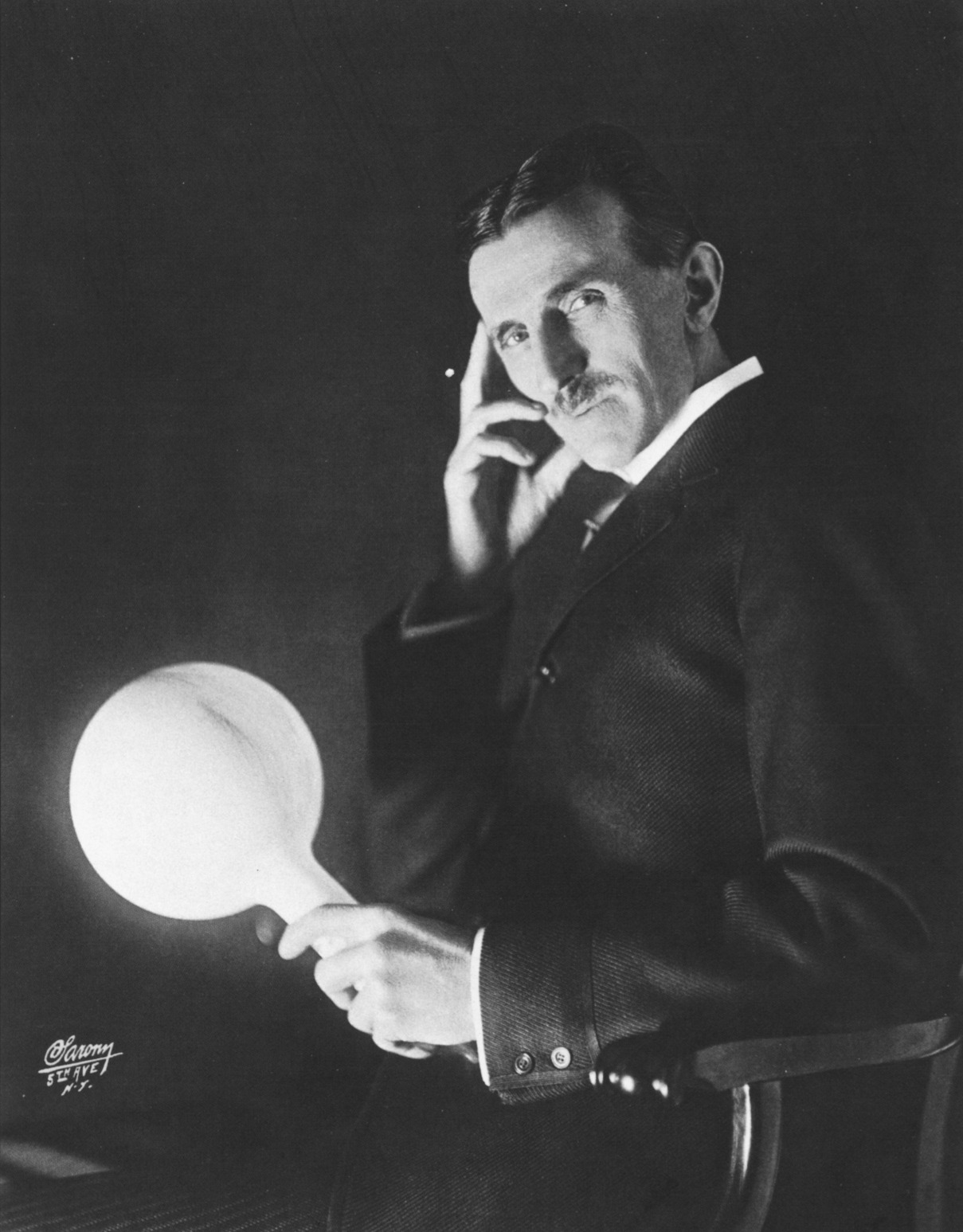
Nikola Tesla holding a wirelessly lit light globe by photographer Napoleon Sarony, 1898. Public Domain. Included with appreciation.

Peter Glaser, in 1973, combined wireless power technology pioneered in 1893 by Nikola Tesla with space competencies demonstrated by the 1969 first human lunar landing. Glaser filed the world’s first patent application for orbiting satellites to collect solar energy and beam it, wirelessly, back to power the entire Earth. Recent advances are now leading to active projects.

NASA, public domain. With appreciation.

Achieving 360 degrees steadily is a milestone reached in a recent demonstration by Space Solar showing space-based wireless power transmission with CASSIOPeiA could achieve 360 degrees in coverage. The plan would be to launch the solar plant to 22,000 miles (36,000 kilometers) above earth in geostationary orbit. It would be assembled in space by robots.

China has announced a solar array as part of its space mission. Some see it as the next step in the massive macro engineering achievements like Three Gorges Dam that has twenty times the generating capacity of the US Hoover Dam. One scientist from the Chinese Academy of Engineering (CAE) said: “It is like relocating Three Gorges Dam to space.” Another comparison? The South China Morning Post called it a “Manhattan Project in space.”The Manhattan Project started with a letter and a train ride. Space Solar will begin with the Long March-9 (CZ-9), a reusable rocket with lift capacity of a blue whale.

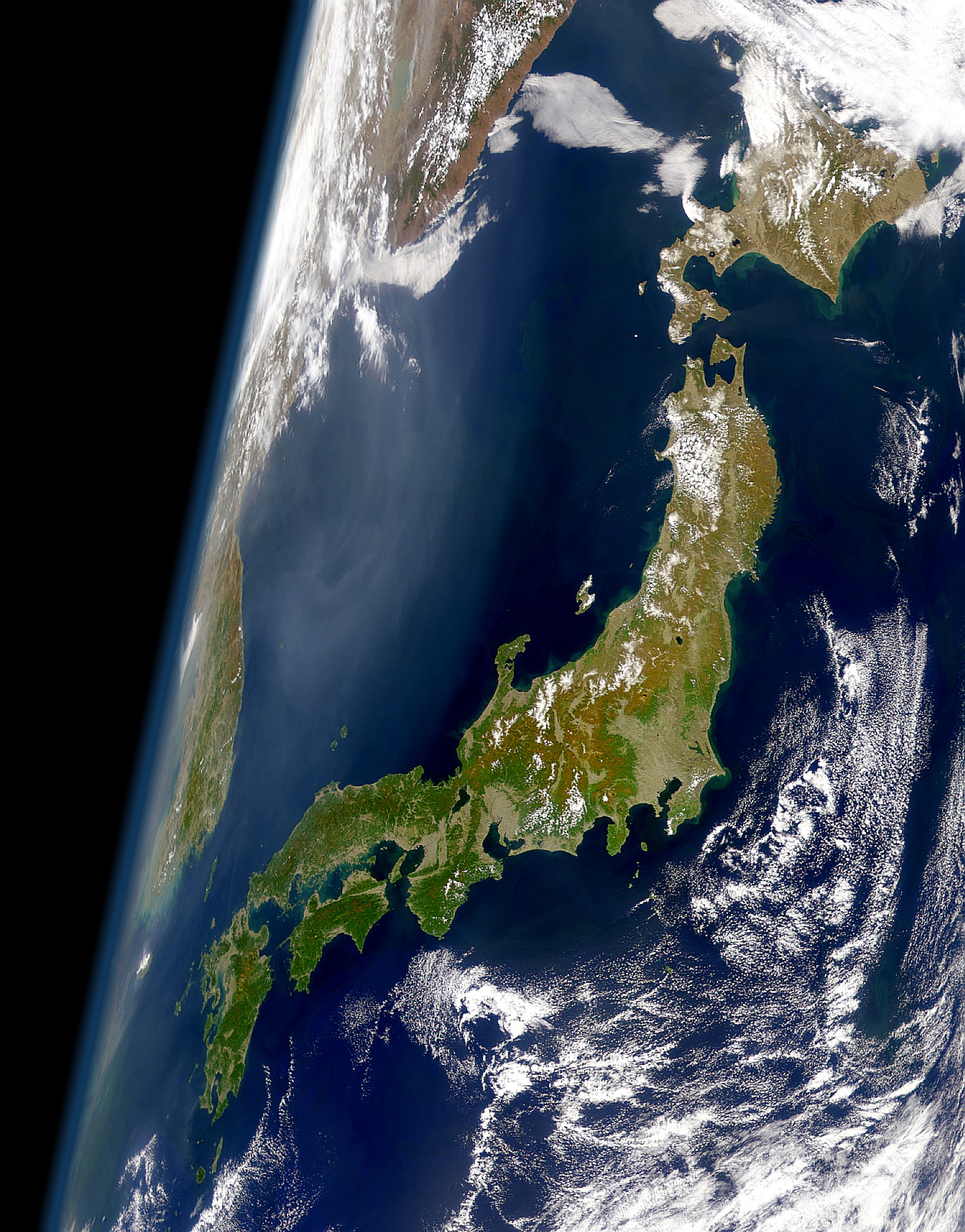
Satellite View of Japan by SeaWiFS, Nasa, 1999. Public Domain, with appreciation.

Japan is advancing in space solar power. Japan Space Systems built a model mini power plant weighing 400 pounds (180 kilograms) to test wireless power transmission from low earth orbit (LEO) of 250 miles (400 kilometers). The Needham question is answered.

Concerns remain. Glaser met with doubts about microwaves affecting health; a generation of satellites, cellphones, and household appliances may provide data. Military weaponization is another worry; nations and states are already establishing military programs. On an operational level, questions about distribution, governance, and management of a global utility are practical issues with profound implications. Would a macro central power supply like that envisioned by Bauer and Costello (1949) or China’s GEI (more recently) be examples? Or perhaps Euratom? If you were to organize a global energy network, how would you mobilize the organization?

Aten, Egyptian Solar Deity by Atonx, 2008. Creative Commons 2.5. Included with appreciation.

Solar power has demonstrated its effectiveness but on land, it will always plagued by intermittency. To meet the gap, co-dependent technologies of battery and other forms of storage are developed. And to develop those, mining for minerals is the first step in a long production line. Space solar power bypasses all the intermittency and storage headaches: it is infinite and continuous. Oh, and free.

Bauer, John and Peter Costello. Public Organization of Electric Power: Conditions, Policies, and Program. New York: Harper, 1949.

Eckstein, Gabriel. “Who Owns the Heat?” December 2024. https://papers.ssrn.com/sol3/papers.cfm?abstract_id=5066007

Frederickson, Emma. “China Is Building a Solar Station in Space That Could Generate Practically Endless Power.” 12 March 2025. Popular Mechanics. https://www.popularmechanics.com/science/energy/a64147503/china-solar-station-space/

Glaser, Peter E., Frank P.  Davidson, Katinka I. Csigi. Solar Power Satellites: A Space Energy System for Earth. Chichester: Wiley/Praxis, 1998. ISBN: 047196817X.

Litwin, George H., John J. Bray, K. Lusk Brooke. Mobilizing the Organization London: Prentice Hall, 1996. ISBN: 0131488910

Pultarova, Tereza.”Japanese satellite will beam solar power to Earth in 2025.” 19 April 2025. Space. https://www.space.com/japan-space-based-solar-power-demonstration-2025

Pultarova, Tereza. “Space-based solar power may be one step closer to reality, thanks to this key test (video)” 15 April 2024. Space. https://www.space.com/space-based-solar-power-technology-demonstration

Building the World Blog by Kathleen Lusk Brooke and Zoe G. Quinn is licensed under a Creative Commons Attribution-NonCommercial-NoDerivs 3.0 U

SPACE: Critical Minerals – Land, Sea…or Space

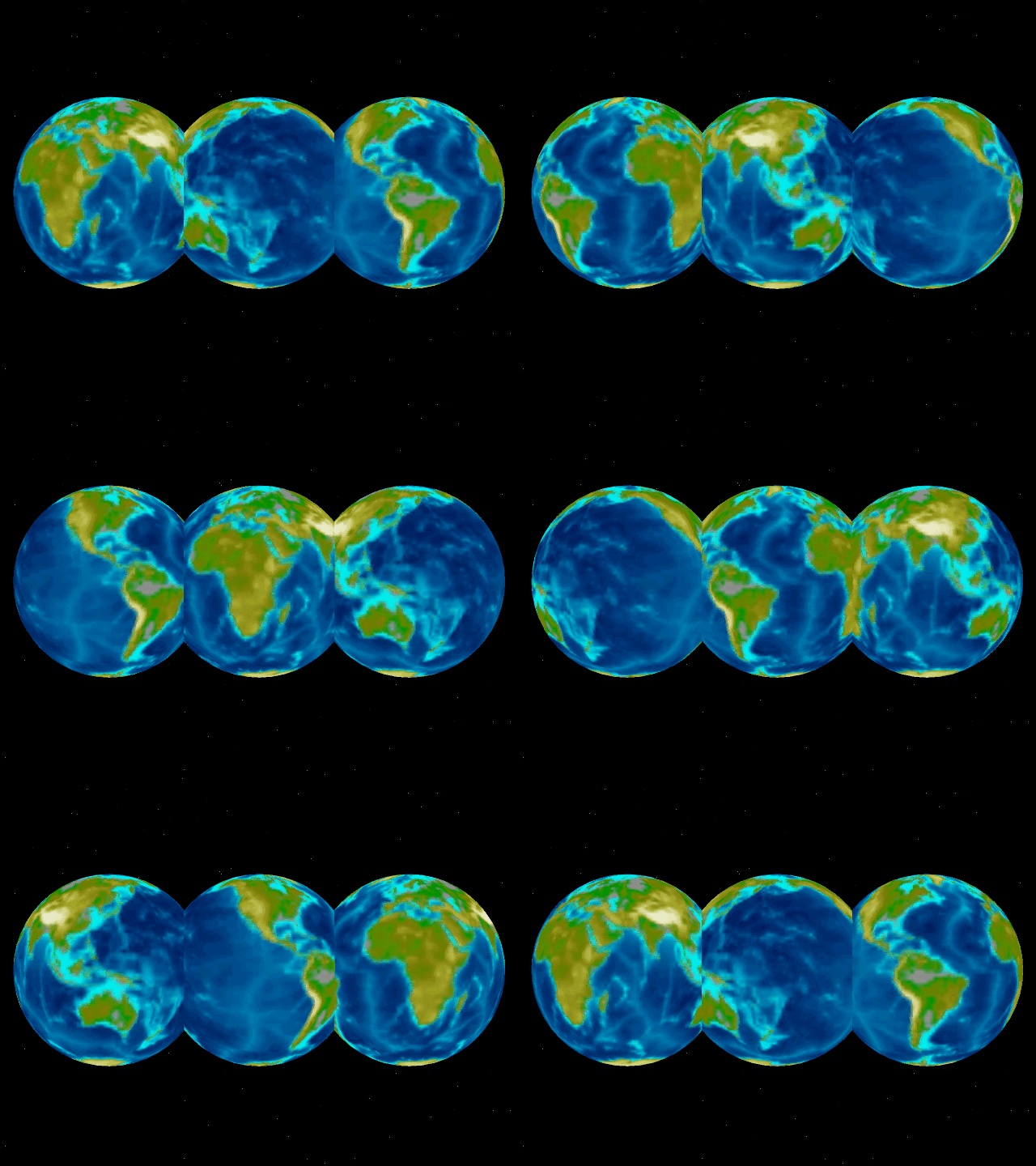
Land, sea, or space – where is the best place to mine critical minerals? Image: “Three Globes” by Alex Carmona, 2001. Public Domain, with appreciation.

Land, Sea, or Space – the search for critical minerals has increased in importance, and value, with the advent of renewable energy technologies requiring mineral-dependent battery storage. This week, Ukraine and the United States were about to finalize a deal for access to Ukraine’s critical minerals as spoils of war, with an unclear promise of protection stating “we’ll be looking to future security later on” (Butenko 2025). Ukraine holds about 5% of the planet’s land-based critical minerals including 19 million tonnes of graphite, essential for batteries powering electric vehicles, as well as one-third of all European deposits of lithium, another battery essential. It should be noted that Ukraine’s President Zelensky opened up the topic for discussion several months ago when the US administration appeared to be swinging into a more transactional stance; the deal appears to be in question, following a meeting on 28 February 2025. World Economic Forum reports Ukraine has 20,000 mineral deposit sites with only 15% yet tapped.

There are three places where minerals and metals can be obtained: land, sea, and – now – space. All three have problems, and potential, but some say space mining may be the least destructive.

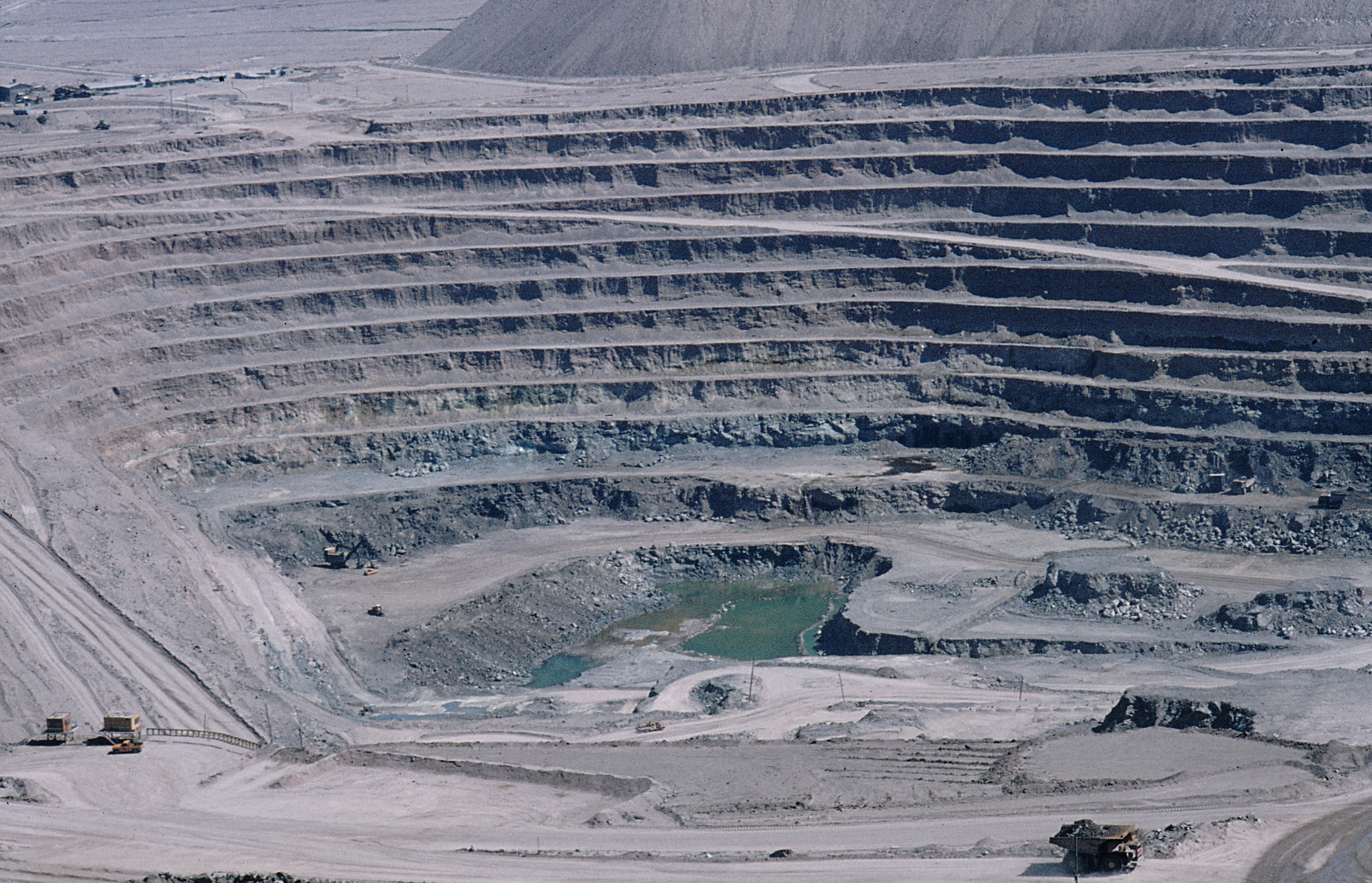
Chuquicamata mine, Chile: largest open pit copper mine in the world. Photograph by Diego Delso, 2016. CC by- SA. With appreciation.

Land mining for minerals like cobalt or copper, for example, inflicts environmental damage, affects First Nation or Indigenous people on whose land such mining often occurs, and adversely influences public health. In some mining areas, like the Democratic Republic of Congo, human rights violations are a concerning problem.

Seabed mining would cause yet-unknown destruction to the marine environment. Print of sea anemone (Actiniaria) by Giacomo Merculiano, 1893. Pubic Domain, with appreciation.

Seabed mining may pose even greater environmental damage. Mining always involves explosives and massive disruption. It’s bad enough on land, but what will happen when explosions and digging by autonomous robotic bulldozers hack open the deep seabed’s polymetallic nodules to harvest cobalt, nickel, and other critical minerals? How far will ocean current carry and spread debris? And, which victor would own the spoils? The United Nations Convention on the Law of the Sea (UNCLOS) assigns the right to exploit mineral resources only to a set point for coastal nations. Everything beyond 200 nautical miles belongs to everyone: it is the blue commons. Managed by the International Seabed Authority (ISA), seabed mining is advancing: contracts moving from exploration to exploitation are in development. There is cause for concern. So, if land and seabed pose environmental, economic, health, and political problems, what’s left? Look up.

Asteroids contain an abundance of critical minerals: advocates of space mining point out that no environmental damage to (known) habitat would occur. Image: “Comparative sizes of eight asteroids by NASA, JPL-Caltech/JAXA/ESA. 2011. Public Domain with appreciation.

Space mining may offer access to critical minerals without disturbing land, or sea. Asteroids contain an abundance of cobalt, copper, graphite, iron, nickel, platinum, and rare earth elements, among others. Japan’s space agency JAXA recently obtained asteroid samples for analysis. China will launch Tianwen-2 to explore asteroid 2016HO3, and then visit the asteroid belt between Mars and Jupiter. United Arab Emirates plans a similar trip in 2028. NASA in the US scooped material from Bennu and will visit Psyche in 2029 to sample the metals worth $10,000 quadrillion – more than the entire global economy.

OSIRIS-REx was the first US spacecraft to return samples from an asteroid. Image: NASA, 2011. Public domain, with appreciation.

While governments have resources for launches and collections (it cost NASA’s OSIRIS-REx, Asteroid Sample Return Mission, $800 million), private enterprise may play a role. Early entrant Planetary Resources failed to launch, as did Deep Space Industries. New companies like US-based TransAstra and China’s Origin Space are developing space mining. But the first place runner may be AstroForge. Founded by Jose Acain and Matt Gialich, the company’s strategy is to launch a patented mini-refinery that can perform mineral extraction while in space, and return to Earth only the valuable material from metallic (M-type) asteroids. Set for launch from NASA’s Kennedy Space Center on a SpaceX Falcon 9, AstroForge’s “Odin” will travel to Asteroid 2022 OB5, about 403,000 miles (649,000 kilometers) from Earth to examine what is expected to be a M-type asteroid rich with platinum.

Asteroids identified by NASA’s Near-Earth Objects search: now over 18,000 with a discovery rate of 40 more per week. Image: NASA/JPL-Caltech, 2018. Public domain with appreciation.

Which is preferable: mining critical minerals from land, sea, or space? The first two surely have environmental and political problems. The third may cause space debris, a different kind of environmental issue. But, as space policy attorney Paul  Stimers observed: “We are removing a rock from something that has no life, no ecology, no indigenous people – none of the downsides of traditional mining.” Legal concerns involve law firms like Stimer’s Holland & Knight or the Duchy of Luxembourg where many space exploration private companies register. Global legal frameworks are spare. The Outer Space Treaty of 1967 mentions only countries, but not private enterprise. The Convention on International Liability for Damage caused by Space Objects, implemented in 1972 , considers space debris. But who owns asteroids? Apparently, anyone who can get there – and back.

Abdurasulov, Abdujalil and Robert Plummer. “What minerals does Ukraine have and what are they used for?” 26 February 2025. BBC. https://www.bbc.com/news/articles/c20le8jn282o

AstroForge. https://www.astroforge.com

Brooke, K. Lusk. “Renewing Minerals – New Energy Paradigm.” Building the World Blog. https://blogs.umb.edu/buildingtheworld/year-2024-renewing-minerals-new-energy-paradigm/

Brooke, K. Lusk. “Speedo Diplomacy and Buried Treasure: Deep Sea Mining and Marine Protected Areas.” Renewing the World: Casebook for Leadership in Water. 2024. ISBN: 979-8-985035957. https://renewingtheworld.com

Brooke, K. Lusk. “SPACE: Bienvenu, Bennu – Rock Star.” 23 September 2023. https://blogs.umb.edu/buildingtheworld/2023/09/25/space-bienvenu-bennu-rock-star/

Butenko, Victoria, Nick Paton Walsh, and Gul Tuysuz. “US and Ukraine agree to terms on natural resources and reconstruction deal, Ukrainian official says.” 26 February 2025. CNN. https://cnn.com/2025/02/25/europe/us-ukraine-resources-reconstruction-deal-intl-latam/index.html

Gunia, Amy. “Minerals are in short supply on Earth. This startup wants to mine asteroids.” 23 April 2024. CNN. https://www.cnn.com/world/astroforge-asteroid-mining-nasa-spc-scn?

Holland & Knight. https://www.hklaw.com

NASA. “OSIRIS-REx, Asteroid Sample Return Mission.” 2016. https://www.nasa.gov/wp-content/uploads/2016/06/0siris-rex_press_kit_0.pdf

Saltman, Max, Katharina Krebs, and Matthew Chance. “Russia says it’s open to economic cooperation with US on rare earth minerals and energy.” 24 February 2025. https://www.cnn.com/2025/02/24/europe/putin-russia-us-cooperation-economy-rare-earths-intl-latam?

United Nations. Office for Outer Space Affairs. “Convention on International Liability for Damage Caused by Space Objects.” 1972. http://www.unoosa.org/oosa/en/ourwork/spacelaw/treaties/introliability-convention.html

United Nations. “Treaty on Principles Governing the Activities of States in the Exploration and Use of Outer Space, Including the Moon and Other Celestial Bodies.” 1967. https://2009-2017.state.gov/t/isn/5181.htm

Wattles, Jackie. “A tiny spacecraft is poised to launch on an unprecedented deep-space mission.” 25 February 2025. CNN. https://www.cnn.com/2025/02/25/science/astroforge-asteroid-mining-spacex-launch?

Xinhua. “China to launch Tianwen-2 mission to explore asteroid.” 25 April 2023. CNSA. https://www.cnsa.gov.cn/english/n6465652/n6465653/c10003702/content.html

Building the World Blog by Kathleen Lusk Brooke and Zoe G. Quinn is licensed under a Creative Commons Attribution-NonCommercial-NoDerivs 3.0 U

ENERGY: If Walls Could Talk

Technology may give us walls that talk, and charge our phones at the same time. Image: “Talking Walls of Shtula Village” by Zeller Zalmanson, Pikiwiki Israel project. Creative Commons 2.5. Included with appreciation.

Nikola Telsa was there first; Peter Glaser, next. Telsa was sending wireless power from Niagara Falls; Glaser, from space to earth. Now, technology might free your mobile phone from battery recharging when you are in a wi-fi zone. And the walls of your office or school could tell a tale or two.

London Bridge Tube Station in England has wifi; so does British Rail. Image: Boston’s Zakim Bridge. Photography by Eric Vance, US EPA. Public Domain. Included with appreciation.

It’s more than just a personal device. The rectenna converts AC electromagnetic waves into DC electricity. New MIT-designed rectennae could stretch across highways or bridges, making it possible to report all manner of developments while recharging an array of options. The technology, developed by Professor Tomás Palacios of MIT/MTL Center for Graphene Devices and 2D Systems in the Microsystems Technology Laboratories (MIT-CG), might extend the internet of things. Partners in the project include Technical University of Madrid, Boston University, and other institutions and research labs.

Intestinal walls can talk too, via capsule endoscopy. Image: Dr. H.H. Krause, 2013. Creative Commons 3.0. Included with appreciation.

Another application? A medical device you may happen to wear like an insulin pump, watchman, or pacemaker, or even a diagnostic “pill or capsule” that patients swallow to circulate internally and report data. Such pills cannot be powered by batteries lest lithium might leak toxins. Developments at MIT’s Medical Electronic Device Realization Center (MEDRC) may advance the information-driven healthcare sector.

Miniaturization of communications technology may have begun with the NASA Apollo lunar missions. Image: “Surveyor 3 – Apollo 12,” NASA. Public Domain. Included with appreciation.

Where did the miniaturization trend begin? Many trace miniaturization communications technology to the early days of the US Apollo space mission; the capability proved to have uses on earth, too.

Charge your phone from ambient wifi? “A cell phone” by Pixabay, 2015. Creative Commons0 1.0. Included with appreciation.

At the beach?  Visit the coffee kiosk where wifi might charge your phone. Even whole cities are going live: Philadelphia declared it would be the first municipal wifi network in 2004: the vision is still to be completed. Offices have wifi; so do airports, hospital lobbies, schools. It’s a two-way proposition: charging and also data-collecting. Now, wi-fi harvesting devices could give new meaning to the phrase: “If walls could talk.”

Glaser, Peter. “Method and Apparatus for Converting Solar Radiation to Electrical Power.” US Patent 3,781,647. 1973.

Matheson, Rob. “Converting Wi-Fi-signals o electricity with new 2-D materials.” 28 January 2019. MIT News Office. https://news.mit.edu/2019/converting-wi-fi-signals-electricity-0128

Zhang, Xu, et al., “Two-dimensional MoS2 enabled flexible rectenna for Wi-Fi-band wireless energy harvesting.” 28 January 2019. Nature 566, pages 368-372. https://www.nature.com/articles/s41586-019-0892-1


ENERGY: Does Life Blush?


Does life blush? Pink may be the color of nascent energy. Image: “Storm in Tuscon,” by photographer Emascandam, 2018. Creative commons 4.0. Included with appreciation.

Does life blush? Pink may be the color of nascent energy.

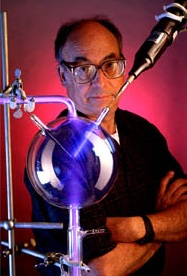
Stanley Miller, in 1951, came to the University of Chicago to study with nuclear physicist Edward Teller who had worked on the Manhattan Project, and later established Lawrence Livermore National Laboratory (where recent success in fusion energy was achieved). While Teller’s student, Miller attended a lecture by Harold Urey, Nobel Laureate in Chemistry, on the Oparin-Haldane hypothesis, on the possible origin of organic life from inorganic compounds. After the lecture, Miller approached Urey with an idea for an experiment to test the hypothesis. Urey was skeptical – no one had ever proven the mystery of how life began – but intrigued. The professor granted Miller one year of funding.

Stanley Miller in 1999. Image courtesy of NASA. Public Domain. Included with appreciation.

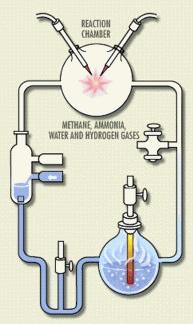
Using water (H2O), methane (CH4), ammonia (NH2), and hydrogen (H2) in a mixture – and stimulating them with an electric arc that acted like lightning to produce fast intense heat and then applying a condenser to cool – Miller repeated alternation of heat and cold to see what might happen. The mix of components has the acronym WHAM (water, hydrogen, ammonia, methane).

“Miller-Urey Experiment” by NASA. ImageP public domain. Included with appreciation.

Soon, water droplets began to form and then a watery solution dripped into what started to look like a tiny pond. Miller left the lab for the night. The next day, he awakened with curiosity and dashed to the lab. The pond was now turning color – a pale pink. Encouraged, he ran to tell Urey. The two watched and waited. In a week, the pink pond turned a reddish brownish black. What was happening?

Miller’s experiment turned pink. Examination revealed the presence of amino acids, building blocks of organic life. Image: TBurnArts, 2016. Creative Commons 4.0. Included with appreciation.

Miller identified five amino acids that had formed: aspartic acid, glycine, a-aminobutyric acid and two forms of analine (Australian Earth Science Foundation, 2024). This was significant because previous to that moment, all of science avowed that amino acids, molecules of life, could only be built inside living bodies. That belief was traditionally expressed in the phrase Omne vivum ex vivo (All life comes from living things). But now living energy had appeared from inorganic compounds in Miller’s lab.  “Primordial soup” – the parlance given to Oparin/Haldane’s hypothesis and picked up by Miller/Urey – was now served. And it was pink.

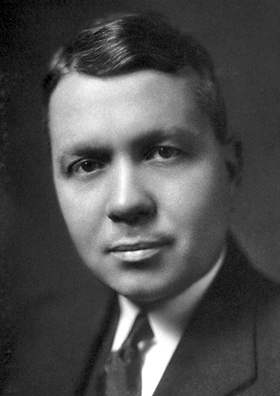
Nobel Prize Laureate Harold Urey in 1934. Later, a crater on the Moon was named for him: Urey Crater. Image: Nobel Foundation, public domain. Included with appreciation.

Professor Harold Urey urged Miler to publish the findings but refused to put his name on the paper for two reasons. First, the idea and experiment was totally Miller’s and the professor was just the verifier. And, Urey worried – with reason – that the journal editors would give him all the credit because of his Nobel status. As predicted, the journal turned down the paper. But Urey wrote them a very clear note about Miller, attached his name as verifier, and they immediately published the findings. Eventually, the experiment became known as Miller-Urey. Harold Urey is also known from discovering deuterium, an isotope of hydrogen, and the process of enriching uranium. Later in life, Urey became interested in space, participating in examination of lunar rocks brought back by Apollo NASA astronauts. A crater on the moon is now named Urey Crater.

Last Chance Lake in British Columbia, Canada, has been noted as a candidate for conditions similar to those described by Miller-Urey. Image: ‘British Columbian Lundbom Lake Rogaine” by photographer Murray Foubister, 2011. Creative Commons 2.0. Included with appreciation.

Miller-Urey’s demonstration that organic life can spring from inorganic, under certain conditions, recently made news when scientists noted that Last Chance Lake – a shallow body of water in British Columbia – has the highest concentration of phosphate ever found in any natural pond or body of water on Earth.  Why is this interesting? Phosphate contains phosphorus, a life-related molecule found in DNA, RNA, and, well, life. Last Chance Lake also has dolomite that triggers reactions among calcium, magnesium, and carbonate. In the geology of the volcanic soil around the lake, phosphate may have been part of how life originated. In geological circles, it’s called a “soda lake;” some say it is just the kind that Darwin envisioned when he wrote to his colleague in February 1871 about a hypothetical “warm little pond.” But as Miller-Urey proved, it is the stimulus and alternation of heat energy that sparked those components to organic life in that pond and in the lab.

Alternation of intense heat energy proved to be the spark of organic life, in the Miller-Urey experiment. Image: “Animated lightning” by Kunal Sen and TIsha Pillai, Wikimedia Foundation, 2021. Creative Commons 4.0. Included with appreciation.

Tesla also placed importance on alternating current. But the idea is not new. Tantra, a philosophy arising around 500 ce in India, proposed that “Spanda” (from Sankrit Spadi “to move back and forth, to vibrate”) was the original energetic force that gave forth life.

Image: “Yantra with Om symbol” said to be the vibratory sound of the universe in Tantric philoophy. From photographer Tomoaki Inaba, 2011. Creative Commons 2.0. Included with appreciation.

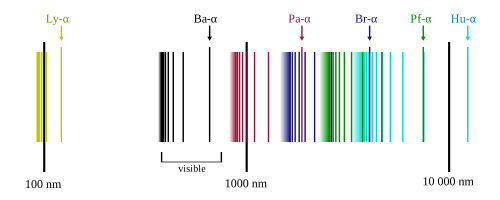
The world’s future depends upon energy in clean, renewable, sustainable forms. Solar, wave and wind (caused by thermal alternation), and advances in fusion energy, may lead the way. Interestingly, plasma fusion energy from hydrogen radiates a series of colors from red to aqua, but when they combine, they often produce pink. (Eurofusion 2024).  What is it about pink?

“Hydrogen spectrum” graphic by OrangeDog. Creative Commons 4.0. Included with appreciation.

Australian Earth Science Foundation. “Origin of Life: Miller-Urey.” https://ausearthed.com.au/wp-content/uploads/2020/06/Origin-of-Life-Miller-Urey-Reading.pdf

Brooke, K. Lusk. “Energy: Darwin’s Big IF and the Oparin-Haldane Hypothesis.” 1 February 2024. https://blogs.umb.edu/buildingtheworld/2024/02/01/energy-darwins-big-if/

Center for Chemical Evolution (CCE). https://centerforchemicalevolution.com

Darling, David. “Oparin-Haldane Theory: Chart on Differences in Theories of Oparin and Haldane” https://www.daviddarling.info/encyclopedia/O/OparinHaldane.html

Eurofusion. “Where does the plasma colour come from?” 2024. https://euro-fusion.org/faq/where-does-the-plasma-colour-come-from/

Forsythe, Jay G., et al., “Ester-Mediated Amide Bond Formation Driven by Wet-Dry Cycles: A Possible Path to Polypeptides on the Prebiotic Earth.” 15 July 2015. Angewandte Chemie, Volume 127, Issue 34, pages 10009-10013. https://onlinelibrary.wiley.com/doi/10.1002/ange.201503792

Gronstal, Aaron. “Origins of life in a drying puddle.” 10 August 2015. National Science Foundation and NASA. https://astrobiology.nasa.gov/news/origins-of-life-in-a-drying-puddle/

Horn-Muller, Ayurella. “A shallow lake in Canada could point to the origin of life on Earth.” 17 February 2024. CNN. https://www.cnn.com/2024/02/17/world/last-chance-lake-origin-of-life-phosphate-scn?cid=ios_app

Mitnick, Michael. “The Current War.” Film starring Benedict Cumberbatch as Thomas Edison, Nicholas Hoult as Nikola Tesla, and Michael Shannon at George Westinghouse. Premiered 2017. https://www.imdb.com/title/tt2140507

National Institute of Standards and Technology (NIST). “Atomic Spectra Database.” Version 5.11, December 2023. https://www.nist.gov/pml/atomic-spectra-database

Stated Clearly. Narrated by Jon Perry. “What was the Miller-Urey Experiment?” Center for Chemical Evolution, National Science Foundation, and NASA.  https://youtu.be/NNijmxsKGbc?si=iHSgQ0wK5ZoHP_g

Thomas, Jeremy. “Igniting the Future.” 15 May 2023. Lawrence Livermore National Laboratory (LLNL). https://www.llnl.gov/article/49786/igniting-future-hundreds-gather-celebrate-historic-fusion-achievement

Building the World Blog by Kathleen Lusk Brooke and Zoe G. Quinn is licensed under a Creative Commons Attribution-NonCommercial-NoDerivs 3.0 U

TRANSPORT: Super Bowl Sustainability

“Taylor Swift at 2023 MTV Video Music Awards,” image by iHeartRadioCa. Creative Commons 3.0. Included with appreciation.

Taylor Swift hopes to attend the Super Bowl in Las Vegas but must take a private jet from Japan where she is on tour. Her fans, “Swifties,” quip that the superstar’s flight finally forced a certain news network to actually mention the words: “climate change.” Swift’s previous attendance at the AFC championship game in January resulted in three tons of carbon emissions – and that flight was just from New Jersey to Maryland. Flying over 5,000 miles will require a lot more jet fuel, and result in even more emissions. Joining her plane circling Las Vegas will be an estimated 1000 private jets. Swift is flying to see her boyfriend Travis Kelce of the Kansas City Chiefs play versus the San Francisco 49ers in the football contest.

“Cole Hollcomb and Travis Kelce football in action” All-Pro Reels 2021. https://www.flickr.com/photos/joeglo/51616124289/

Sports fans with private planes are not the only winged emitters. World Economic Forum attendees jetted into Davos, Switzerland in over 1,000 private jets. That’s the same emissions that would be generated by 350,000 cars driving for seven days. Worldwide, in 2022, private jets emitted carbon dioxide totaling 573,000 metric tons.

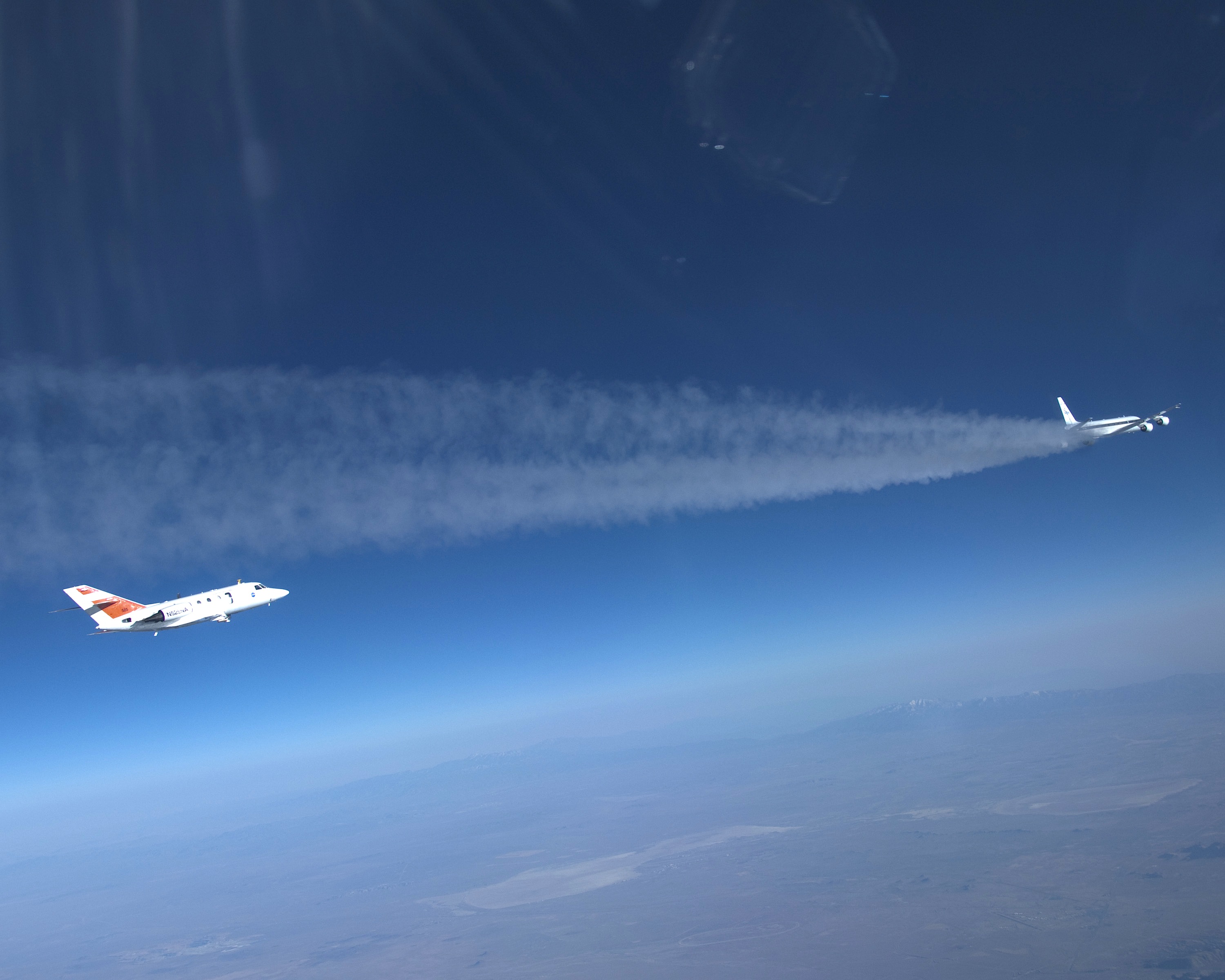
Can we improve aviation emissions? Image: NASA, 2013. Public Domain. Creative commons. Included with appreciation.

Commercial aircraft emit carbon dioxide reaching levels of 1 billion tons every year. That is more that the entire country of Germany. If aviation were a country, it would come just after China, USA, India, Russia, and Japan in emissions levels.

“Dutch Roll” animation graphic by Pacascho, 2021. Public Domain. Included with appreciation.

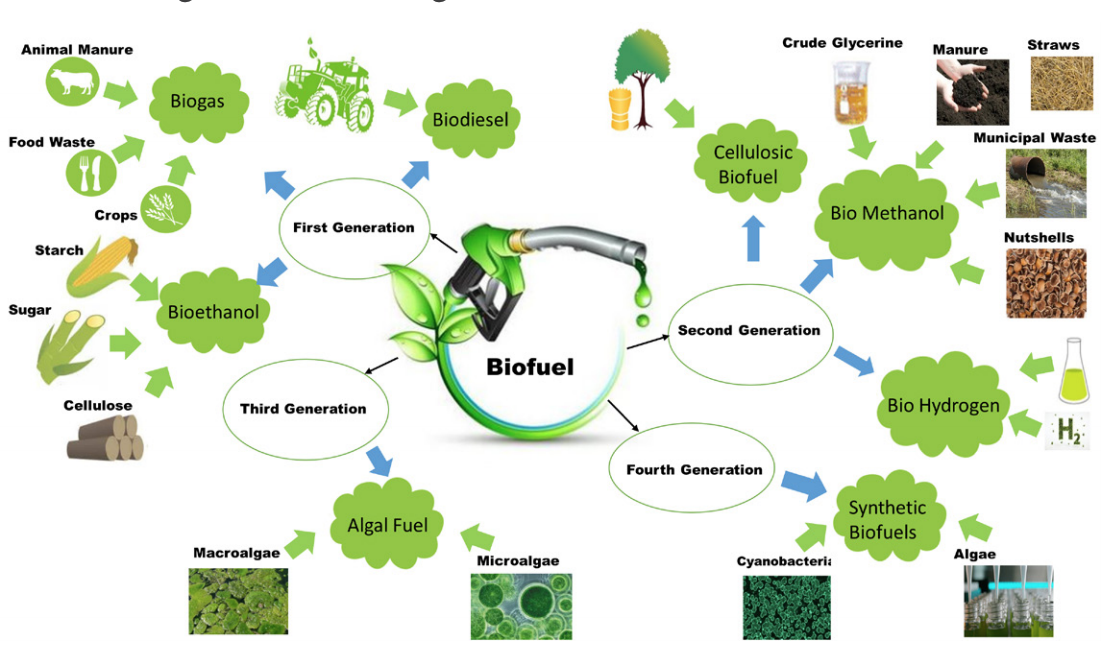
Is there a solution? How about flying on leftover sugar, fat, and corn waste? Sustainable Aviation Fuel (SAF) made from biofuels produced from renewable crops or collected waste offers advantages. SAF produces 85% less emissions over its lifecycle. And, importantly, SAF can use the same delivery infrastructure and personnel systems as traditional kerosene-based jet fuel. In 2021, United Airlines flew from Chicago to Washington, DC, using 100% SAF in one of its jet engines. In 2023, Emirates claimed the honor of being the first aircraft to fly an Airbus A380 using 100% SAFs in one of the plane’s engines. Virgin Atlantic’s Boeing 787 flew from London to New York. Gulfstream led private aviation in a flight from Savannah, George to Farnborough Airport in England using 100% SAF.

“Types and Generation of Biofuels,” by Muhammad Rizwan Javed, et al., 2019. Creative Commons 4.0. Included with appreciation.

Leading innovators producing Sustainable Aviation Fuel include Engine Alliance, Neste, Pratt & Whitney, and Virent. Investors are interested. But it should be noted that growing enough crops for biofuels in the UK would consume one half of all available agricultural land.

Logo: Brightline West Logo, 2023. Public Domain. Included with appreciation.

In 2028, stars attending Las Vegas festivities might change the game by riding the coming high-speed electric train Brightline West that will run from Los Angeles to Las Vegas in two hours with almost zero emissions.

Las Vegas – bright lights, bright future. Image: “Fremont Street, Las Vegas, 2010,” by User: Jean-Cristophe Benoit, 2010. Creative Commons 3.0. Included with appreciation.

Brooke, K. Lusk. “TRANSPORT: New ‘Wingprint’ for Aviation.” 29 November 2023. Building the World Blog.

Department of Energy (DOE), United States. “Sustainable Aviation Fuel.” https://afdc.energy.gov/fuels/sustainable_aviation_fuel.html

Narciso, Gerald. “It’s a big weekend for football. And for fancy jets.” 7 February 2024. The New York Times. https://www.nytimes.com/2024/02/07/climate/super-bowl-private-jets.html

One Monroe Aerospace. “Why airplanes use kerosene rather than plain gasoline for fuel.” 29 April 2023. https://monroeaerospace.com/blog/why-airplanes-use-kerosene-rather-than-plain-gasoline-for-fuel/


WATER/SPACE: New Year’s Eve Invitation

“New Year’s Eve” celebration by videographer Cemp, 2019. Creative commons 3.0. Included with appreciation.

New Year’s Eve is often celebrated by popping a cork, releasing bubbles of hope for health and happiness. This year, cork your name into a bottle, sending your greetings and wishes into the future. Who knows who might pop the cork?

Europa, one of Jupiter’s moons, is a watery world that may support life. Image: European Space Agency (ESA) Hubble, 2016. Included with appreciation.

NASA‘s Europa Clipper spacecraft, traveling 1.8 billion miles (2.6 billion kilometers), will visit Europa, a moon of Jupiter. Evidence reveals a water world there that may support life. Arriving on the shore, in a very high-tech bottle, could be your name and a message.

“A bottle containing a sheet of music that has washed up on shore.” Image: snapwire, 2017. Dedicated by the photographer to the public domain. Included with appreciation.

This message will be from one water world to another. Ada Limón, U.S. Poet Laureate, whose “In Praise of Mystery: A Poem for Europa” will grace the gift, has written this poem:

In Praise of Mystery: A Poem for Europa by Ada Limón

Arching under the night sky inky

with black expansiveness, we point

to the planets we know, we

pin quick wishes on stars. From earth,

we read the sky as if it is an unerring book

of the universe, expert and evident.

Still, there are mysteries below our sky:

the whale song, the songbird singing

its call in the bough of a wind-shaken tree.

We are creatures of constant awe,

curious at beauty, at leaf and blossom,

at grief and pleasure, sun and shadow.

And it is not darkness that unites us,

not the cold distance of space, but

the offering of water, each drop of rain,

each rivulet, each pulse, each vein,

O second moon, we, too, are made

of water, of vast and beckoning seas.

We, too, are made of wonders, of great

and ordinary loves, of small invisible worlds,

of a need to call out through the dark.

You can listen to the poem, read by Ada Limón, here.

Ada Limón, U.S. Poet Laureate. Photograph of Ada Limón by Christopher Michel, 2019. Included with appreciation.

Would you like to join Ada Limón by adding your name to NASA’s message in the bottle? Names submitted by 31 December 2023 will be etched on a microchip sent to Europa, when NASA launches the mission. To sign your name and send your greetings to the future, click here.

Sign your name on a message sent to Europa. Image: “Fountain pen” by photographer Petar Milošević, 2017. Creative Commons/wikimedia 4.0 license. Included with appreciation to Petar Milošević.

NASA. “Message in a Bottle.” 2023. https://europa.nasa.gov/message-in-a-bottle/sign-on/

Building the World Blog by Kathleen Lusk Brooke and Zoe G. Quinn is licensed under a Creative Commons Attribution-NonCommercial-NoDerivs 3.0 U

ENERGY: (Re)Vision for Coal

Coal-fired power plants, repurposed, may offer great innovation opportunities. Image: “Coal burning” by Diddi4, 2017. Creative Commons CC0. Included with appreciation.

Many are terming COP28 as the “beginning of the end.” While the desired wording of “phasing out” degraded into “transitioning,” still it was the first time directly naming and targeting “fossil fuels in energy systems.”

Of the three primary fossil fuels (coal, oil, natural gas), coal is the most polluting. And it is also very expensive to mine: digging enormous holes in the ground, hauling up heavy materials, crushing, washing, transporting coal to plants that themselves are both expensive to run and in need of repair, replacement, or retirement. More than 80% of U.S. coal plants cost more to keep running than to replace with new forms of energy generation. Regulations will accelerate closings: the 2028 laws concerning protecting drinking water from coal ash and other toxins may make compliance prohibitively costly. Duke Energy announced intention to close 11 coal-fired power facilities earlier than expected, at the same time declaring a move to renewable energy investment.  Georgia Power stated it would close all of its 14 coal plants (by 2035) while pivoting to solar and wind. Peabody Coal, largest private company in the coal business in the world, recently announced investment in solar and storage. (Marcacci, 2022).

Coal is the most polluting of the fossil fuels. Image: “Close up of smoke from coal stack” by John L. Alexandrowicz, 1975, National Archives and Records Administration, USA. Public Domain Creative Commons CC0. Included with appreciation.

Even if soon becoming obsolete in their original purpose, repurposed coal plants offer a valuable asset: they are already wired to the grid. That’s why repurposing rather than decommissioning coal-fired power plants may be a great opportunity. And, it should be noted that repurposing plants will keep jobs, taxes, and revenues in the community. Here’s two examples of advantageous repurposing of coal-fired power plants.

Brayton Point went from coal to wind. Image: “Aerial view of Brayton Point Power Station,” circa 1990, from Massachusetts Department of Environmental Protection. CC2.0. Included with appreciation.

Brayton Point Power Station was once the biggest coal-fired power plant in New England, generating 1600 MW of electrical power for more than half a century. In 2017, the plant closed. One year later, Commercial Development Company, Inc., (CDC) bought what was left and started the process of clean-up, needed demolition, site re-grading, and preparing for a new vision. With 300 acres (121 hectares) on a spacious waterfront with a 34-feet (10 meters) deep water port, the site was advantageous. Brayton Point offered access to the powerful winds of the Atlantic Ocean. When partner Prysmian Group signed on to acquire 47 acres for construction of a subsea cable manufacturing facility, coal-to-wind transition was born with a planned energy capacity of 30GW. Partner Mayflower Wind will also take a role, bringing 1,200 MW to Brayton Point from its wind farms 30 miles (48 kilometers) off island Martha’s Vineyard and 20 miles (32 kilometers) off Nantucket. Brayton Point will serve as a valuable nexus for wind energy because it has legacy grid connections. A National Grid substation will bring power to one million homes. Further benefits are construction jobs (325) and area revenues ($250 million). More opportunities will open for tenants on the newly designed site.

Space Solar Power, wirelessly beamed to Earth, could use retired, repurposed coal-fired power plants as receiving and transmission stations. There are over 8,000 on the planet – offering an instant global distribution network. Caltech demonstrated success in 2023. Image: “Solar Power Satellite Concept” by NASA, 2011. Public domain image included with appreciation.

A powerful possibility is using former coal-fired power plants as land stations to receive and transmit space solar power. In 1971, visionary Peter E. Glaser filed US patent application US00165893A for “Method and apparatus for converting solar radiation to electrical power.” NASA started work on Glaser’s idea, but at the time space technology was not developed sufficiently to realize the potential.  In 2023, the dream became vision with demonstrated proof. Caltech’s Space Solar Power Project (SSPP) and its Microwave Array for Power-transfer Low-orbit Experiment (MAPLE) sent a space solar power prototype into orbit, and wirelessly transmitted to a receiver on Earth – March 3, 2023 was the exact moment. The success was designed by a Caltech team led by Bren Professor of Electrical Engineering and Medical Engineering, co-director of SSPP, Ali Hajimiri. It was with the help of Donald Bren, chair of Irvine Company. Bren had read an article in Popular Science as a young person and never forgot the concept. A series of donations launched the Caltech project. Northrop Grumman also donated. It might be noted that when space-based wireless power arrives on earth, the energy source may need receiving stations. Rather than build a whole new network, repurposed coal-fired plants, already connected to the grid, might stand at the ready to realize a new power system. With over 8,000 coal-fired power plants already in place, coal-fired power plants may be the ideal, already-built, global network for reception and distribution of space solar power.

California Institute of Technology (Caltech). “In a first, Caltech’s space solar power demonstrator wirelessly transmits power in space.” 1 June 2023. Caltech. Includes VIDEO. https://www.caltech.edu/about/news-in-a-first-caltechs-space-solar-power-demonstrator-wirelessly-transmits-power-in-space

Commercial Development Company, Inc. “Case Study: Repurposing New England’s Largest Coal-Fired Power Plant for Offshore Wind Energy.” 2023. https://www.cdcco.com/brayton-point/

Glaser, Peter E. “Method and apparatus for converting solar radiation to electrical power.” 1971. United States Patent application US00165893A. https://patents.google.com/patent/US3781647A/en

Hajimiri, Ali. “How wireless energy from space could power everything.” TED2030. https://go.ted.com/67UN

Marcacci, Silvio. “So much for coal’s rebound – plant closures come roaring back. It’s time to unlock a just transition.” 15 March 2022. Forbes. (Audio available). https://www.forbes.com/sites/energyinnovation/2022/03/15/so-much-for-coals-rebound-plant-closures-come-roaring-back-smart-policy-must-unlock-a-just-transition/

United Nations. Framework Convention on Climate Change. “First Global Stocktake,” 13 December 2023. FCCC/PA/CMA/2023/L.17. https://unfcc.int/sites/default/files/resource/cma2023_L17:adv.pdf

World Bank Group, Energy Sector Management Assistance Program. “Coal plant repurposing for ageing coal fleets in developing countries.” Technical report 016/21. License: Creative Commons 3.0 https://documents1.worldbank.org/curated/en/144181629878602689/pdf/Coal-Plant-Repurposing-for-Ageing-Coal-Fleets-in-Developing-Countries-Technical-Report.pdf

Yale Environment 360. “Canadian Coal-Fired Power Plant Transformed into Solar Farm.” 8 April 2019. Yale E360 Digest. https://e360.yale.edu/digest/canadian-nanticoke-coal-fired-power-plant-transformed-in-solar-farm

Building the World Blog by Kathleen Lusk Brooke and Zoe G. Quinn is licensed under a Creative Commons Attribution-NonCommercial-NoDerivs 3.0 U


SPACE: Bienvenu, Bennu – Rock Star

“Mosaic of images showing Bennu’s rotation.” OSIRIS-REx, NASA, 2018. Public Domain. Included with appreciation.

September – a good month for rock collecting. In September 1999, asteroid 101955 Bennu was first spotted by the collaborative team of NASA, the U.S. Air Force, and MIT’s Lincoln Laboratory, working together under acronym LINEAR.  In addition to Bennu, the consortium discovered 140,00 minor planets, several comets, and some asteroids. A few of these celestial orbiters are potential unwanted visitors to Earth: Bennu could crash into our planet in September 2182. But NASA did not want to wait that long.

OSIRIS-REx, mission logo. By NASA 2011. Public Domain. Included with appreciation.

In 2018, the OSIRIS-REx (Origins, Spectral Interpretation, Resource Identification, and Security – Regolith Explorer) spacecraft launched, aiming for Bennu. It took two years to arrive, and then land on Bennu in October 2020 to collect samples. The landing was brief, called a “pogo stick:” a brief impact to plunge in and grab a sample to be returned to the spacecraft, and eventually to Earth. In September 2023, OSIRIS-REx flew near Earth to release a capsule containing Bennu samples to a landing spot in Utah, USA. The gift was promptly scooped up by a waiting NASA team and carefully loaded onto a special vehicle to bring it to a “clean room” with a continuous supply of nitrogen. Why nitrogen? It’s a gas that does not mingle or interact with most chemicals so keeping the capsule continuously bathed in nitrogen will wash away any earthly contaminants picked up en route and during the Utah landing.

Bennu, like Earth, orbits the sun. Bennu’s year is similar to Earth’s, with a year just 19 days longer than ours. “Animation of Bennu’s orbit around Earth” by graphic artist Phoenix 7777. Creative Commons 4.0. Included with appreciation.

Today, 25 September, the capsule will continue its journey aboard an aircraft headed for the Johnson Space Center in Houston. The gift will be shared: NASA scientists will evaluate samples and distribute them globally to the space community. It should be noted that Bennu is not the first asteroid to be sampled and brought to Earth. In 2010, Japan returned asteroid particles from Itowaka (also identified by LINEAR). A sequel mission visited carbonaceous asteroid Ryugu to collect samples during the Hayabusa2 mission, bringing the collection to Earth in 2020. Ryugu’s specimens were also shared worldwide. Asteroids, now more visible with the James Webb Space Telescope, may be the next chapter in space exploration.

Asteroids, now more visible with the James Webb Space Telescope (JWST), may be the next chapter in space exploration. Image: “Asteroid 6481 Tenzing” by JWST, 2022. Public Domain. Included with appreciation.

Why are asteroids (the word means “star-like”) important? And, why Bennu? Bennu is a carbonaceous asteroid with a diameter of 490 miles (788 kilometers). It’s dotted with boulders, some more than 50 miles (80 kilometers) in span. Of interest is Bennu’s probable possession of water. According to Professor Dante Lauretta of the University of Arizona,  principal mission investigator and also chief scientist for the Peace Satellite Project, water would be the prize. Bennu could be a celestial “filling station” providing water for various uses including the production of hydrogen rocket fuel. While the surface water may evaporate, traces could remain, allowing NASA to assess the amount of water on and in Bennu. In addition to water, Bennu may contain valuable information about the origins of the universe.

Bennu, Egyptian deity, named after the Bennu Falcon that stands as tall as a human. Image: Egyptian papyrus, photographed by Cobrenet, 2007. Public Domain. Included with appreciation.

What’s in a name? Bennu is an Egyptian deity in the form of a bird, often depicted as a heron. The name was the winner in a contest sponsored by the University of Arizona, along with LINEAR and The Planetary Society. It was a global contest, yielding 8,000 entries. The winner, and proud namer of the asteroid, was a third-grader Michael Puzio who attended school in North Carolina, USA. Following Puzio’s theme, NASA has named all of Bennu’s features after birds. The landing site was Nightingale, and a back-up location named Osprey. Interestingly, Japan’s Hayabusa spacecraft was named for a falcon. And, of course, the USA’s first lunar lander of Apollo 11 was called Eagle.

Apollo 11’s Lunar Lander was named “Eagle.” Image: “Animated eagle” by Rovsen.vahabov, 2017. Creative Commons 4.0. Included with appreciation.

Do you think naming space – celestial bodies as well as exploration missions and vehicles – should be open to the world’s students and citizen scientists? What would you name the next asteroid to be explored?

What would you name the next asteroid to be explored? Graphic by Eviatar Bach, 2011. Public Domain. Included with appreciation.

Bartels, Meghan. “Touchdown! Incredible Photos Show 2nd Asteroid Landing by Japan’s Hayabusa1.” 11 July 2019. Space.com. https://www.space.com/incredible-asteroid-n

Brooke, K. Lusk. “SPACE: Hayabusa Touchdown on Ryugu.” 21 September 2018. https://blogs.umb.edu/buildingtheworld/2018/09/21/space-hayabusa-touchdown-on-ryugu/

Fox, Karen, Alana Johnson, Rani Gran, Rob Garner. “NASA’s First Asteroid Sample Has Landed, Now Secure in Clean Room.” 24 September 2023. NASA. https://www.nasa.gob/press-release/nasa-s-first-asteroid-sample-has-landed-now-secure-in-clean-room

Lauretta, Dante S., et al., “OSIRIS-REx: Sample Return from Asteroid (101955) Bennu.” 22 February 2017. Space Science Reviews, Volume 212, Issue 1-2, pages 925-964. https://link.springer.com/article/10.1007/s11214-01700405-1

Wall, Mike. “9-Year-Old Names Asteroid ‘Bennu’ for NASA Mission.” 1 May 2013. Space.com. https://www.space.com/20923-nine-year-old-names-asteroid.html

Building the World Blog by Kathleen Lusk Brooke and Zoe G. Quinn is licensed under a Creative Commons Attribution-NonCommercial-NoDerivs 3.0 U