SPACE: What is the Next Step?

Earth and Moon, NASA. Public domain.

On 20 July, in 1969, the first human to set foot upon the moon proclaimed the achievement was: “One small step for a person, one giant leap for humankind.” Since the Nasa Apollo lunar landing, advances in space have accelerated.

July 20, 1969: Buzz Aldrin standing on the moon. NASA, Apollo 11. 1969. Public domain.

Six moon landings were completed by the US between 1969 and 1972. Russia deployed the first extraterrestrial rovers up until 1976. Since then, the moon has been visited by China, European Space Agency (ESA), India, Israel, Italy, Luxembourg, Pakistan, Russia, South Korea, and the United Arab Emirates.

India’s Chandrayaan Landing Sites on the moon. Did you know the Sanskrit/Hindi word for moon is Chandra? Image by Footy2000, from Lunar Reconnaissance Orbiter data, 2023. Creative Commons 3.0.

While the Outer Space Treaty prohibits countries from proclaiming ownership of the moon, or other celestial bodies, private enterprise is not forbidden. At the time the Outer Space Treaty was developed, it was thought that no commercial company could ever amass needed funding, staff, and technology. But now, governments are partnering with businesses to explore – and exploit – lunar assets.

Image of the moon illustrating the various minerals located in the lunar northern hemisphere. NASA, Galileo project. Public Domain.

The moon contains water ice (useful for rocket fuel from hydrogen), helium-3 (useful for fusion reactors), and critical minerals including rare earths. There are also deposits of aluminum, calcium, manganese, magnesium, and titanium, as well as iron and silicon.

Flag of the United Nations (UN). Image: UN, public domain.

Agreements since the UN’s Outer Space Treaty (1967) further defined and regulated lunar assets. The 1972 Convention on International Liability for Damage caused by Space Objects, and the 1979 Agreement Governing the Activities of States on the Moon and Other Celestial Bodies may influence lunar activities.

Ocean seabed mining is now under review by the International Seabed Authority. Environmental damage could be severe. Image: “Sea Anemones” by Giacomo Merculiano, 1893. Public Domain.

During this time of demand for critical minerals, humans are beginning to look beyond traditional land. The International Seabed Authority (ISA) is considering whether to permit ocean mining: environmental damage could be severe. Would the moon be safer? What about space debris?  ISA decisions might affect space mining: ocean and space are the commons that belong to everyone.

Space mining and lunar harvesting are possible. But would they be a small step, or a giant misstep? Image: Space mining painting by Denise Watt, 1977, Ames Research Center (ARC) 1977. NASA image: S78-27139. Public Domain.

What do you think about space mining? Who owns the assets? What environmental and other aspects might need guidelines? Should the world’s governing organizations like the United Nations further define rights for space?

Brooke, K. Lusk. “Mining for Critical Minerals: Land, Sea, or Space? ” 27 February 2025. Building the World Blog. https://blogs.umb.edu/buildingtheworld/2025/02/27/energy-critical-minerals-land-sea-or-space/

Koch, Jonathan Sydney. “Institutional Framework for the Province of all Mankind: Lessons from the International Seabed Authority for the Governance of Commercial Space Mining,” 2008, Astropolitics 16: 1, pages 1-27. https://www.tandfronline.com/doi/full/10.1080/14777622.2017.1381824

International Seabed Authority. https://www.isa.org.jm

United Nations. “Outer Space Treaty.” 1967. https://www.unoosa.org/oosa/en/ourwork/spacelaw/treaties/introouterspacetreaty.html

United Nations. “Convention on International Liability for Damage Caused by Space Objects.” 1972. https://www.unoosa.org/oosa/en/ourwork/spacelaw/treaties/introliability-convention.html

United Nations. “Moon Treaty.” 1979. https://www.unoosa.org/oosa/ourwork/spacelaw/treaties/intromoon-agreement.html

Building the World Blog by Kathleen Lusk Brooke and Zoe G. Quinn is licensed under a Creative Commons Attribution-NonCommercial-NoDerivs 3.0 U

Sunny Forecast?

“Sun mask of Apollo” by Johann Melchior Dinglinger. Source: Google Cultural institute, and wikimedia commons.

Solar technology continues to develop, and scientists are once again looking at the Sahara Desert for opportunities to generate, store, and distribute power. African visions are diverse, regarding Desertec (which some term green exploitation) and related initiatives that hold promise. Will other sunny desert areas of the world follow suit? Solar power is the preferred means of providing electricity in space, including celestial habitations such as the International Space Station. Will proposals for global solar power from space be developed in the vision of Glaser, holder of patent US3781647 A? Or might atomic energy developments, including ITER, create sun on earth with nuclear fusion? United Nations Climate Change conference, COP21, set standards for a balanced environment. What advances in energy are needed to build a better world?

Building the World Blog by Kathleen Lusk Brooke and Zoe G Quinn is licensed under a Creative Commons Attribution-NonCommercial-NoDerivs 3.0 Unported License

Round Trip Success

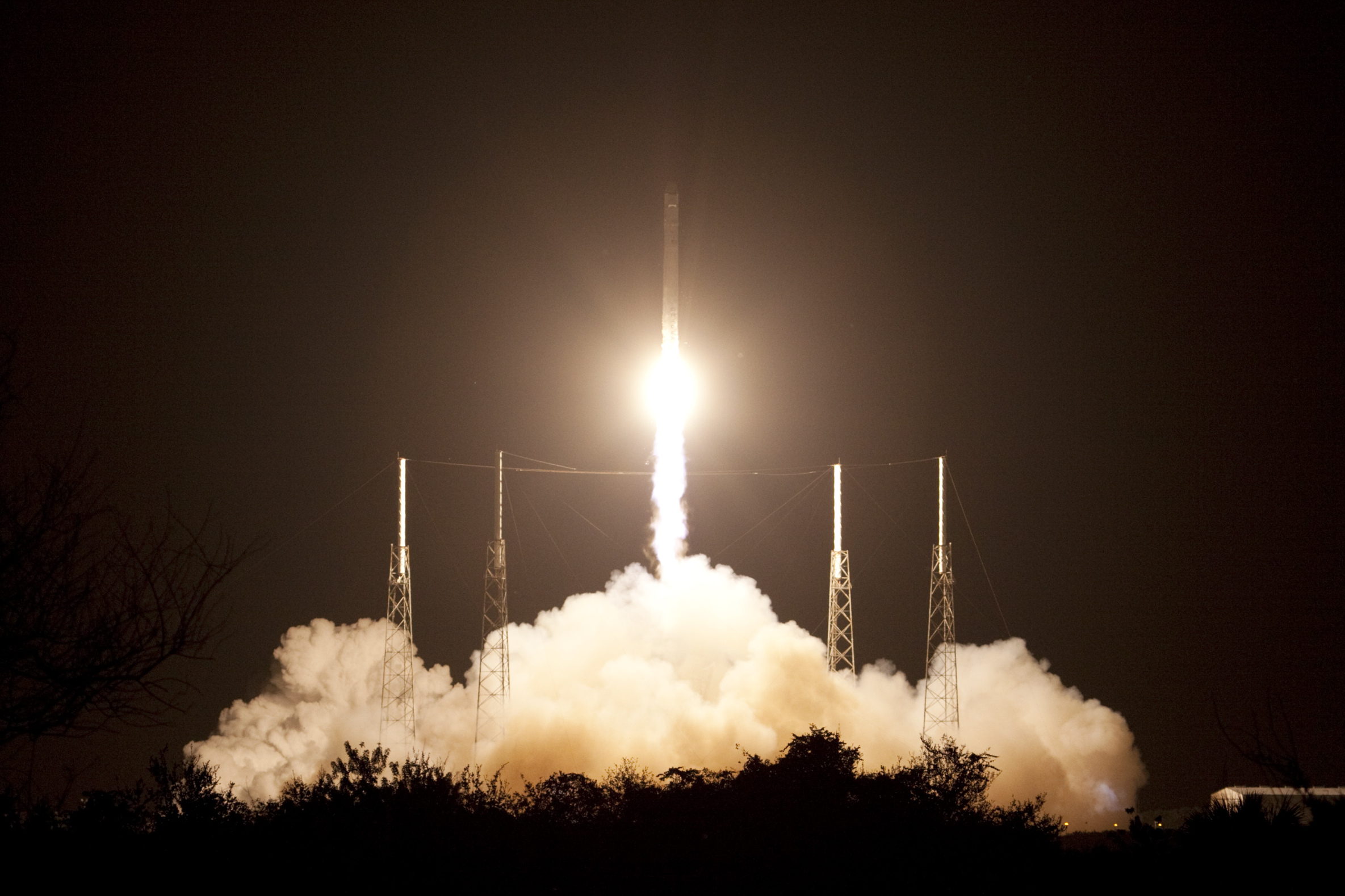
SpaceX CRS-1 Falcon 9 illuminates NASA launch area 40 in 2012. Photo credit: Jim Grossmann, NASA. Image: wikimedia commons.

A turning point in human exploration has been achieved; SpaceX returned a rocket. Significance? Up until 21 December 2015, all trips to supply orbital cargo, including delivery trips to the International Space Station, were one-way for the stage one launch rocket. Launch rockets cost $54 million but only $200,000 is for fuel; there is significant economic and environmental benefit to reuse, especially if the launch vehicle can return to the original launch site, as a car might return to its home driveway. Elon Musk, founder of SpaceX and Tesla, called the success, realized after a series of attempts, a “revolutionary moment.” An earlier game changer? Extra-vehicular activity, or EVA, enabling construction, repair and  building in space. Alexey Leonov was the first human to achieve EVA: for 12 minutes in March 1965. EVA advanced to over two hours during the 21 July 1969 Apollo moonwalk by Neil Armstrong and Buzz Aldrin. EVA missions have repaired and refined the Hubble telescope. Like EVA, round-trip rocketry has a history with milestones. Just days before orbital success, Blue Origin actually made history in the first successful launch rocket return, in a test flight on 23 November 2015. But SpaceX’s  21 December feat is different in two ways: orbital and very much not a test flight. SpaceX carried and successfully delivered Orbcomm’s constellation of 11 communications satellites into orbit, bringing forward the future opened by another game-changer: COMSAT. It might be noted that roundtrip rocketry appears to have been first achieved by private industry; Blue Origin LLC, by Jeff Bezos, founder of Amazon.com and SpaceX, Elon Musk, founder of PayPal and Tesla. Roundtrip rocketry marks a milestone; what new frontiers may now be open for business?

To watch the launch and landing: http://www.orbcomm.com/

Wall, Mike. “Wow! SpaceX Lands Orbital Rocket Successfully in Historic First.” Space.com 21 December 2015. http://www.space.com/31420-spacex-rocket-landing-success.html

Building the World Blog by Kathleen Lusk Brooke and Zoe G Quinn is licensed under a Creative Commons Attribution-NonCommercial-NoDerivs 3.0 Unported License

Lunar Crowd-funding?

Lunar crowd funding in 2024? Image: wikimedia commons.

Would you like to have your DNA included in a time capsule on the moon? Cost? Just 50 British pounds. The world’s first lunar landing, the Apollo Program, employed 36,000 civil-service specialists; 376, 000 contract experts, for an annual budget of $5 billion. But Lunar Mission One, a UK-based probe of the moon’s south pole, will forego government budgeting and instead appeal to the public for funding, according to David Iron, project leader. Kickstarter participants can also send selfies, texts, and videos. It is estimated that these messages will survive for one billion years. Also tucked in will be a brief history of human civilization; the time capsule may preserve history, if the human species manages to extinguish life on earth.

Building the World Blog by Kathleen Lusk Brooke and Zoe G Quinn is licensed under a Creative Commons Attribution-NonCommercial-NoDerivs 3.0 Unported License.

Space Pace


Orion module. Image from nasa.gov.

Orion, test-launched today by NASA, may change the picture of space — with humans back in the center of the frame. Since the space shuttle mission concluded in 2011, NASA has been planning a new era. Orion is successor to the Apollo program, made famous by Neil Armstrong’s words as he became the first human to set foot on the moon: “That’s one small step for a man, one giant leap for mankind.” Orion will go far beyond, perhaps to Mars, according to Mark Geyer, program manager. Along with making history, Orion will be taking history; the space ship will carry an oxygen hose from an Apollo 11 space suit and a small grain of land from the lunar surface.

For more: http://www.nasa.gov/orion/

Building the World Blog by Kathleen Lusk Brooke and Zoe G Quinn is licensed under a Creative Commons Attribution-NonCommercial-NoDerivs 3.0 Unported License.

Lunar Landing!

Buzz Aldrin walking on the moon, from NASA at nasa.gov.

Today marks the anniversary of humankind’s first steps on the moon. On July 20, 1969, the world held its collective breath as Neil Armstrong and Edwin E. “Buzz” Aldrin set foot on the lunar surface. Television had just gone global a few days earlier when COMSAT achieved world coverage via Intelsat on July 1. More than 500 million people witnessed Armstrong making history as he spoke these famous words: “That’s one small step for a man, one giant leap for mankind.” With advances in aerospace including Elon Musk’s Space Exploration Technologies (www.spacex.com) and Sir Richard Branson’s Virgin Galactic (www.virgingalactic.com), the future is seemingly boundless. To what purposes should space exploration be dedicated? To read the original New York times report of the NASA’s success, please see:

http://www.nytimes.com/learning/general/onthisday/big/0720.html#article

Creative Commons License
Building the World Blog by Kathleen Lusk Brooke and Zoe G Quinn is licensed under a Creative Commons Attribution-NonCommercial-NoDerivs 3.0 Unported License.

The Oracle at Delphi

Temple of Apollo, Delphi, from Sweet Briar College, at sbc.edu.

The Oracle at Delphi is credited as having told the Greeks to settle at Cyrene, among many other prophesies, but who was the Oracle? She has most traditionally been associated with Apollo, but her beginnings were more humble than that. Her powers were actually discovered by a shepherd and his sheep. The shepherd noticed his sheep near a chasm and acting rather strangely; when he went to investigate, he was overcome with a fit. The vapors coming from the cavern that caused the strange behavior in the shepherd and his sheep were the source of the Oracle’s powers.

The Oracle fell from favor with the introduction of Christianity to the area, but she did not fall from interest. More recently a group of scientists studied the prophetic vapors, and discovered that they have a narcotic effect on people, and in large concentrations could send one into a trance similar to that of the Oracle.

To read more please visit National Geographic

Creative Commons License
Building the World Blog by Kathleen Lusk Brooke and Zoe G Quinn is licensed under a Creative Commons Attribution-NonCommercial-NoDerivs 3.0 Unported License.