Author: Amelia Gantt, Archives Student Supervisor and graduate student in the American Studies department at UMass Boston

Carol McEldowney’s legacy is most stark in the context of her early death at the age of 30. Within those few years cut short, McEldowney led a storied career of political activism and aid, having established herself as a relevant figure in the New Left at its peak.
One of the foremost political organizations that came to represent the New Left was called the Students for a Democratic Society (SDS), whose mission was to ensure democratic participation in social and economic organizing, spurring dramatic societal change (read: Port Huron Statement). Only a few years after the SDS launched in 1960, the organization had thousands of members at more than 50 schools. McEldowney was there from the start, attending the University of Michigan-Ann Arbor where and when the SDS was first established. In 1962, McEldowney is recorded as registering for the very first SDS convention and in 1964, she was elected chair of the SDS chapter at Michigan.
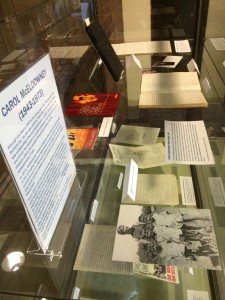
McEldowney’s collected papers held in the UMass Boston Archives contain various publications created by or related to the SDS including promotional material and correspondence ranging from 1960-1967.
The “New Left” is a broad term, describing political groups of the 1960s that ranged from those who abstained from violent protests (Dave Dellinger and MOBE) to those who encouraged them (“Yippies”). What connected these groups, though, was a common consciousness characterized by generational values. Thus, the New Left was mainly made up of students like McEldowney, hopeful and practical as an early undergraduate in 1962.
The previous decade of the 1950s was one of conformity and affluence, creating both a temporal gap in leftist political activism until the turbulent 1960s (hence “New”), and also a stark generational divide between those under and above 30 years of age. The New Left critiqued exactly that 1950s conformity— a lifestyle and value system that the new generation understood as forced cultural and political complacency to a political system that, by the mid-1960s, was becoming more obviously violent and undemocratic.
While the SDS was generally organized around the leftist ideal of a democratic and equitable society, by 1967, the group’s motivating stance was ending the Vietnam War. At the age of 24, McEldowney was part of a highly coveted 10-person group of activists poised to visit Vietnam during the war. Most of this cohort was connected to the SDS, including Tom Hayden, original writer of the Port Huron Statement. Taking her values with her after graduation, McEldowney worked in community organizing and development initiatives in Cleveland for multiple years, remaining connected with SDS projects, like this Vietnam trip.

McEldowney documented her experiences of the 1967 visit in a journal titled Hanoi Journal, which we hold in the UMass Boston Archives. The journal includes observations of Vietnamese daily and cultural life, and the impact of war on society there. This artifact is particularly relevant for our archival focus in alignment with the William Joiner Institute for the Study of War and Social Consequences. The UMass Boston Archives also holds numerous other documentary materials from the Vietnam trip, including photographs and notes, that showcase Vietnam the year before the country would see the highest number of American soldiers drafted.
Reflecting on McEldowney’s impact in her introduction to Hanoi Journal, Suzanne Kelley McCormack notes that up until this point, publicized perspectives on the Vietnam War were male-dominated. Indeed, McEldowney was one of two women in the Vietnam contingent. The McEldowney papers held at the UMass Boston Archives serve to preserve and promote an often-overlooked feminine perspective on issues of war and society in this pivotal era of anti-war activism. McEldowney seemed to find that femininity was a useful factor of drawing connection between white Americans and the Vietnamese, and thus a mechanism of humanizing those portrayed as the enemy.

In the late 1960s and early 1970s, many of those previously organized through the SDS began to orient themselves towards related, but more specific, fights. McEldowney herself became focused on women’s liberation, though it had been a major theme within her anti-communist reflection on the war in Vietnam and a throughline throughout her work. When she moved to Boston, McEldowney became involved with Bread and Roses, a socialist women’s liberation collective, and she came out as lesbian. Her passion for women and queer self-determination led her to prioritize self-defense, teaching martial arts and self-defense for rape prevention until her death in 1973.
Contact library.archives@umb.edu to schedule an appointment to view the Carol McEldowney papers. View three of her digitized journals here.
References:
Finding aid for the Carol McEldowney papers, SC-0087. University Archives and Special Collections, Joseph P. Healey Library, University of Massachusetts Boston. https://archives.umb.edu/repositories/2/resources/281.
McEldowney, Carol Cohen. Hanoi Journal, 1967. Edited by Suzanne Kelley McCormack and Elizabeth R. Mock. University of Massachusetts Press, 2007. http://www.jstor.org/stable/j.ctt5vk38c.