Open Now – Material Dialogues: Artist Unresidency, 2025-2026 Exhibition

University Archives and Special Collections in the Joseph P. Healey Library at UMass Boston is excited to announce that the exhibition Material Dialogues: Artist Unresidency, 2025-2026 at UMB Archives opens Monday, January 26, 2026, in the Grossmann Gallery on the fifth floor of Healey Library. This exhibition showcases UMass Boston’s Artist Unresidency Pilot Program. The Unresidency invited five artists to create new artwork in response to archival collections to expand how archives are encountered and understood while bringing these materials into contemporary dialogue. Participating artists explored themes of cultivating care, lifting voices, and looking at how the past can shape the future. The program is intended to grow into an annual initiative supporting three to five artists.

Giant audio tape cassette by Brian Wilson, inspired by the Massachusetts Hip-Hop Archive

Five artists from the Northeast are featured in this exhibition: Caleb Cole, Nanc Hart, Christina Hunt Wood, Brooke Toczylowski, and Brian Wilson. Working across mixed media, painting, collage, film, sculpture, and handmade books, each artist engages a different archival collection, including the Carol McEldowney papers, the Theresa-India Young papers, the Massachusetts Hip-Hop Archive, the University of Massachusetts Boston permanent site selection records, the Boston School Bus Drivers Union records, USW Local 8751 records, the Elizabeth Bouvier collection of radical and leftist posters, and the Stephen Lewis poster collection.

From left to right: Christina Hunt Wood, Nanc Hart, Brian Wilson, Caleb Cole, Brooke Toczylowski, and archivist Meghan Bailey

Participants were selected from applications by the Art+Everywhere community. The selection panel and exhibit curation were overseen by Meghan Bailey, Associate University Archivist for Collection Management; Carol Scollans, UMass Boston art history professor; and Jeremy Andreatta, Art+Everywhere board member. This project was funded by the Art+Everywhere Innovation Grant and is hosted by the Joseph P. Healey Library at the University of Massachusetts Boston. It will be on view from January 26 through May 15, 2026, during the Healey Library’s open hours. An opening reception is scheduled for Friday, February 20, 2026, from 3:00 pm-5:30 pm. The date for the artist panel via Zoom is pending and will be posted here once determined.

Watercolor on paper by Nanc Hart, inspired by the University of Massachusetts Boston permanent site selection records
Record A, sewn monotype and watercolor on paper by Brooke Toczylowski, inspired by the Stephen Lewis Poster Collection
Photograph by Christina Hunt Wood on view with artwork inspired by the Theresa-India Young papers
Caleb Cole, “Settle for Nothing Less than a Totally New World,” inspired by the Carol McEldowney papers

Contact library.archives@umb.edu for more information about this exhibition, the Artist Unresidency program, or the archival collections that inspired the exhibition’s artwork.


University Archives and Special Collections in the Joseph P. Healey Library at UMass Boston collects materials related to the university’s history, as well as materials that reflect the institution’s urban mission and strong support of community service, notably in collections of records of urban planning, social welfare, social action, alternative movements, community organizations, and local history related to neighboring communities.

University Archives and Special Collections welcomes inquiries from individuals, organizations, and businesses interested in donating materials of an archival nature that that fit within our collecting policy. These include manuscripts, documents, organizational archives, collections of photographs, unique publications, and audio and video media. For more information about donating to University Archives and Special Collections, email library.archives@umb.edu.

Launch of the Inaugural Artist Unresidency Pilot Program

Grossmann Gallery image with visitors in front of Michelle Napoli's paintings for the group exhibit "Native American Resilience Through Art."

University Archives and Special Collections in the Joseph P. Healey Library at UMass Boston is pleased to announce the launch of its inaugural Artist Unresidency Pilot Program — a unique artist residency model that supports creative engagement with archival materials without requiring a physical residency. This initiative reflects the UMass Boston Archives’ commitment to fostering innovative approaches to archival engagement while exploring the intersections of art and archives. This pilot program is supported by an Innovation Grant awarded by Art+Everywhere, a global, artist-led foundation that supports creative experimentation, collaboration, and care.

Five local artists have been selected for this pilot program to explore the UMass Boston Archives and create original artwork inspired by their research. Working independently in their own studios, the artists will draw inspiration from the archives through in-person visits throughout the summer and fall of 2025.

To support their work, artists will receive an orientation to the UMass Boston Archives and the collections they have selected to use, with archivists available to support their research throughout the process. Each artist will receive a small stipend to support the development of their project.

The resulting artworks will be featured in a public exhibition in the Grossmann Gallery at UMass Boston’s Healey Library, on view from January 20 to May 15, 2026. The exhibit will be co-curated by Jeremy Andreatta, board member of Art+Everywhere, Art History Professor Carol Scollans, and UMB archivist Meghan Bailey.

As part of the exhibition programming, a public artist panel will be held on campus, offering the community an opportunity to hear directly from the participating artists about their creative processes and the role archival materials played in shaping their artwork.

This image features a view of the Grossmann Gallery with one visitor walking through an exhibit.

For questions about the Artist Unresidency Pilot Program or the UMass Boston Archives, contact library.archives@umb.edu.

The Frederick Middle School exhibit now on view in the Grossmann Gallery

In Between Middle: Where Stories Reside, an exhibition opening June 10, 2025 in the Grossmann Gallery on the fifth floor of the Healey Library, features photographs by Lisa Kessler, and artwork and textual narratives collaboratively created by students and staff of the Lilla G. Frederick Pilot Middle School in Dorchester, MA. Exhibit hosted by the Joseph P. Healey Library at UMass Boston.

In Between Middle: Where Stories Reside, an exhibition opening June 10, 2025, in the Grossmann Gallery on the fifth floor of the Healey Library, features photographs by Lisa Kessler, and artwork and textual narratives collaboratively created by students and staff of the Lilla G. Frederick Pilot Middle School in Dorchester, MA. The exhibit is hosted by the Joseph P. Healey Library at UMass Boston. The Frederick, the last standalone middle school in the Boston Public School system, will close this year as part of a broader district-wide restructuring. This project captures the final year of the Lilla G. Frederick Pilot Middle School, a community located in the Grove Hall neighborhood of Boston.

The exhibition will be on display through December 5, 2025. A reception will be held in the Grossmann Gallery of the Healey Library on Tuesday, June 10, 2025, from 4:00-5:30 p.m. Members of the university community and the general public are welcome to attend.

As a restorative justice school, the Lilla G. Frederick Pilot Middle School is rooted in community and collective responsibility. Its foundation rests on the five pillars of PRIDE: Personal Responsibility, Respect, Integrity, Determination, and Empathy. Students and staff have long strived to embody the values championed by the school’s namesake, Ms. Lilla Frederick—a Grove Hall resident, tireless community advocate, and passionate believer in the potential of every child.

While the Frederick will no longer serve as a middle school, the community views this transformation with cautious optimism. The shift to a more unified K-6 and 7-12 school model represents an opportunity to address the long-standing systemic inequities and create more equitable access for all of Boston’s children. The building will continue to serve the children and families of Grove Hall as an elementary school—and it will continue to carry the name Lilla G. Frederick, a lasting tribute and a powerful reminder that “someone you never knew believed fiercely in you.”

This project was made possible with support from Unity Circles whose commitment to centering communities most impacted by carceral systems and for their leadership in cultivating intergenerational networks grounded in the principles of Restorative Justice and Transformative Justice. Their support has been instrumental in helping Lilla G. Frederick Pilot Middle School document and archive the powerful community and justice efforts taking place across our learning community. This work reflects our shared vision of supporting young people in developing to their full potential in a welcoming and nurturing environment and creating positive connections to the larger community and the world they will lead.

The Grossmann Gallery is open during Healey Library hours.


University Archives and Special Collections in the Joseph P. Healey Library at UMass Boston collects materials related to the university’s history, as well as materials that reflect the institution’s urban mission and strong support of community service, notably in collections of records of urban planning, social welfare, social action, alternative movements, community organizations, and local history related to neighboring communities.

University Archives and Special Collections welcomes inquiries from individuals, organizations, and businesses interested in donating materials of an archival nature that that fit within our collecting policy. These include manuscripts, documents, organizational archives, collections of photographs, unique publications, and audio and video media. For more information about donating to University Archives and Special Collections, click here or email library.archives@umb.edu.
Denim Day display now on view in the Grossmann Gallery

Denim Day: Sexual Violence Prevention and Education Campaign. A series of events will occur across the month of April on the UMB campus hosted by the Title IX Office for Students.

The Denim Day display is currently on view in the Grossmann Gallery on the fifth floor of the Healey Library. This display features a collection of denim jeans that serve as an example of what survivors were wearing when they were sexually assaulted. The Denim Day campaign is an opportunity for survivors of sexual assault to raise awareness of rape myths and rape culture, where victims are often blamed for what they were wearing. The stories in the display cases were sourced from the Susan B. Anthony Project’s What Were You Wearing? exhibit. The Denim Day display is featured as part of a series of campus events for Sexual Assault Awareness Month hosted by UMass Boston’s Title IX Office for Students. For more information, email Brikitta O. Hairston, Title IX and Civil Rights Investigator for Students, at brikitta.hairston@umb.edu. The display will be on view through May 31, 2025.

The Grossmann Gallery is open during Healey Library hours.


University Archives and Special Collections in the Joseph P. Healey Library at UMass Boston collects materials related to the university’s history, as well as materials that reflect the institution’s urban mission and strong support of community service, notably in collections of records of urban planning, social welfare, social action, alternative movements, community organizations, and local history related to neighboring communities.

University Archives and Special Collections welcomes inquiries from individuals, organizations, and businesses interested in donating materials of an archival nature that that fit within our collecting policy. These include manuscripts, documents, organizational archives, collections of photographs, unique publications, and audio and video media. For more information about donating to University Archives and Special Collections, click here or email library.archives@umb.edu.
“Artists in the Archive” exhibition now on view in the Grossmann Gallery

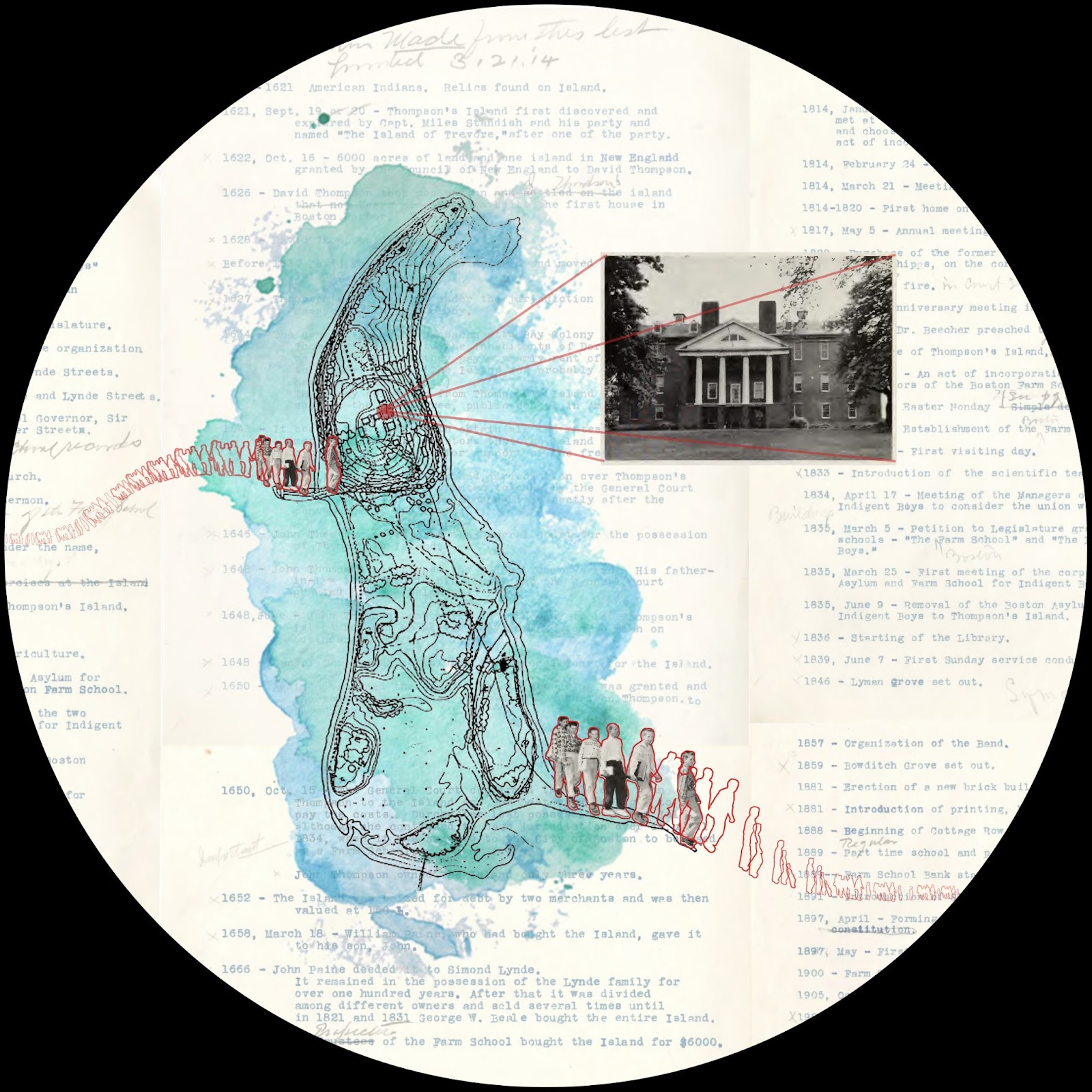
Image of artwork by Margaret Hart, featuring materials pulled from the Thompson Island Farm and Trade School collection at UMass Boston. Includes a collage of text beneath a drawing of Thompson Island, a photograph of a building, and outlines of students.

Thompson Island Boys School, Margaret Hart, from the Scrapbook of Thompson Island Farm and Trade School 1921-1928, inkjet prints and watercolor on rag paper collage, 2024. 

Artists in the Archive, an exhibition opening this week in the Grossmann Gallery on the fifth floor of the Healey Library, features original work by members of the Endpoint Collective–Deborah Carruthers, Gabriel Deerman, Margaret Hart, and Mark Roth–as well as multi-disciplinary and Indigenous artist Erin Genia. All artists worked directly with materials from the University Archives and Special Collections in the Joseph P. Healey Library at the University of Massachusetts Boston to address issues of climate change and social justice in this region.

The exhibition is curated by Carol Scollans, Professor of Art and Art History at UMass Boston, and will be on display through January 17, 2025. A reception will be held on Friday, October 25, 2024, from 4:00-5:30 p.m. Members of the university community and the general public are welcome to attend.

The Endpoint Collective is a group of research-based artists from around the world who have found value in challenging traditional subjects and processes in their artmaking practices. One of the central questions they posit is the transition toward a posthuman existence exacerbated by the looming environmental issues we face. Their work explores non-hierarchical positioning of human and non-human beings (such as animals, fauna, and the earth). By means of traditional and inventive research, group discussions, and the creation of artworks, the collective has found a distinct vocabulary for their originative endeavors. Through exhibitions of their shared work, the collective invites the public into a conversation about these thought-provoking concepts as well.

Through their respective works, each of the five artists investigates issues of connection, replication, and structure via process-based mechanisms including printmaking, collage, photomontage, painting, and textiles. The works present a fascinating investigation into these complex issues with multi-layered and process-centered resources while boldly engaging the viewer through rich imagery and provocative methodological approaches.

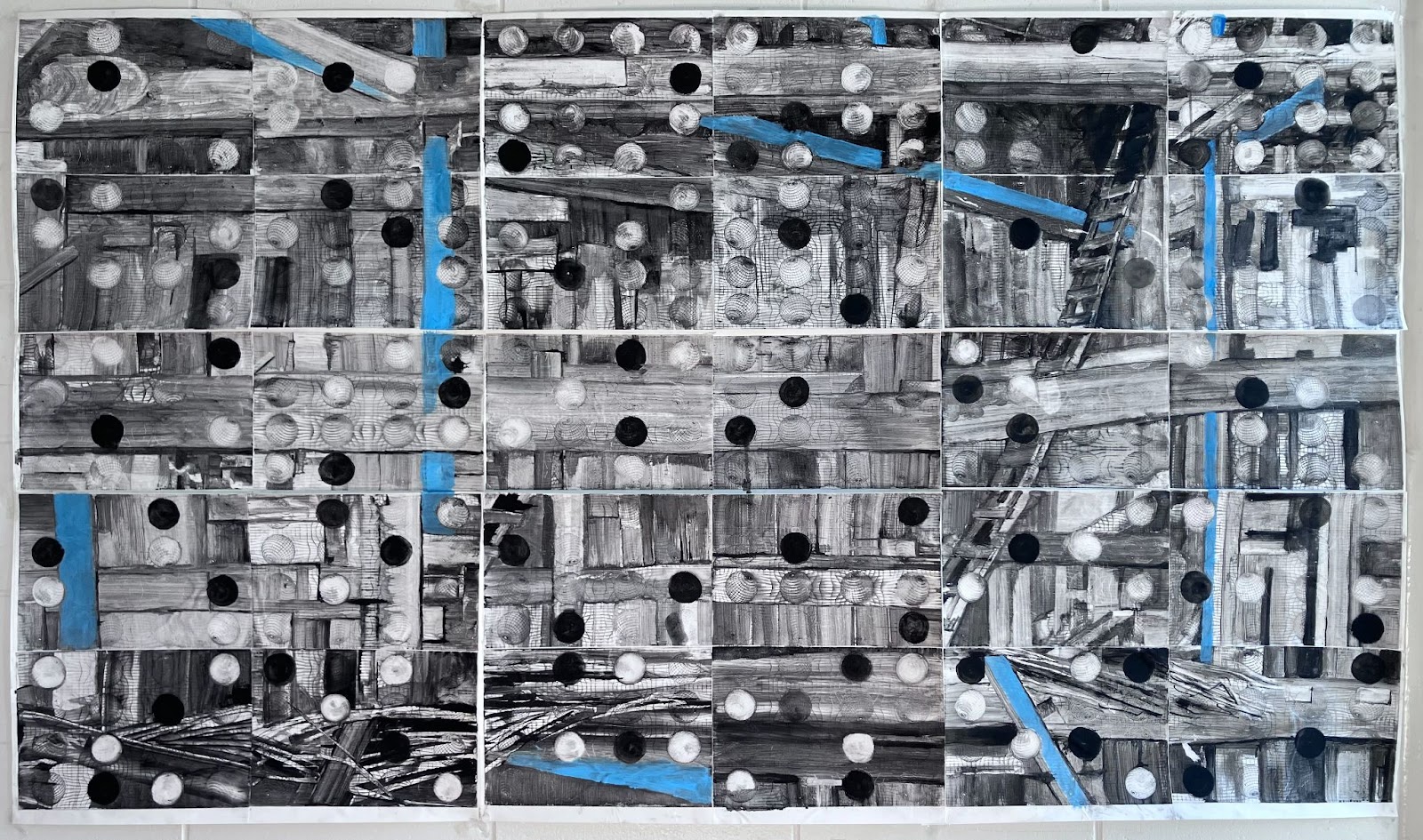
Image of artwork by Gabriel Deerman showing various images of printing blocks and blue lines.

Looking for Light Under the Ground (diptych), Gabriel Deerman, block printing ink on paper, 2024.  

Gabriel Deerman is a painter, printmaker, and draftsman exploring figurative and landscape based art.  Working from observation, his approach addresses globalization and climate change triggered by scientific and cultural human relationships to time and place. His distinctive approach questions traditional aesthetic experiences of the natural world as a way to bridge the human and nature divide.

Image of artwork by Margaret Hart showing a collage that includes a yellow jewel beetle, outlines of islands in the Boston Harbor, and text.

Boston Harbor Islands Jewel Beetle, Margaret Hart, inkjet print on rag paper collage, 2024.

Margaret Hart is a mixed media artist, using principally photography and collage as a way to investigate climate change, gender, technology, and personal narratives. Her work examines the philosophical potential of a post-human era questioning what the world is and what it could look like where humans are no longer the central characters of existence.

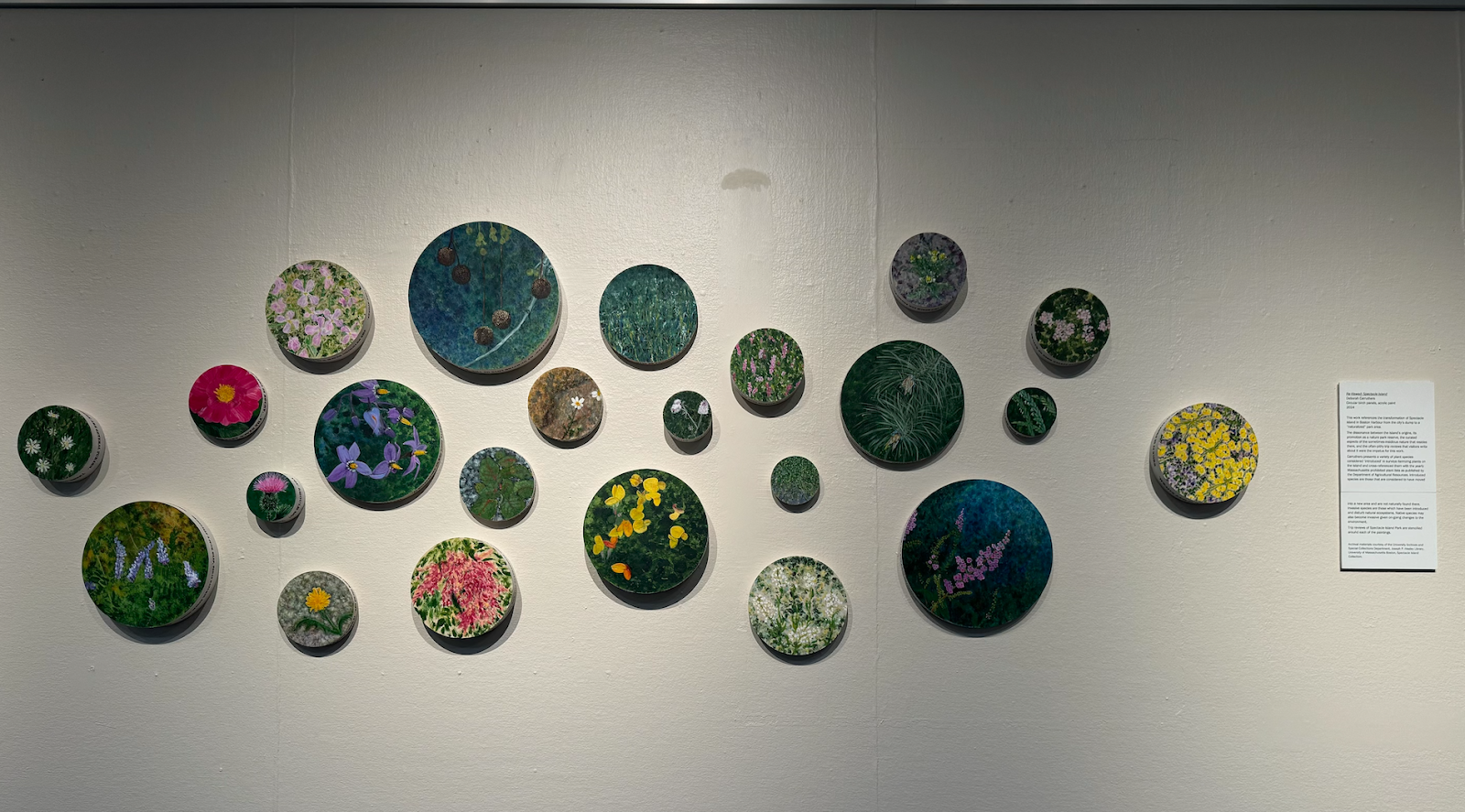
Photograph of various round artwork pieces by Deborah Carruthers hanging on a wall.

Re-Viewed, Deborah Carruthers, Circular birch panels, acrylic paint, 2024.

A Montreal native Deborah Carruthers is an interarts painter, installation artist, and composer who collaborates with scientists and activists around the world exploring environmental issues; particularly the distress caused by the lived experience of environmental change and human intervention called “solastalgia.”

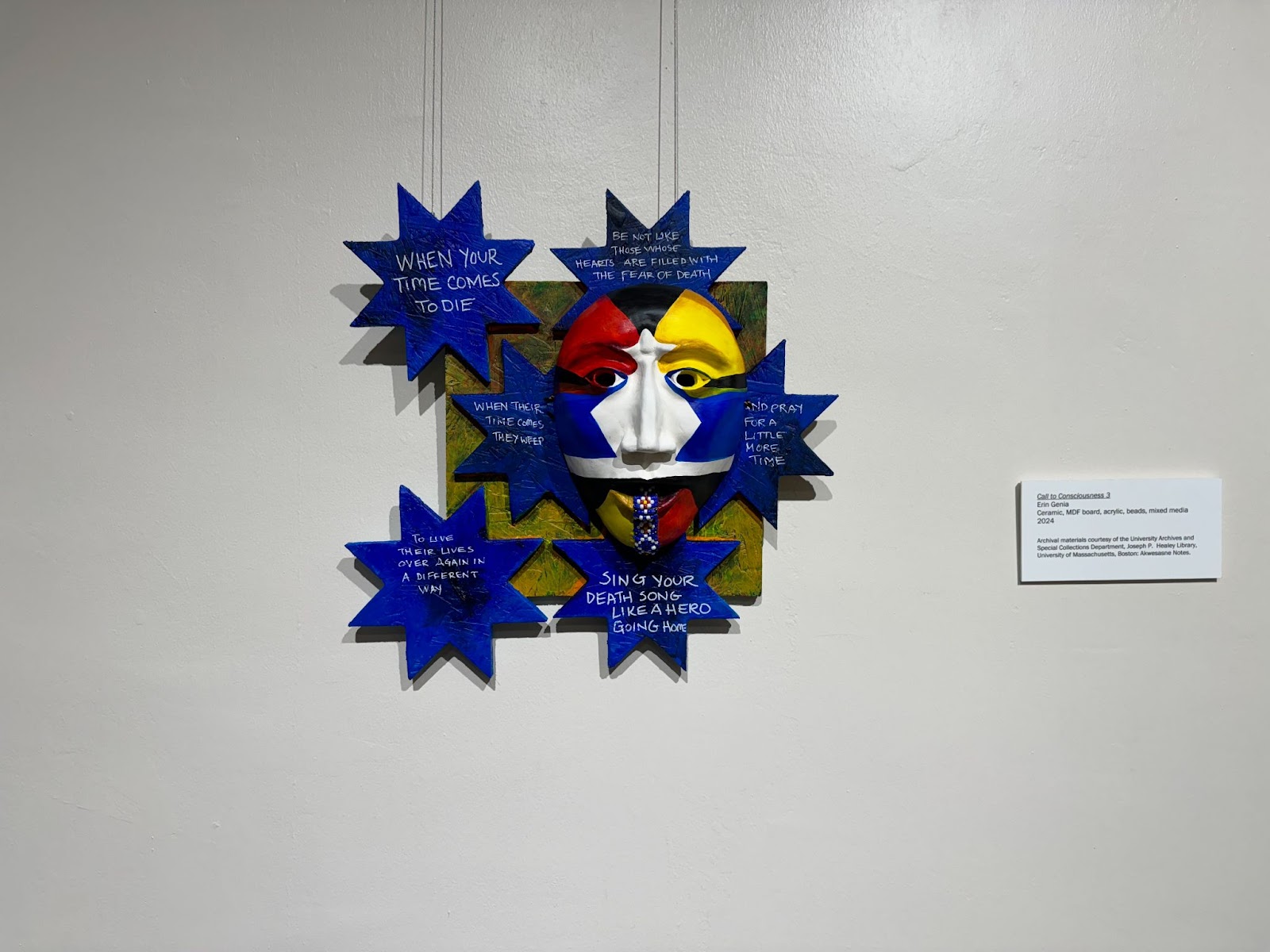
Photograph of artwork by Erin Genia on a wall. Includes a face or facemask with various text statements in blue starts.

Call to Consciousness 3 Erin Genia, Ceramic, MDF board, acrylic paint beads, mixed media, 2024. 

Erin Genia, Sisseton-Wahpeton Oyate, is a multidisciplinary artist, educator, and community organizer specializing in Native American and Indigenous people’s arts and culture. Her work is focused on amplifying the presence of Indigenous peoples and seeks to invoke an evolution of thought and practice aligned with the natural world and the potential of humanity.

Group Gather Around Group after “Group Gathers Around Fir Tree” photograph from the Boston Urban Gardeners Collection, Mark Roth, acrylic on canvas, 2024.  

Painter and curator Mark Roth is based in New York and studies human behavior from a biological perspective. Using formal painting practices, Roth aspires to discover stories resonant to the Anthropocene or the current geological age during which human activity has been the dominant influence on climate and the environment.

This exhibition is held in conjunction with the Thinking About Climate Change: Art, Science, and Imagination in the 21st Century conference which will be held in the UMass Boston Campus Center Ballroom on October 25-26, 2024.


The Grossmann Gallery is open during Healey Library hours.


University Archives and Special Collections in the Joseph P. Healey Library at UMass Boston collects materials related to the university’s history, as well as materials that reflect the institution’s urban mission and strong support of community service, notably in collections of records of urban planning, social welfare, social action, alternative movements, community organizations, and local history related to neighboring communities. University Archives and Special Collections welcomes inquiries from individuals, organizations, and businesses interested in donating materials of an archival nature that that fit within our collecting policy. These include manuscripts, documents, organizational archives, collections of photographs, unique publications, and audio and video media. For more information about donating to University Archives and Special Collections, click here or email library.archives@umb.edu.